




















































































































Hydrodynamic Wedges, Soot Traps, and Thermal Runaway: The Physics Behind Dashboard Lights
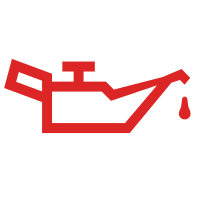
A glowing symbol on an instrument cluster is not a polite suggestion to schedule a dealership coffee visit—it is a real-time telemetry alert from sensors monitoring fluid pressure, exhaust thermodynamics, or high-voltage insulation resistance. Take the most misunderstood icon in automotive history: the red oil can (ISO 7000-0248). Inside a running internal combustion engine, steel crankshaft journals rotating at 4,000 RPM never actually touch the soft babbitt metal of the connecting rod bearings. They float on a pressurized hydrodynamic oil wedge barely 5 to 20 micrometers thick—thinner than a human hair. When the red oil pressure tell-tale illuminates, pressure has collapsed below 0.5 bar. That microscopic fluid film vanishes, metal shears directly against metal, and Joule friction welds the engine into a block of scrap iron in under sixty seconds.
Modern diesel and electric powertrains obey equally unforgiving physical laws. When the amber DPF symbol (ISO 7000-2433) lights up, differential pressure sensors before and after the exhaust honeycomb have detected a wall of trapped carbon soot. Because city drivers rarely sustain highway speeds long enough for exhaust gas temperatures to reach the 600 °C oxidation threshold required to burn soot into carbon dioxide, the filter chokes engine backpressure. In electric vehicles, the amber Turtle Mode icon (ISO 7000-2944) or Regen Braking Limited indicator steps in when the Battery Management System (BMS) detects freezing cell temperatures or voltage sag. Forcing high-amperage regenerative current into a cold lithium-ion graphite anode causes metallic lithium plating—growing microscopic needles (dendrites) that can pierce the separator membrane and trigger a 1,000 °C exothermic thermal runaway.
Step outside passenger cars into heavy commercial trucks, agricultural tractors, locomotives, marine vessels, and aircraft, and the physics gets even more dramatic. In a 40-ton semi-truck, a red low air brake pressure warning (ISO 7000-0244) works in the exact opposite way of a passenger car: instead of losing braking force, dropping below 5.5 bar releases massive mechanical coil springs inside the brake chambers that lock the wheels solid. On an inboard gasoline boat, ignoring the Bilge Blower symbol (ISO 7000-0623) for four minutes before cranking the starter risks igniting heavier-than-air hydrocarbon vapors pooled in the hull bottom. And in an aircraft cockpit, an EICAS STALL alert or iced Pitot probe warns that boundary-layer airflow has detached from the upper wing camber at a critical angle of attack (~16°), demanding an immediate nose-down pitch input regardless of altitude.
From 1930s Hudson Idiot Lights to ISO 2575, OBD-II, and EICAS Cockpit Displays
In the early decades of motoring, dashboards looked like steam-locomotive boiler rooms. Drivers watched mechanical Bourdon-tube oil pressure gauges, glass sight-glasses, and analog ammeters. Then, in the 1930s, the Hudson Motor Car Company decided to cut manufacturing costs by replacing sweeping needle gauges with simple binary pressure and voltage switches wired to tiny incandescent bulbs. Veteran mechanics were furious: because a binary switch only closes the circuit after pressure has already hit zero or coolant is already boiling, the bulb often lit up three seconds before the engine seized. Mechanics sarcastically dubbed them idiot lights—a name that stuck for ninety years.
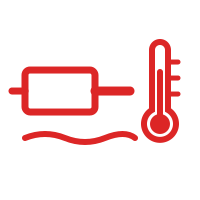
As global vehicle exports exploded in the 1960s, text-based warning lamps (such as English OIL, German OEL, or French HUILE) became a dangerous regulatory bottleneck. In 1973, the International Organization for Standardization published ISO 2575 (Road vehicles — Symbols for controls, indicators and tell-tales), drawing heavily from the master graphic archive of ISO 7000. Engineer-designers stripped language out of the cockpit and replaced it with universal geometry: a dripping oil can, a wavy thermometer, a skidding car for ESP (ISO 7000-2629), and a cross-sectioned tire horseshoe for TPMS (ISO 7000-1434). Parallel standards soon followed for motorcycles (ISO 6727), agricultural tractors (ISO 3767), earth-moving excavators (ISO 6405), marine helms (ISO 11192), European railways (EN 16186 / ETCS DMI), and aviation glass cockpits (EICAS and Airbus ECAM).
Decoding the Color Hierarchy: Why Red, Amber, Green, and Blue Mean Life or Engine Death
Even if you encounter an unfamiliar symbol in a rented vehicle, a heavy excavator, or a boat helm, international human-factors engineering enforces a strict four-color traffic-light hierarchy across all 160 indicators in our database:
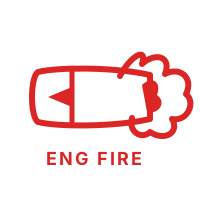
- Red Indicators (Critical Danger / Immediate Action — 60 Symbols): Red means an immediate threat to human life or imminent catastrophic mechanical destruction. Whether it is low oil pressure, coolant overheating, brake hydraulic failure, an unlocked semi-truck fifth wheel, excavator bucket quick-coupler release, train SIFA dead-man intervention, or an aviation ENG FIRE warning—pull over, shut down, or execute the emergency checklist immediately.
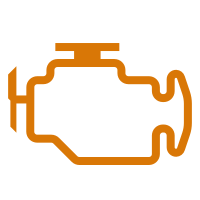
- Yellow / Amber Indicators (Malfunction, Caution, or Limp Mode — 77 Symbols): Amber tells you a subsystem has drifted outside normal parameters, lost a sensor signal, or entered a protective derate state. Examples include Check Engine (MIL), ABS or ESP faults, low tire pressure (TPMS), clogged DPF, tractor hydraulic filter bypass, and motorcycle cornering ABS alerts. You can usually drive cautiously to a workshop, but ignoring an amber light often escalates into a red failure.
- Green Indicators (Active System & Normal Operation — 20 Symbols): Green confirms that a requested functional system is healthy and currently engaged—dipped headlights, turn signals, cruise control, Auto Hold, electric vehicle READY status, tractor creeper snail gear, or motorcycle neutral (N) and quickshifter.
- Blue Indicators (High Beam & Special Status — 3 Symbols): Because blue wavelengths scatter heavily inside the human eye at night (causing glare and night-vision degradation), ISO 2575 reserves bright blue almost exclusively for main high-beam headlights (ISO 7000-0082) and automatic high-beam assist so the driver is constantly reminded not to blind oncoming traffic, alongside specialized marine bow-thruster direction indicators.
Dealership Diagnostic Ransoms vs. Our Printable A4 PDF Glovebox Reference
Open any modern 600-page vehicle owner manual when a warning lamp lights up on a dark highway, and you will find the most useless sentence in modern publishing: Please contact an authorized dealership immediately. Service departments love when drivers panic over a loose fuel filler cap triggering an EVAP Check Engine light or a frozen ultrasonic bumper sensor disabling Park Assist—because plugging a handheld scanner into the OBD-II port for thirty seconds lets them bill an hour of shop labor.
We engineered this 160-symbol interactive tool to put factory-level diagnostic literacy back in your hands. Use the Dashboard Lights Quiz tab to test your reflexes across all 160 vehicle symbols, or narrow the quiz down by vehicle category (All Passenger Cars, EVs, Trucks, Tractors, Motorcycles, Trains, Boats, or Aircraft) and light color (Red, Amber, Green, Blue). Switch to the All 160 Symbols (Print PDF) tab to search by ISO code or keyword, filter by warning color, and print either a complete multi-page A4 PDF glovebox reference chart or a full-page A4 workshop wall poster with a single click—100% vector sharp, watermark-free, and built for real mechanics and drivers.