
Free Printable Handwriting & Name Tracing Worksheet Generator
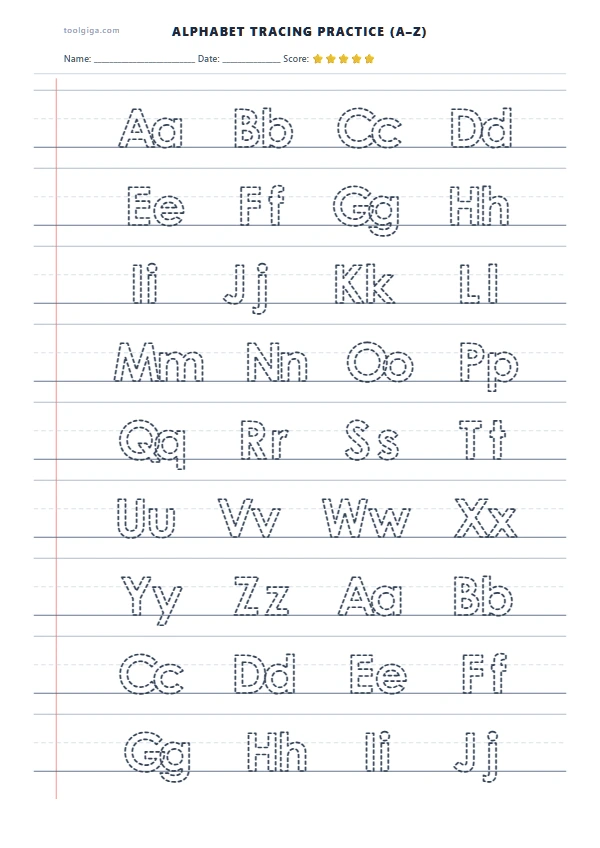
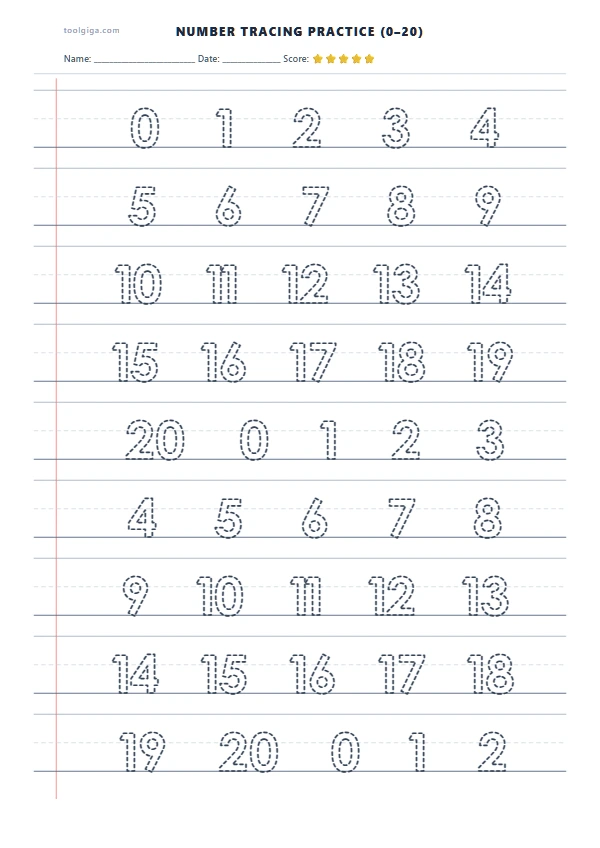
The TOOL GIGA Handwriting and Name Tracing Generator is a versatile, browser-based educational tool engineered to create high-precision, printable A4 practice sheets for early childhood education, kindergarten, primary school classrooms, and home learning. Whether you are helping a preschooler write their very first name, teaching kindergarteners proper letter formation for the entire alphabet from A to Z, practicing counting digits from 0 to 20, or composing custom spelling lists and sentences, this generator produces mathematically sharp vector worksheets tailored to every developmental stage.
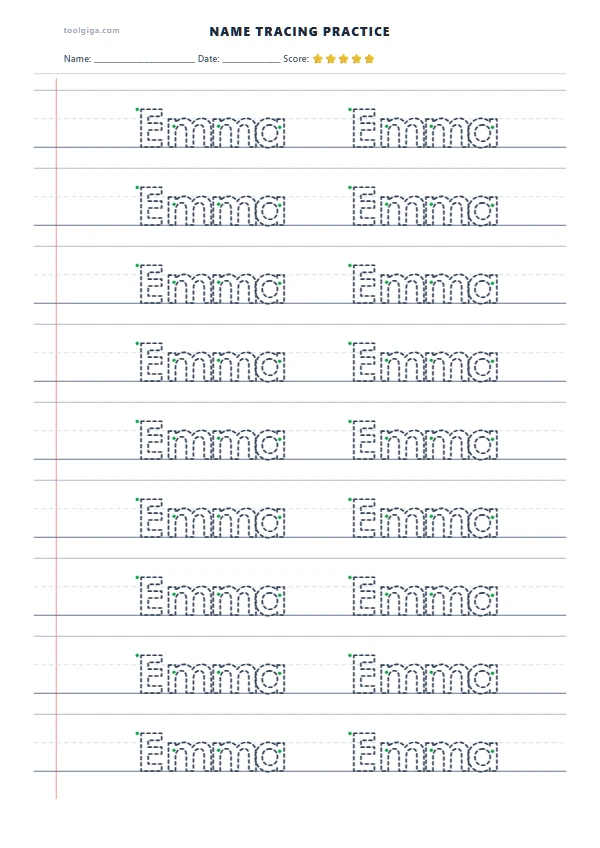
Unlike static PDF downloads or rigid commercial workbooks, our generator gives educators, parents, and pediatric occupational therapists complete creative control over line styles, letter sizes, and instructional guidance. You can easily switch between primary three-line ruling with dashed midlines, authentic 65-degree slanted dailyraštis guidelines for rhythmic cursive flow, or simple baseline guides. Choose from four letter sizes—from giant 28 mm lines for toddlers using chunky wax crayons down to 8 mm lines matching standard school notebooks. With features such as directional green start dots, full-line dotted tracing, hollow coloring letters, and trace-and-copy repetition rows, young learners build motor confidence step by step with zero visual clutter.
Everything runs seamlessly in your browser with zero account registration, no watermarks, and no subscription fees. You can instantly print directly to A4 paper via your browser print dialog, or export lossless vector SVG files and ultra-crisp 300 DPI PNG graphics for digital whiteboard instruction and customized classroom packets.
From Spencerian Flourishes to D'Nealian: The 150-Year Evolution of Classroom Penmanship
Handwriting instruction has never been merely about putting ink on paper; it is a direct reflection of historical technological shifts, educational philosophy, and industrial demands. In the 1850s, Platt Rogers Spencer developed the Spencerian script, drawing inspiration from natural curves, rolling river pebbles, and leafy vines. Spencerian penmanship was ornamental, rhythmic, and demanding, designed for an era when business correspondence, legal ledgers, and formal diplomacy relied entirely on ornate copperplate flourishes executed with flexible steel dip pens.
By 1894, the explosion of urban commerce and industrial manufacturing rendered Spencerian flourishes obsolete. Austin Norman Palmer introduced the Palmer Method, stripping away delicate ornamental loops in favor of rapid, utilitarian, unshaded cursive. Palmer pioneered "muscular movement penmanship"—insisting that clerks and schoolchildren write not through finger cramping, but via continuous rhythmic rotations of the forearm muscles resting on the desk. This method turned classroom drill exercises into quasi-mechanical training for future typewriter-era office clerks.
Nearly a century later, in 1978, Michigan educator Donald Thurber diagnosed a pervasive pedagogical flaw: American children were being taught rigid, circle-and-stick "ball-and-stick" printing in kindergarten, only to have their motor memory forcibly disassembled and rebuilt two years later when transitioning to continuous cursive. Thurber invented D'Nealian script, designing manuscript letters with slanted oval forms and curved entry/exit tails that directly mimicked cursive strokes, reducing letter reversals (such as confusing b and d) and making cursive transition effortless.
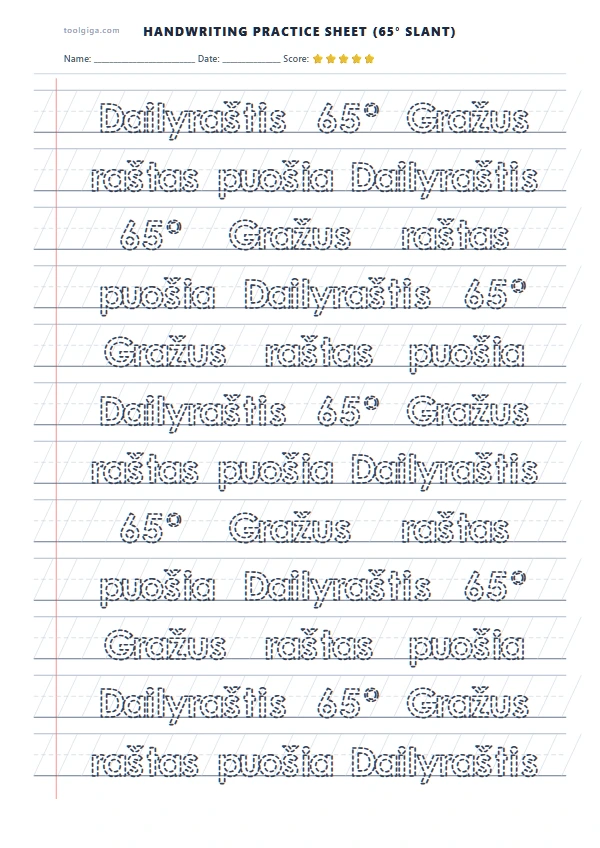
Meanwhile, across continental Europe, educators took a distinctly geometric approach. In France, the renowned Seyès ruling (grands carreaux) mandated an exacting multi-tiered grid where every millimeter of ascender and descender height was regulated. In Central and Eastern Europe, primary schools standardized on dailyraštis—notebook ruling featuring prominent 65-degree slanted guidelines. These angled rails served as physical train tracks for the wrist, ensuring that young learners maintained uniform forward slant and rhythmic spacing long before muscle memory could achieve it autonomously.
The Biomechanics of the Tripod Grip: Proprioception vs. Screen-Induced Motor Atrophy
Neurologically, handwriting is one of the most sophisticated fine-motor operations a human brain can perform. Between ages 3 and 8, children transition through distinct developmental grasping stages: from the primitive palmar supinate grasp (fisting the crayon like a club) to the digital pronate grasp (fingers pointing downward toward the tip), and finally to the mature dynamic tripod grasp, where the pencil is precisely stabilized between the thumb pad, index fingertip, and the radial side of the middle finger joint.
When a child holds a triangular graphite pencil and moves it across physical cellulose fibers, their sensory nervous system lights up with rich proprioceptive and tactile afferent feedback. The physical friction of graphite grinding on paper grain, the varying resistance across stroke directions, and the micro-adjustments of hand pressure communicate directly with the primary motor cortex (Brodmann area 4 / M1) and the parietal somatosensory circuits. Brain imaging studies have repeatedly demonstrated that writing characters by hand activates the neural reading circuit—including the visual word form area (VWFA) and Broca's area—in ways that passive tablet tapping or keyboard typing simply cannot replicate.
Today, educators face an unprecedented developmental crisis: the rise of "touchscreen motor atrophy." Toddlers who spend thousands of hours swiping smooth, frictionless iPad glass with a single flaccid index finger arrive at kindergarten with severely underdeveloped intrinsic hand muscles. Their thenar eminence (the fleshy muscle at the base of the thumb) is weak, their finger web-spaces collapse under minimal pressure, and after writing just two awkward sentences, they complain of intense hand cramping. Physical handwriting worksheets are not an antiquated relic of the pre-digital past—they are an indispensable therapeutic gym for juvenile brain and muscle development.
Why "$47/Year Printable Worksheet SaaS Platforms" Are Pure Comedy
The modern EdTech landscape is inundated with predatory subscription services preying on overworked elementary teachers and well-meaning parents. A quick internet search for custom name tracing sheets leads to bloated corporate platforms demanding $47 to $99 annual recurring subscriptions. What do you get for that extortionate price? Archaic raster generators built on obsolete 1990s tech stacks that take ten seconds to process a single name, restrict downloads to three low-resolution sheets per month, plaster obnoxious corporate watermarks across your child's homework, and bombard you with desperate upgrade popups.
Even more embarrassing is their complete engineering incompetence when handling global names. Type a name containing any non-English diacritical character—such as Ąžuolas, Kääriä, Iñaki, François, or Gökçe—and their subscription-locked engines crash, vomit broken question marks (�), or produce mangled typography with missing dots and severed accents. Expecting an educator to pay a recurring fee for software that cannot even render a child's legitimate birth name is comical.
TOOL GIGA rejects this commercial racket entirely. Our Handwriting & Name Tracing Sheet Generator is 100% free, forever, with zero subscription tiers, zero watermarks, and zero account registration required. It runs entirely on client-side vector geometry and high-performance server-side PHP, generating mathematically lossless 300 DPI A4 printable sheets with full Unicode support for all European, Baltic, Nordic, and Latin extended character sets.
The Master Penmanship Protocol: Scaffolding from Tracing to Freeform Mastery
Handwriting fluency is acquired through systematic instructional scaffolding—gradually releasing visual constraints as the child's neuromuscular memory solidifies. To achieve rapid, fatigue-free results, follow our four-stage pedagogical protocol:
- Stage 1: Start Dots (Pencil Placement & Directional Flow): Before a child can trace a shape, they must know where the pencil initiates. The most destructive early habit is bottom-up letter drawing (such as drawing l from the baseline up, or starting o at the bottom). Our green Start Dots highlight the exact anatomical origin of the initial stroke, reinforcing top-to-bottom and counter-clockwise directional conventions.
- Stage 2: Dotted Tracing (Muscle Memory Conditioning): Dotted lines serve as physical training wheels. Repetitive tracing of standardized dashed letters coordinates the flexor and extensor muscles of the thumb and index finger, ingraining proper ascender heights and bowl proportions.
- Stage 3: Trace & Copy (Active Retrieval Practice): Passive tracing alone can lead to mindless visual following. The Trace & Copy mode alternates each dotted guideline row with a clean, blank writing row. The child traces the model on row one, then immediately engages active neural retrieval to write the words independently on row two.
- Stage 4: 65° Slant Lines (Rhythmic Penmanship Discipline): Once individual letterforms are mastered, switch to Dailyraštis (65° Slant Lines). These angled guidelines train children to maintain a consistent forward tilt and prevent backslanted or fluctuating writing angles across full sentences.