



The Sunday Night Stationery Crisis: Why Printable Paper Exists
Every parent on the planet knows the exact terror of Sunday night at 8:45 PM. Dinner is finished, backpacks are being packed, and your second-grader suddenly drops a casual bombshell: "Mom, I ran out of math grid paper, and tomorrow's 20-problem arithmetic homework is due at 8:00 AM." Commercial stationery retailers are closed, supermarket aisles carry only oversized binders with 300% retail markups, and your only emergency option is a home inkjet or laser printer.
Searching online for printable notebook paper is typically an exercise in digital misery. You are greeted by predatory ad-stuffed blogs offering blurry 72 DPI JPEG scans from 2004, watermarked PDFs locking standard 5mm grids behind paid subscriptions, or clunky templates with 25mm margins that burn half your black ink cartridge on useless decorative borders. This generator eliminates that friction: pure vector SVG mathematics rendered with millimeter precision directly in your browser, formatted for instant zero-lag A4 printing.
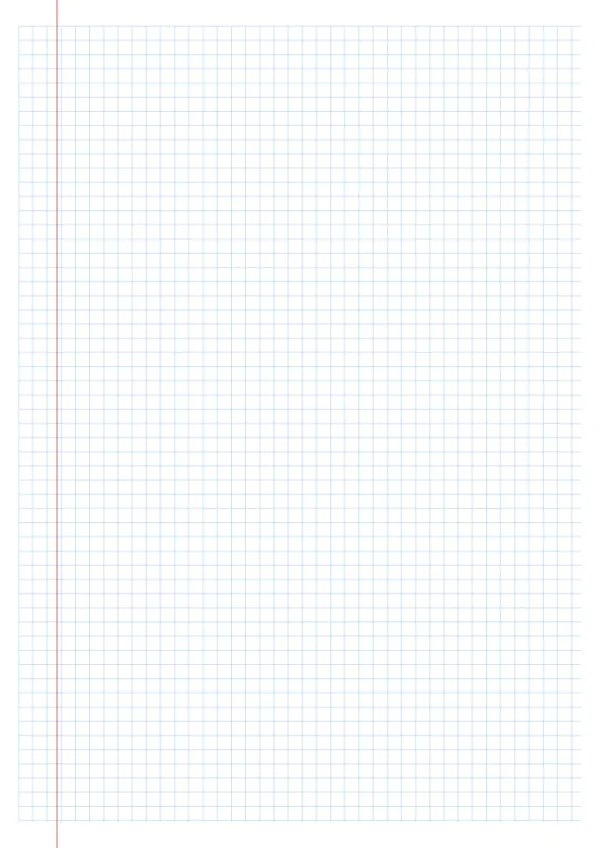
The Geometry of 5mm Math Grids and Metric Paper Standards
The standard European school grid is not an arbitrary aesthetic choice—it is a direct consequence of the metric system and ISO 216 paper geometry:
- Standard 5×5 mm Grid (Grades 2–12): A square grid where exactly two cells equal 1 centimeter. This 5mm pitch accommodates elementary arithmetic alignment, decimal points, long division carries, and geometric coordinate graphing without requiring an external ruler.
- 7×7 mm and 10×10 mm Large Grids (1st Grade): Developed for early childhood motor development. Children aged 6–7 lack refined fine-motor muscle control in the flexor pollicis brevis; larger bounding boxes reduce visual crowding and allow developing wrists to form proportional digits.
- Millimeter Coordinate Grid (Drafting): Dense 1mm sub-grids with accentuated 5mm and 10mm primary axis lines, optimized for physics plotting, lab experiments, and technical engineering drafts.
Furthermore, our red margin guideline (located exactly 20mm from the trim edge) preserves teacher grading space while teaching children spatial discipline and margin avoidance.
The Biomechanics of 1st-Grade Slant Lines and Handwriting Guides
Teaching cursive penmanship to a young student on blank wide-ruled lines is an uphill battle against ergonomics. The human hand naturally pivots from the wrist joint, creating an oblique radial arc. Without structural guides, young writers produce fluctuating letter heights and chaotic backslanted scripts.
Our 1st Grade Primary Lines layout utilizes the time-tested European three-zone ruling system:
- 4mm Main X-Height Band: Constrains the body of lowercase letters (such as a, o, m, e).
- Ascender & Descender Auxiliary Rails: Establish identical vertical boundaries for tall ascenders (b, d, k, l) and descending stems (g, p, y).
- 65° Slant Guidelines: Angled guide lines spaced every 18mm enforce an optimal physiological forward tilt. This angular muscle training prevents wrist hooking, stabilizes pencil grip pressure, and builds consistent cursive cadence.
Specialized Layouts: 3-Column Vocabulary Lists and Music Staves
Language acquisition and musical literacy require specialized organizational structures that standard notebooks simply cannot provide:
- 3-Column Vocabulary Lists: Built with dedicated vertical boundaries dividing each row into three cognitive zones: Foreign Word → Phonetic Transcription [IPA] → Native Translation. This tri-column layout is mandatory in secondary language curricula across Europe, reinforcing associative memory during vocabulary drilling.
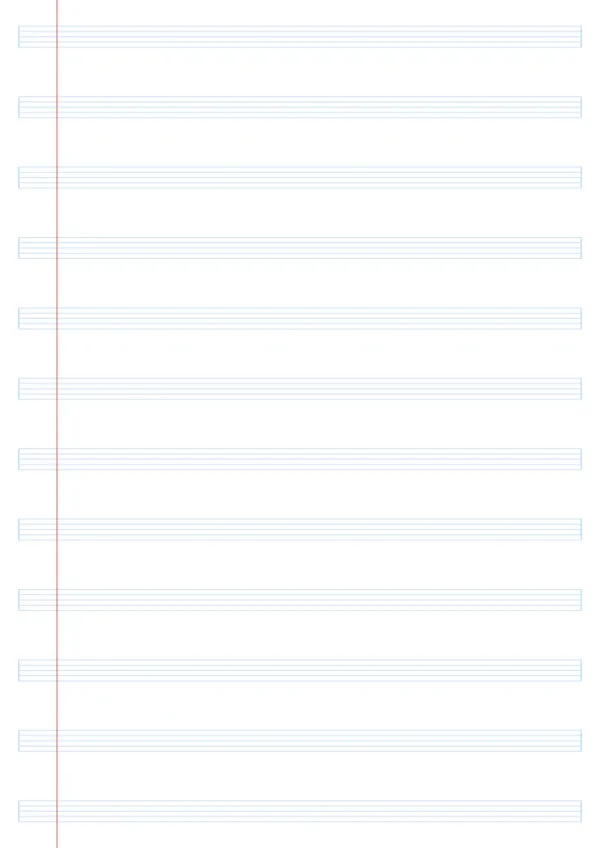
- Music Manuscript Staves: Standard 5-line staves engineered with precise 2mm inter-line pitch (matching standard optical reading distance for musical clefs, notes, and ledger lines) and 25mm inter-staff breathing room for dynamic markings and lyrics.
- Dot Grid (5×5 mm): The modern bullet journaling standard—offering subtle geometric alignment for sketchers and note-takers without the visual noise of dark solid grids.
Pure Vector Math vs. Blurry Scanned JPEGs
When you print a scanned JPEG or compressed bitmap found online, printer raster image processors (RIP) attempt to dither fuzzy gray pixels, resulting in bleeding lines that soak through standard 80 gsm paper and waste expensive toner. Our generator uses procedural inline SVG paths rendered with exact 0.5pt hairline precision. When sent to your printer via window.print(), the vector coordinates translate into microscopic printer dots, producing crisp, razor-sharp lines that use up to 70% less ink while looking indistinguishable from commercial store-bought notebooks.