
The Neurobiology of Haptic Resistance: Why Capacitive Glass Stunts Toddler Cognition
Modern ed-tech startups would have parents believe that shoving an iPad loaded with animated subscription software into a three-year-old’s hands is the pinnacle of early cognitive enhancement. It is not. Neurobiologically, a frictionless capacitive glass screen provides zero haptic feedback. When a child drags an unresisted finger across polished gorilla glass, their brain’s sensory-motor cortex receives negligible kinesthetic feedback. There is no tactile friction, no muscular micro-adjustment, and no spatial proprioception.
Conversely, dragging a wax crayon, graphite pencil, or felt-tip marker across porous wood-pulp cellulose paper generates mechanical resistance. The micro-textures of paper fibers demand real physical torque, activating the cortical homunculus, refining fine motor motor control, and forging indelible neural pathways between visual letter recognition and physical muscle memory. Coloring inside boundaries or tracing dashed contours is not merely entertainment—it is foundational motor neurology.
The $15/Month "Early Reader" Subscription Racket vs. Pure Open Vector Printing
The contemporary web ecosystem is infested with bloated commercial platforms demanding user registrations, biometric tracking, and recurring credit card subscriptions just to spit out a pixelated, watermarked black-and-white number outline. Loading 14 megabytes of tracking scripts and telemetry libraries just to render a number "3" for a child to color is an insult to web engineering.
The TOOL GIGA Printable Letters & Numbers Coloring Generator exists as an antidote to corporate educational bloat. Zero logins, zero paywalls, zero telemetry. Pure client-rendered SVG geometry calculating vector coordinate paths directly on your CPU, scaling effortlessly to physical 300 DPI A4 sheets without raster blur or jagged interpolation.
Geometric Mechanics: Solid Contours, Dashed Tracing, and Counting Bubble Archetypes
Different stages of childhood neurological development demand strictly calibrated visual boundaries:
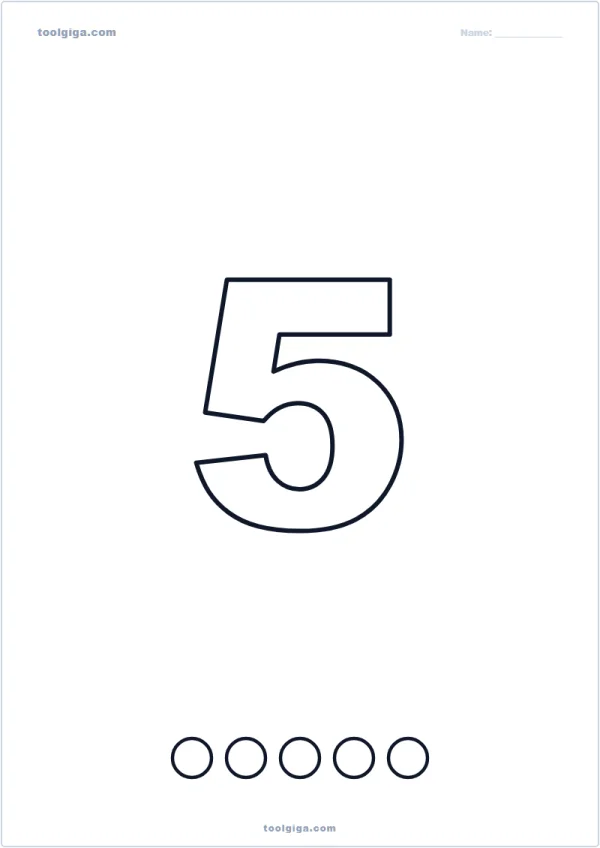
- Solid Contours (Fat Outlines): Designed for toddlers (ages 2–4) mastering gross grasp. The thick 5.5px boundary provides high-contrast visual anchors, encouraging spatial orientation and boundary recognition.
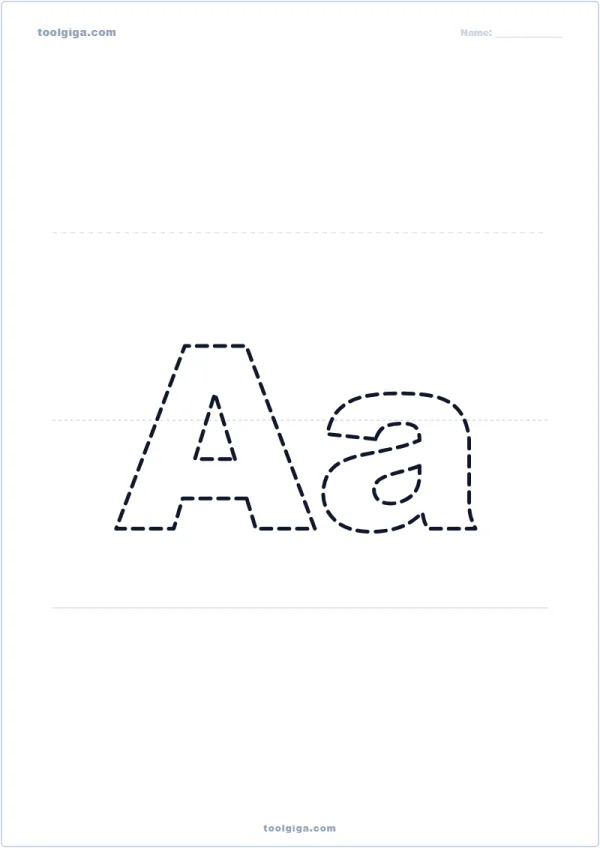
- Dashed Line Tracing: Calibrated with precise 10px strokes and 8px gaps. This mode guides developing hands through penmanship stroke orders (ductus), bridging the transition from unstructured coloring to disciplined cursive and numeral drafting.
- Dotted Stippling: Minimal visual cues requiring active mental interpolation, forcing the child’s brain to connect disparate spatial coordinates into a coherent glyph shape.
- Subitizing & Counting Bubbles: Rote numeral memorization is meaningless without cardinality (understanding that the abstract glyph "5" represents five distinct physical objects). Our automated counting bubbles introduce immediate mathematical subitizing, allowing children to physically fill in one bubble per count unit.
The Cognitive Science of "Chaotic Scatter" (Visual Discrimination & Gamification)
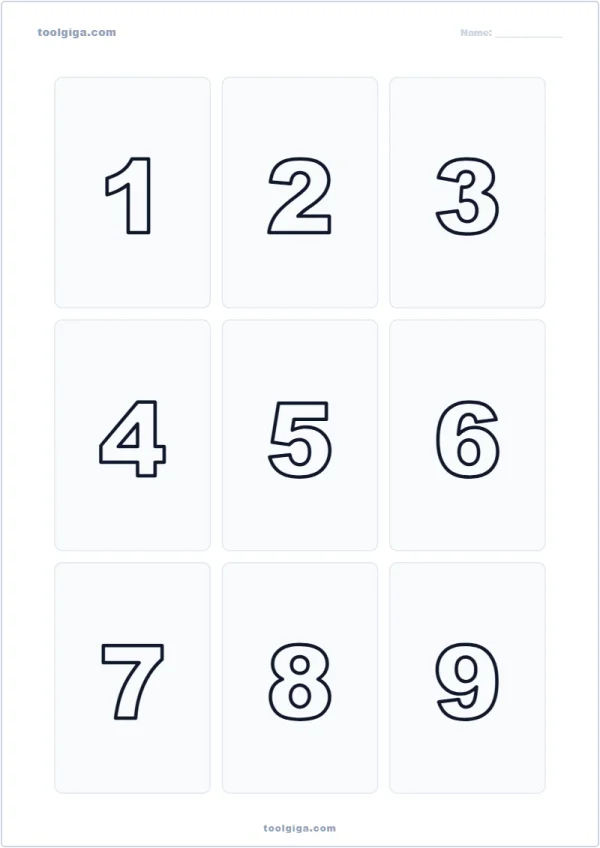
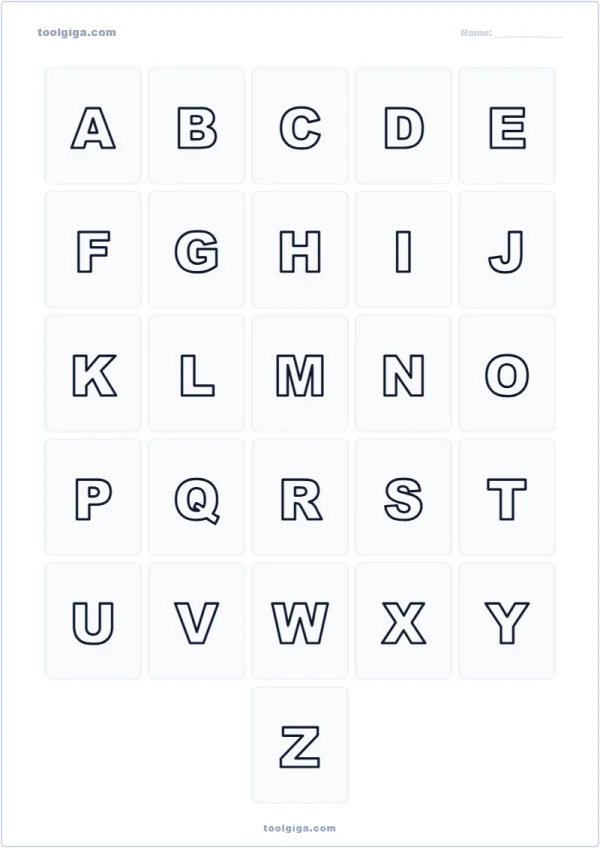
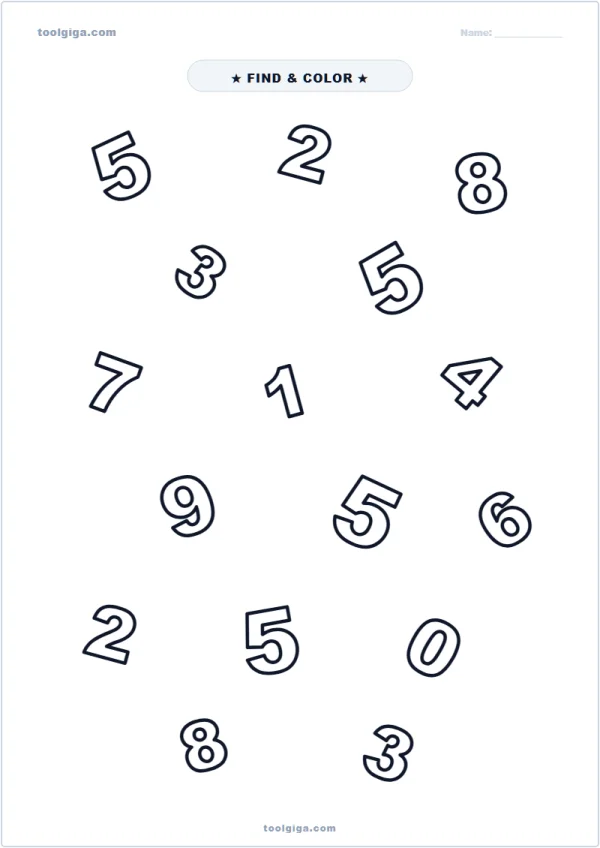
Linear tabular grids are efficient for adult bookkeeping, but young children learn through active visual hunting. When the "Chaotic / Find & Color" mode is toggled, our layout engine breaks Cartesian monotony:
Glyphs are dynamically distributed across randomized coordinates with bounded angular rotations between -24° and +24°. This transforms repetitive worksheet drills into an active cognitive search-and-find exercise. The child must distinguish rotational invariance (recognizing that an inverted or tilted "E" is still an "E") while selectively hunting down target letters and numbers across chaotic visual noise.
Historical Lineage: From Locke’s Alphabet Dice to Montessori Sandpaper Letters
Physical letter manipulation is not a modern fad. In 1693, philosopher John Locke proposed in Some Thoughts Concerning Education that children should learn through physical, play-based alphabet dice rather than punitive rote memorization. In the 1830s, Friedrich Fröbel codified the concept of Kindergarten utilizing geometric "gifts" that children could physically hold and trace.
Dr. Maria Montessori expanded this in the early 20th century with tactile sandpaper letters, recognizing that sensory-motor touch directly precedes linguistic writing. Our vector coloring sheets honor this century-old pedagogical tradition: treating the alphabet and numeral systems as physical geometric structures that children explore, color, conquer, and internalize through physical handcraft.