
The $10 Amazon Activity Book Scam: Why Most Online Mazes Are Broken
Search online for "printable maze activity books," and you will find thousands of self-published paperback collections manufactured by "passive income" hustlers following fifteen-minute YouTube tutorials. These books are filled with generic, low-resolution bitmap graphics scraped from free repositories. Worse, amateur digital maze generators frequently produce defective graphs: disconnected rooms, unintended cyclic loops, multiple conflicting paths, or worst of all, labyrinths where the finish line is mathematically unreachable from the start.
A true labyrinth is not random squiggles; it is a rigorous branch of graph theory and computational geometry. Our procedural engine executes a client-side Randomized Depth-First Search (Recursive Backtracker) that enforces an absolute mathematical property: every generated layout is a Perfect Maze (a topological spanning tree) possessing exactly one unique, continuous solution path with zero cycles and zero isolated islands.
Graph Theory of a Perfect Maze: The Recursive Backtracker Engine
Formally, a maze can be modeled as an undirected connected graph $G = (V, E)$, where every cell is a vertex and every open passage between adjacent cells is an edge. A "perfect maze" is mathematically defined as a spanning tree of this grid graph:
|E| = |V| - 1 (Zero Cycles • 100% Reachability)
Unlike Kruskal's or Prim's algorithms (which construct bushy mazes dominated by hundreds of short, trivial dead ends), the Recursive Backtracker generates long, deeply winding corridors with a high branching factor variance. This creates the quintessential psychological feeling of exploration: deep corridors that meander across the entire page, forcing the solver to hold complex spatial hypotheses in working memory.
Four Radically Distinct Geometries: Moving Beyond Boring Cartesian Grids
Most maze generators only support basic 90-degree square tiles. We have engineered four completely distinct topological engines that engage human visual cognition in radically different ways:
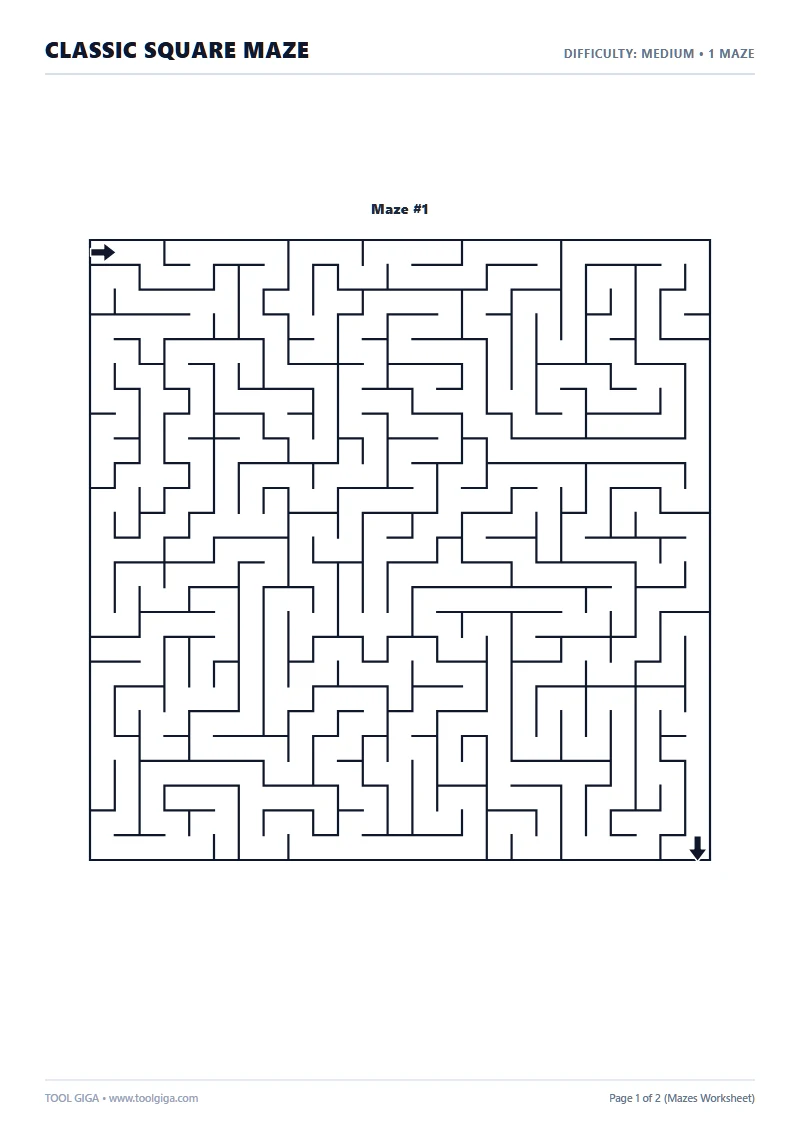
- Classic Square (Orthogonal Grid): The timeless Cartesian standard ($z=4$ neighborhood). Clean horizontal and vertical passages with razor-sharp vector corners, perfect for traditional pencil solving.
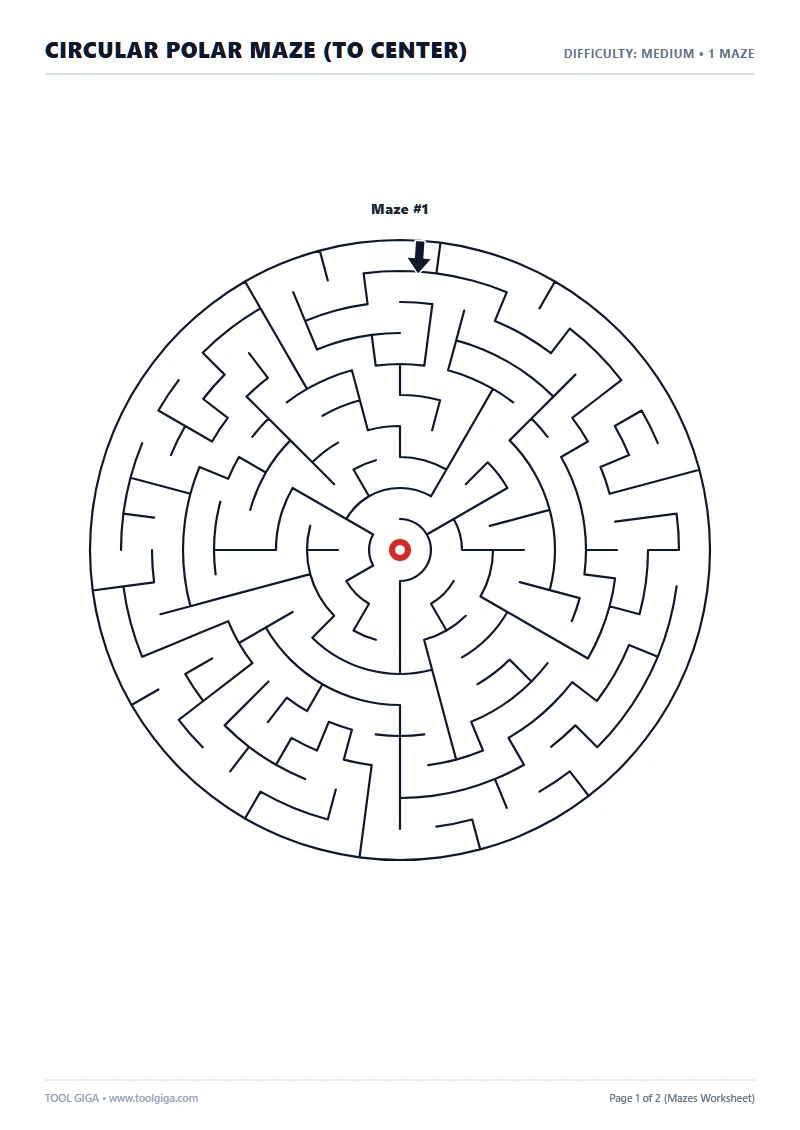
- Polar Concentric Circle (Theta Maze): Modeled after the ancient Cretan Labyrinth of Daedalus. Built in polar coordinates $(r, \theta)$ with concentric circular rings and radial barriers. Solvers enter from the outer perimeter and must navigate inward toward the central bullseye chamber.
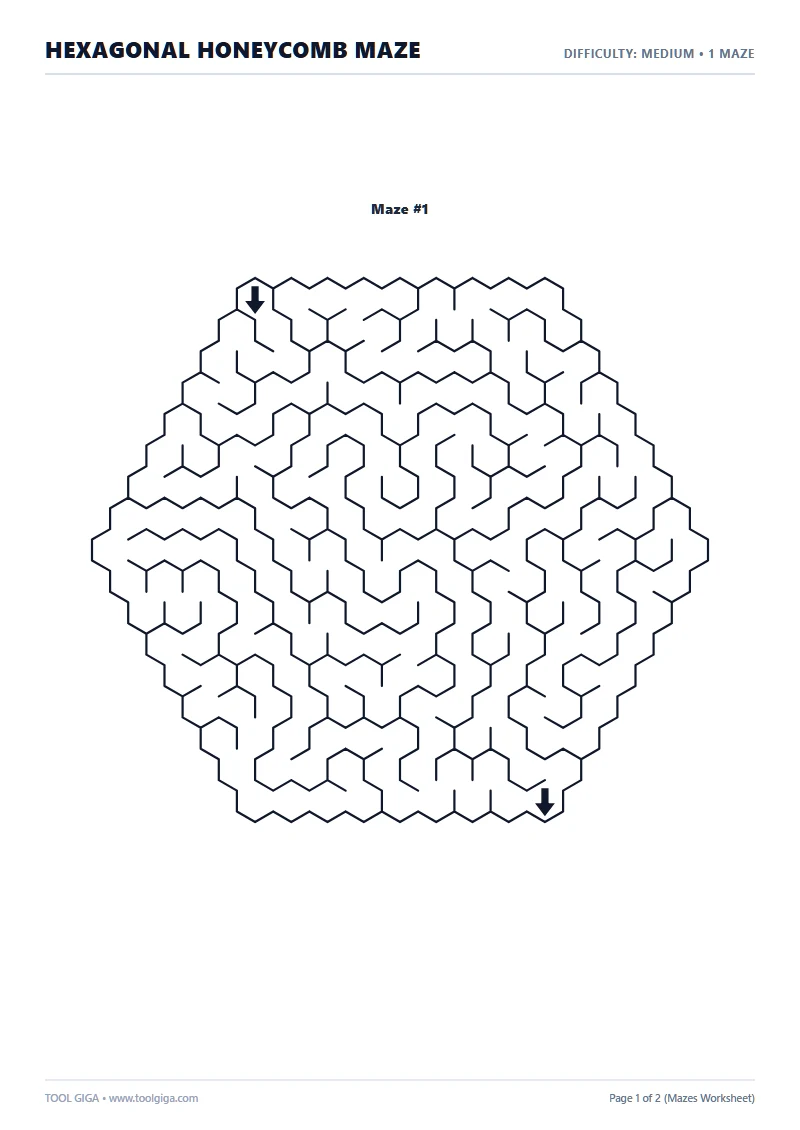
- Hexagonal Honeycomb (Delta Grid): A triangular lattice with hexagonal cells ($z=6$ neighborhood). Instead of 90-degree turns, corridors branch in six directions at 60-degree angles. This disrupts the human eye's natural Cartesian bias, making visual dead-end scanning significantly more challenging.
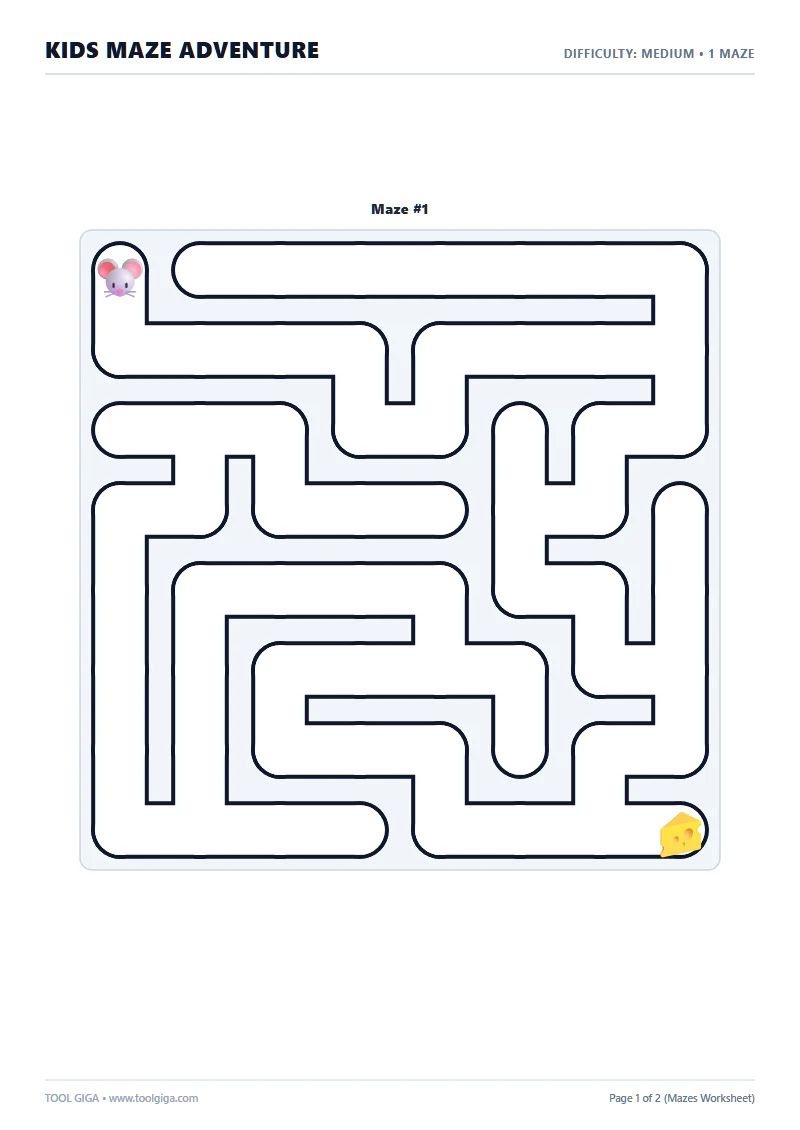
- Kids Fat-Path Cartoon Mazes: Specially engineered for early childhood motor development (ages 4–7). Features extra-wide, rounded corridors paired with playful narrative emoji markers: Mouse → Cheese, Rocket → Planet, Puppy → Bone, Bunny → Carrot. Children can effortlessly trace paths with thick crayons or fingertips without spatial frustration.
Geodesic BFS Solvers and Two-Page A4 Worksheets
When you check "Include Answer Key," our engine does not guess the path. It executes a Breadth-First Search (BFS) from the start vertex, exploring the spanning tree in $O(|V| + |E|)$ time to locate the exact geodesic coordinate path. On page 2 of your A4 printout (separated by a clean CSS page break), the browser automatically outputs identical miniature grids featuring a vivid, smooth vector solution line.
Vector Ink-Saver Printing vs. Fuzzy JPEG Scans
Printing scanned JPEG files from image search engines produces blurry gray pixels that soak standard 80 gsm copy paper and deplete expensive black printer toner. Our generator renders pure procedural SVG paths with 0.5pt hairline precision. When sent to your printer via window.print(), the vector coordinates translate directly into microscopic printer dots, creating sharp, bookstore-quality activity sheets while saving up to 70% of printer ink.