
Mathematics You Can Touch: Why Physical Shapes Outperform Digital Screens
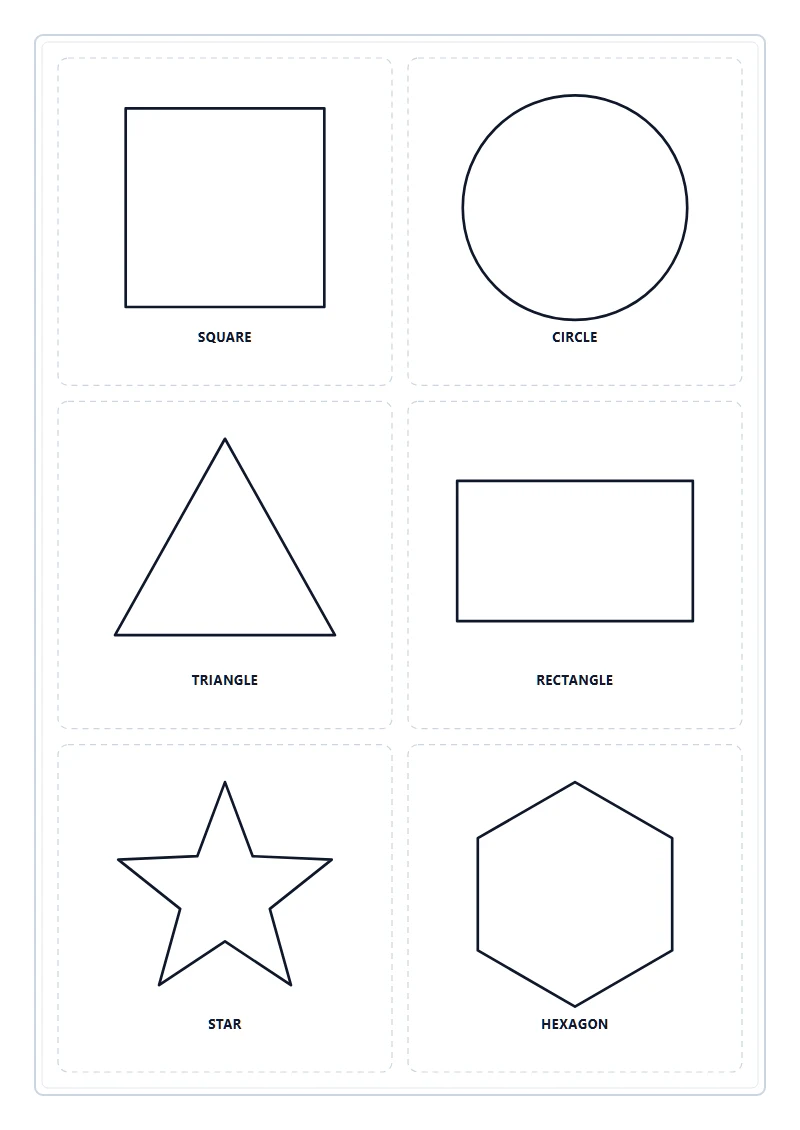
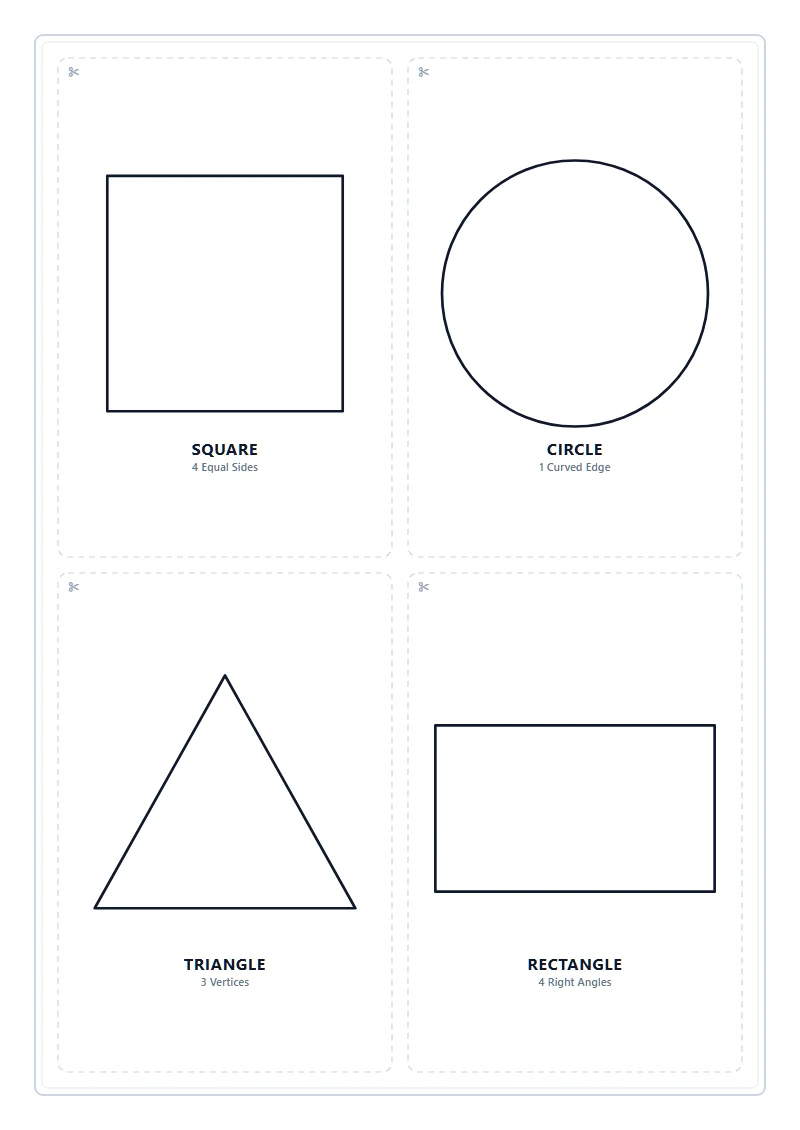
In an increasingly digital classroom, cognitive science confirms a vital developmental truth: spatial reasoning and mathematical intuition develop through tactile touch, scissor cutting, and physical construction (embodied cognition). Until a child traces a smooth circular arc with a pencil, cuts sharp polygon vertices with safety scissors, or physically folds a flat net into a tangible 3D cube, geometric principles remain abstract symbols in a textbook.
Mathematically accurate templates serve as the essential sensory baseline: true 90° square corners, symmetrical hexagons, and uniform circular radii train early perceptual accuracy. Our procedural in-browser engine renders pixel-perfect vector SVG outlines calibrated for standard A4 printing, enabling educators and parents to create customized learning sheets—from early motor cutting practice to advanced stereometry modeling—instantly and with zero visual distortion.
From Friedrich Fröbel to Montessori: The Cognitive Science of Shapes
Early childhood spatial reasoning is not an abstract academic luxury—it is the neurological foundation for future STEM competency, architectural intuition, and arithmetic comprehension:
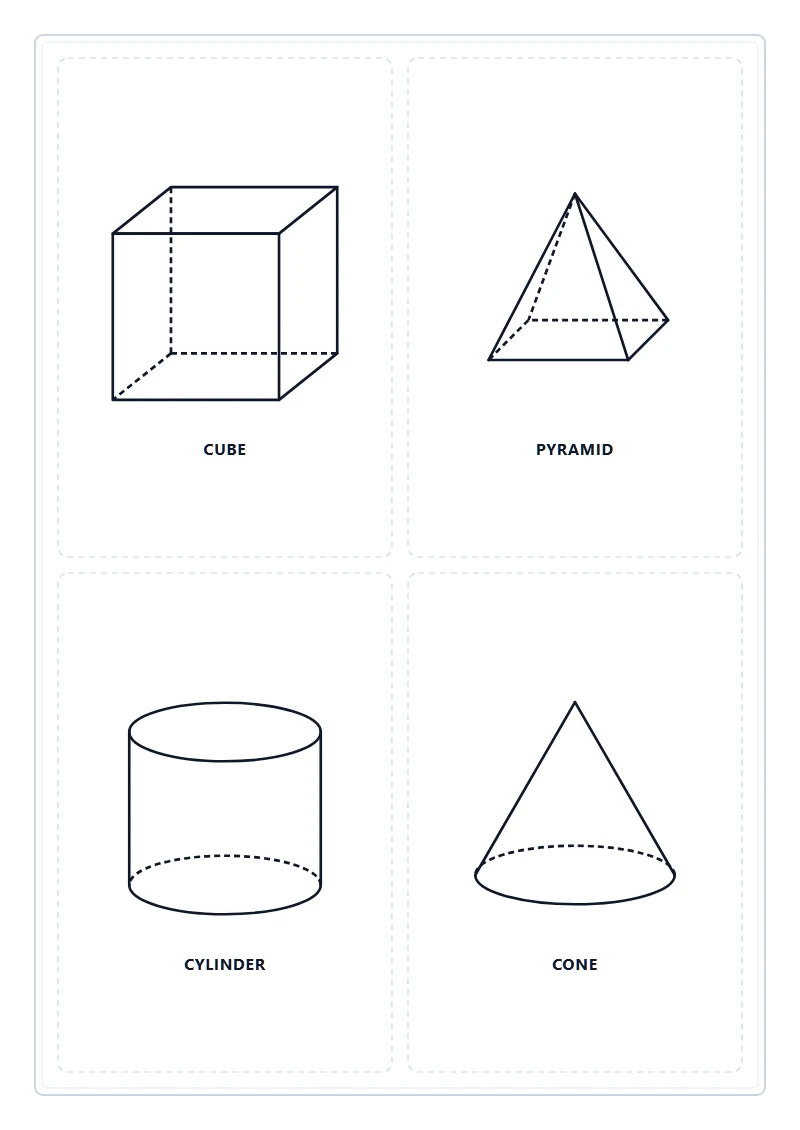
- Fröbel's "Gifts" (1837): When German educator Friedrich Fröbel invented the modern kindergarten, his foundational curriculum was built entirely around physical geometric forms—spheres, cubes, and cylinders. Touching and manipulating these forms teaches toddlers the fundamental boundary conditions of three-dimensional reality.
- Montessori Shape Recognition: Maria Montessori's sensorial materials demonstrate that children categorize visual reality by isolating geometric attributes. Dissecting a circle from an ellipse or comparing an equilateral triangle to a scalene triangle trains visual discrimination long before symbolic letter reading begins.
- Visuo-Spatial Working Memory: Tracing and identifying 2D polygons directly stimulates the parietal cortex, strengthening the mental manipulation of geometric coordinates required later in trigonometry, engineering drafting, and physics.
Polyhedral Nets: Albrecht Dürer's 1525 Paper Folding Revolution
Every elementary school student eventually encounters the rite of passage of assembling a 3D paper cube or pyramid. What few educators realize is that the concept of unfolding a three-dimensional polyhedron onto a two-dimensional plane was invented by the master Renaissance artist and mathematician Albrecht Dürer in his 1525 treatise Underweysung der Messung (Instruction in Measurement).
Our 3D Foldable Nets mode generates Dürer-accurate planar nets equipped with essential engineering features:
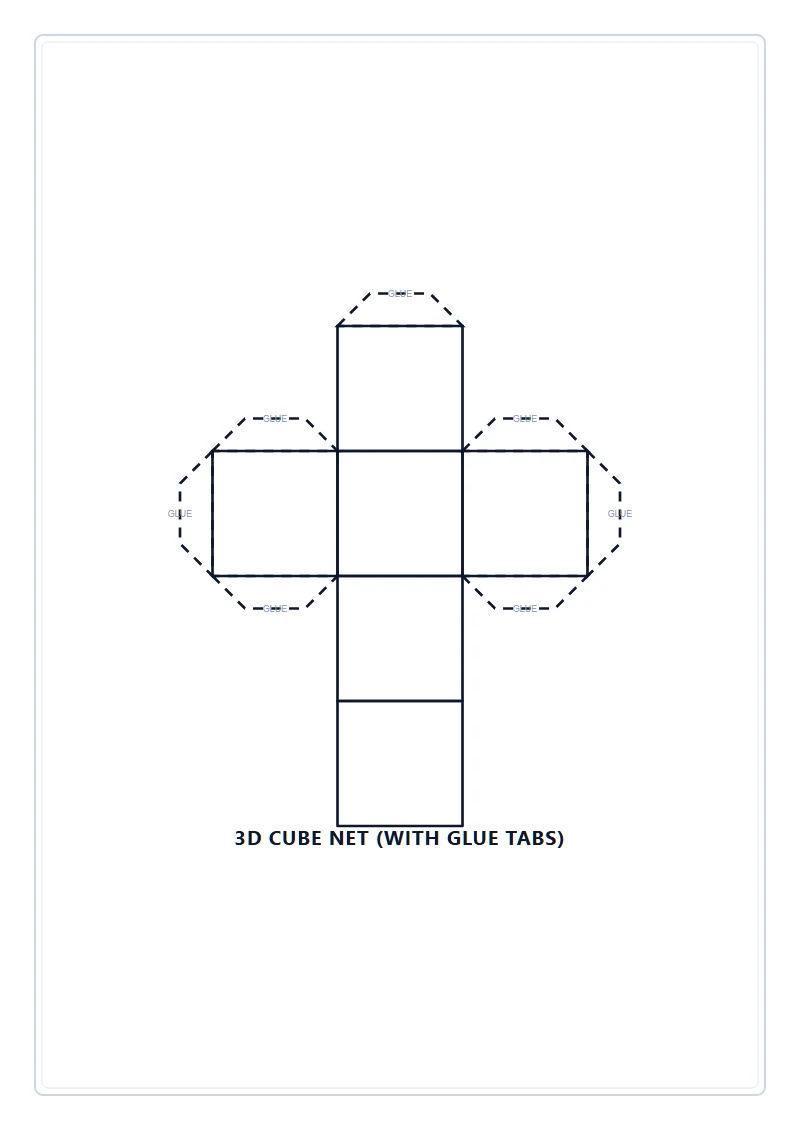
- Cube Net (Hexahedron): The classic Latin cross arrangement of six congruent squares, engineered with seven angled trapezoidal adhesive tabs (marked with clear "GLUE" guides) to ensure structural rigidity.
- Square Pyramid Net: A square central base bounded by four congruent isosceles triangles with lateral locking tabs.
- Cylinder Net: A rectangular lateral surface proportioned to exact circumference $C = 2\pi r$, flanked by two circular bases with circular serrated folding tabs.
Calibrated Line Styles: Scissor Cutting ✂️ vs. Pencil Tracing ✏️
Children of different developmental ages require completely different line ergonomics:
- Dashed Lines (
stroke-dasharray="10,8"): Designed specifically for scissor cutting exercises in preschool and kindergarten. The rhythmic dashes provide visual pacing, teaching small hands where to align scissor blades without tearing paper. - Dotted Lines (
stroke-dasharray="3,5"): Optimized for pencil control and stylus tracing. The fine dots guide developing wrists along precise curvature arcs without obscuring the child's pencil lead. - Solid Lines: Crisp, continuous black boundaries designed for coloring stencils, classroom display posters, and formal geometric construction exercises.
Pure Vector Geometry vs. Fuzzy Pixelated Scans
When you print a compressed JPEG found on image search engines, printer drivers dither fuzzy gray transition pixels, soaking standard 80 gsm printer paper and leaving ragged, blurry borders. Our generator uses pure mathematical SVG coordinate paths with exact hairline or thick border formatting. When sent to your printer via window.print(), circles remain mathematically smooth arcs and polygons retain razor-sharp corners, producing clean, bookstore-grade educational materials while consuming up to 60% less toner.