

Precision Technical & Engineering Graph Paper Generator: Beyond the Limitations of Cartesian Squares
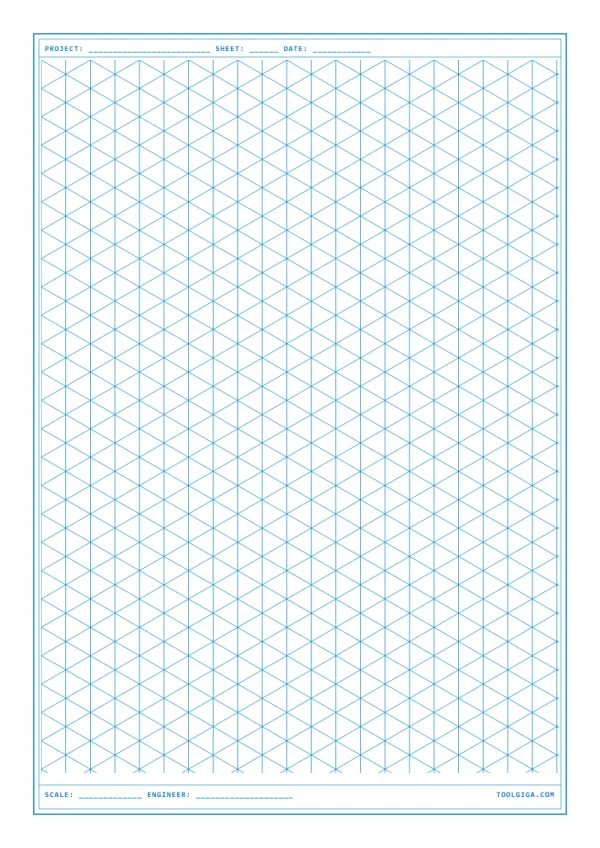
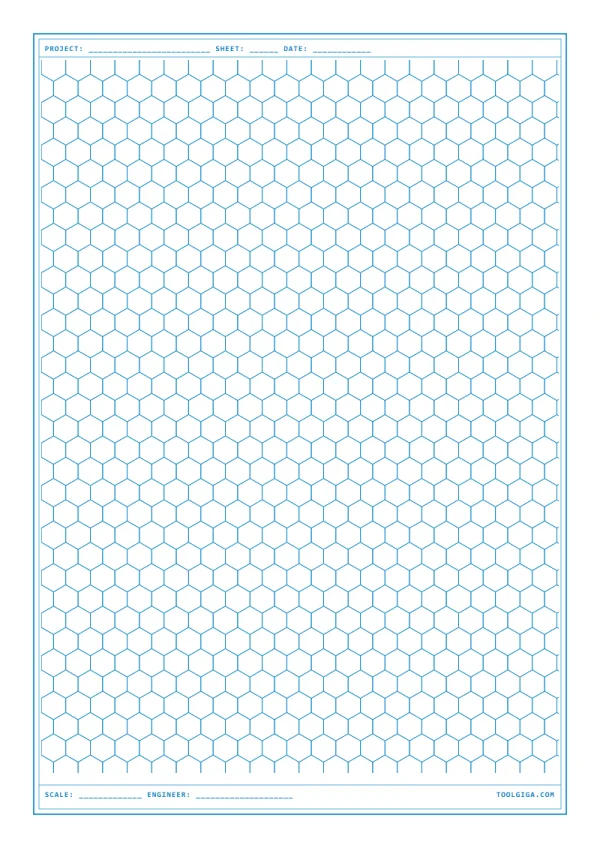
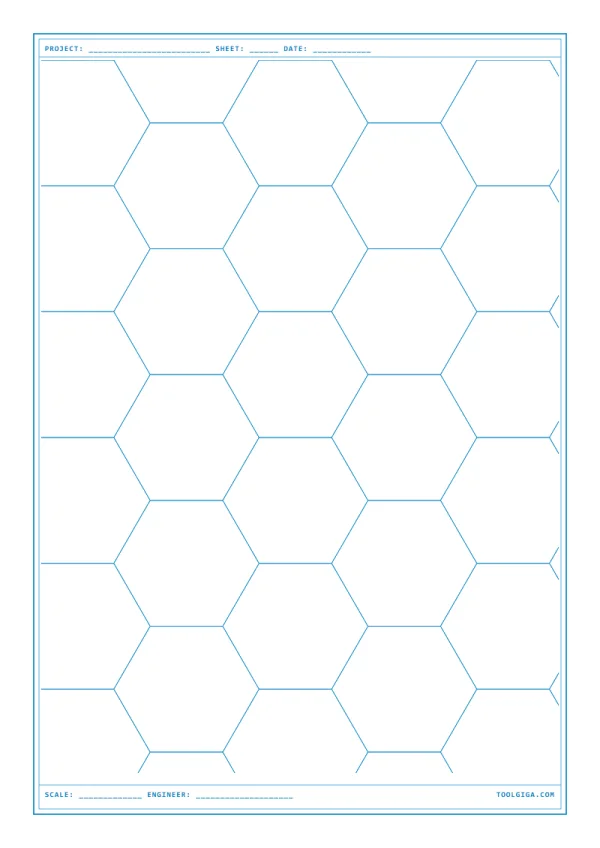
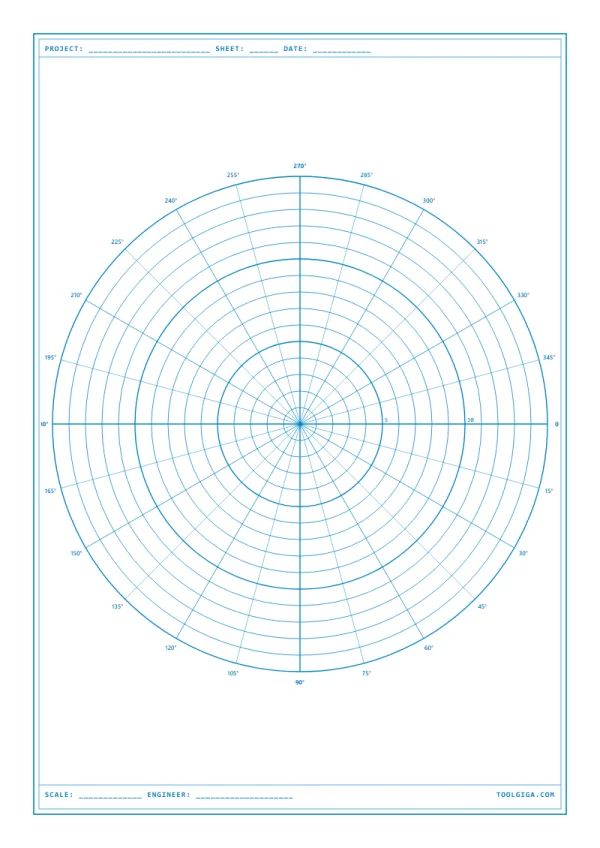
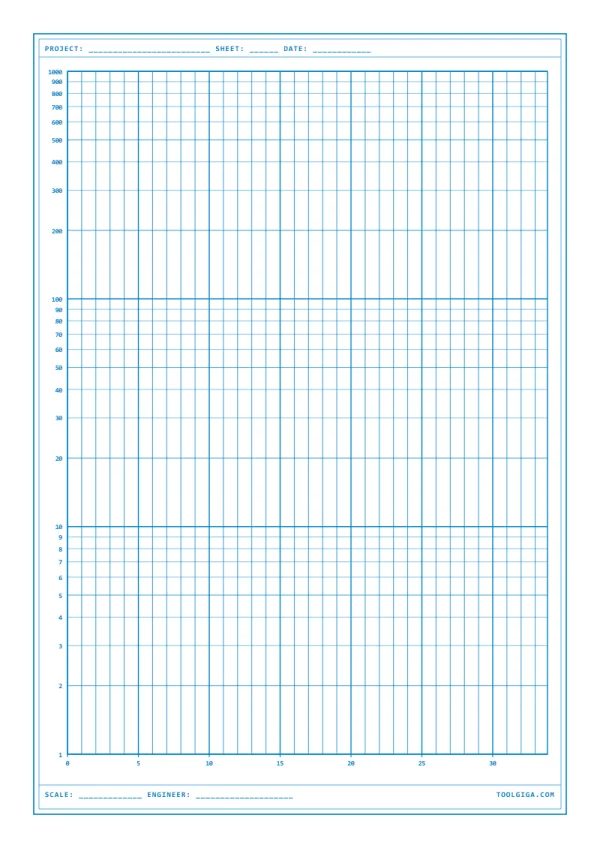
The TOOL GIGA Technical Graph Paper Generator is a specialized, mathematically rigorous online engineering tool engineered to design, calibrate, and print professional A4 vector drafting sheets and PDF documents. When generic square grid paper proves inadequate for three-dimensional piping schematics, organic chemistry synthesis, directional antenna lobes, or tactical cartography, this generator delivers mathematically exact geometric foundations with zero compromise. The application provides four dedicated drafting modes: 3D Isometric axonometry with 60-degree equilateral triangles and clean "Iso-Dots" nodal spacing; Hexagonal honeycomb tiling tailored for organic biochemists (5 mm pointy-top benzene rings) and tabletop RPG gamers (1-inch tactical battle grids); Polar coordinate circles featuring concentric radius increments alongside degree (0°–360°) and radian (0–2π) angular rays; and Semi-Logarithmic coordinate matrices spanning 1 to 5 calibrated log10 decades for electronic frequency response and Bode plots. Every template can be instantly customized by line weight, drafting color, and margin layout (formal 15 mm engineering title block or full bleed edge-to-edge), then printed directly to PDF at true 1:1 metric scale or exported as infinite-resolution SVG vectors and 300 DPI PNG bitmaps.
For four centuries, René Descartes’ orthogonal coordinate system has dominated human bookkeeping. Two perpendicular axes meeting at ninety degrees are convenient for spreadsheets, tax forms, and suburban real estate plotting. But the physical universe does not operate on square tiles. Atoms packing into metallic crystals, bees engineering honeycomb wax cells, and radio waves radiating into the troposphere all despise ninety-degree junctions.
When an engineer forces a three-dimensional isometric piping system onto square graph paper, every diagonal requires tedious manual trigonometric calculation. When a tabletop RPG dungeon master calculates character movement on square tiles, diagonal traversal introduces an artificial 41.4% distance distortion (√2 ≈ 1.414). Hexagonal grids solve this through true geometric isotropy: every adjacent cell center is equidistant (d = 1.0) across all six directions. As mathematician Thomas Hales formally proved in 1999 regarding the ancient Honeycomb Conjecture, a regular hexagonal tessellation provides the absolute minimum perimeter perimeter boundary to divide a two-dimensional surface into regions of equal area. Hexagons are not a design quirk; they are nature’s thermodynamic law of minimal work.
The $30/Month "Smart Canvas" Racket vs. Pure Zero-Dependency Vector Geometry
Modern commercial software vendors have metastasized into predatory digital tollbooths. If an electrical engineering student or an organic chemistry researcher needs a sheet of semi-logarithmic paper or a hexagonal grid to sketch a chemical synthesis, contemporary SaaS platforms demand user registrations, mandatory cloud synchronization, tracking telemetry, and recurring monthly subscriptions. Adding an "AI assistant" button to draw a basic 60-degree triangle grid for $30 a month is an insult to computational engineering.
The TOOL GIGA Technical Graph Paper Generator is built on an uncompromising zero-dependency, zero-telemetry philosophy. No cookies, no paywalls, no bloated client-side JavaScript frameworks. Pure mathematical coordinate algorithms calculate SVG vector geometry directly inside your browser’s execution engine, transforming mathematical equations into crisp, infinite-resolution physical A4 drafting sheets at zero cost.
Two Centuries of Axonometry: From William Farish to Industrial Machine Blueprints
Isometric drafting was not conceived by computer graphics programmers; it was born in the fires of the Industrial Revolution. In 1820, Professor William Farish of Cambridge University published On Isometrical Perspective. Farish recognized that optical perspective—where parallel lines converge to distant vanishing points—made accurate mechanical measurements impossible for machinists trying to cast steam engine cylinders and optical mirrors.
Farish introduced isometric projection: tilting an orthogonal cube until all three axes (x, y, z) project at equal 120-degree angles to each other, creating a uniform foreshortening scale along 30°, 90°, and 150° vectors. Our isometric generator honors Farish’s 1820 mathematical standard: whether you select continuous 60-degree drafting lines or minimalist intersection dots (Iso-Dots), every vector line maintains exact metric precision across physical A4 drafting margins.
Organic Chemistry and the Planar Ring: How Benzene Tamed Hexagonal Symmetry
In 1865, chemist August Kekulé solved the enduring enigma of the benzene molecule (C6H6) after daydreaming of an Ouroboros—a serpent biting its own tail. The aromatic benzene ring, with its planar sp2 hybridized carbon orbital overlap and delocalized π-electron cloud, forms a perfect 120-degree interior angle geometry.
Trying to sketch complex organic synthesis pathways, polycyclic aromatic hydrocarbons (like naphthalene and anthracene), or steroid carbon skeletons on standard square grid paper results in sloppy, distorted bond angles. Our hexagonal generator provides calibrated 5 mm Pointy-Top hexagons optimized for organic chemistry note-taking, alongside 25.4 mm (1-inch) Flat-Top hexagons designed specifically for tabletop gaming miniatures and tactical wargaming maps.
Polar Radiation Lobes and Logarithmic Decades: From Radar to Audio Frequency Response
Human sensory physiology and physical signal propagation are fundamentally non-linear. The Weber-Fechner psychophysical law dictates that human hearing perceives sound loudness logarithmically: each tenfold increase in acoustic sound pressure corresponds to an equal perceived increment in volume (decibels). Similarly, electronic filter cutoff frequencies, RC circuit time constants, and Laplace transform frequency responses span multiple orders of magnitude.
Before digital oscilloscopes, every mid-century RF engineer and acoustics researcher relied on pads of Keuffel & Esser orange-lined semi-logarithmic paper. Our generator reproduces calibrated 1-to-5 decade semi-log grids with true log10 sub-divisions, alongside 360-degree polar coordinate grids with radian and degree boundary markers for antenna radiation lobes, polar Fourier transforms, and radar navigation charts.