
What This Tool Does and How to Use It
This tool prepares printable A4 worksheets for teaching children how to read analog clocks, draw clock hands, and calculate time intervals. You can customize the layout above and print the sheet directly or save it as a PDF file.
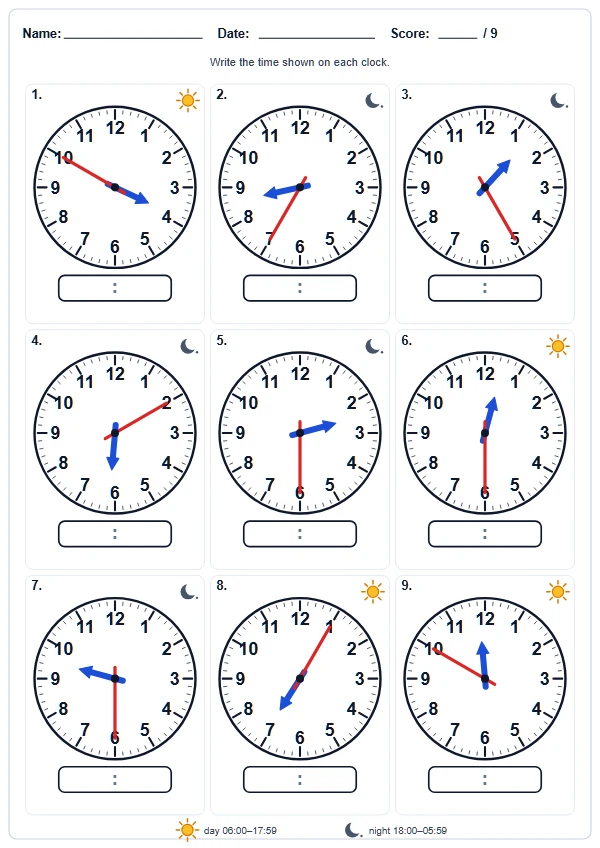
- What Time Is It? (Write with Numbers): Generates 6, 9, 12, or 16 analog clocks with hour and minute hands. Below each clock is an empty box where the child writes the digital time.
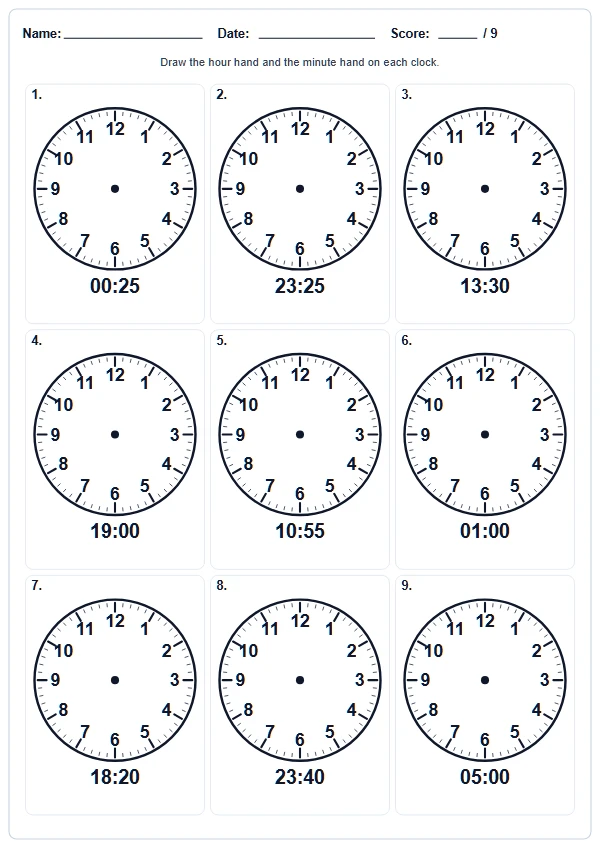
- Draw the Clock Hands: Generates blank clock faces with a digital time printed underneath each dial. The child draws the short hour hand and the long minute hand in the right positions.
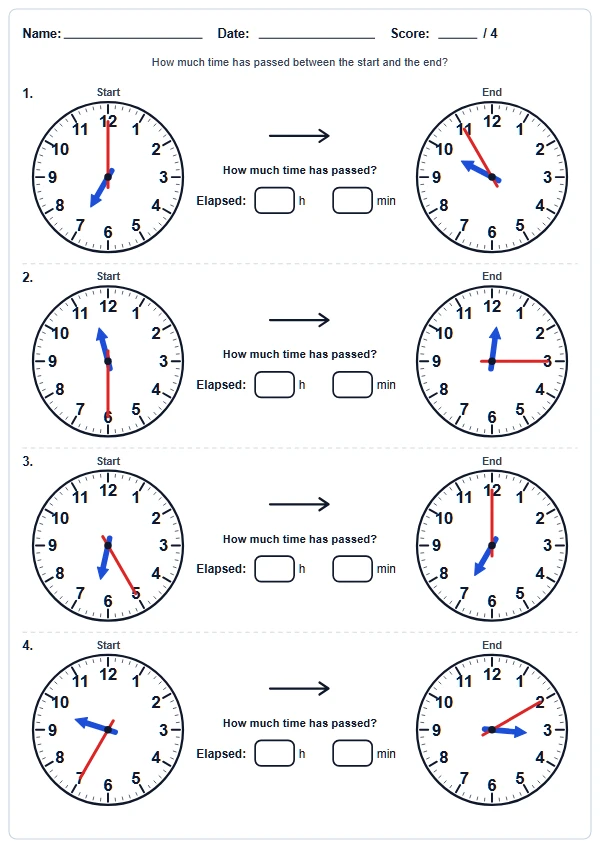
- Elapsed Time (How Much Time Passed?): Displays pairs of clocks showing a start time and an end time so students can calculate how many hours and minutes have passed.
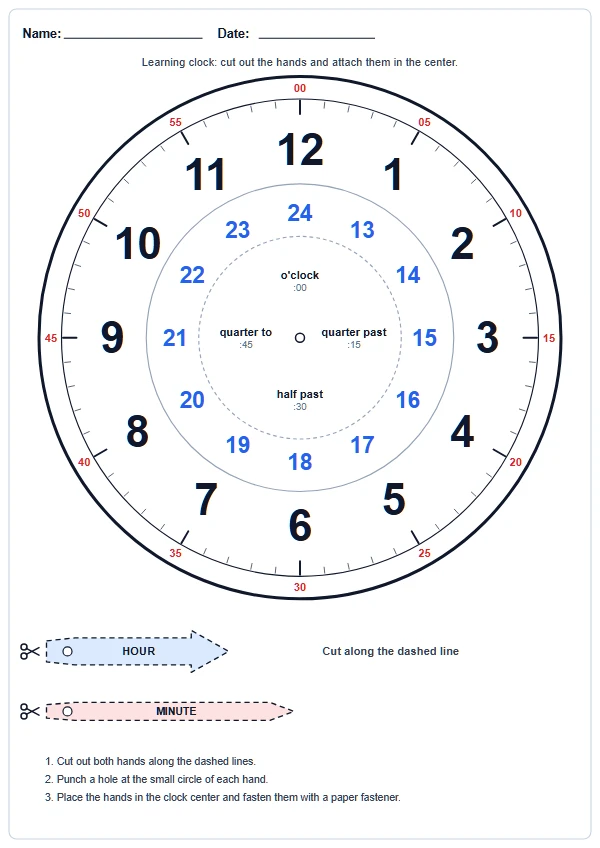
- Cut-Out Learning Clock (Full A4): Prints one large clock face across the entire A4 sheet, complete with an outer 00–55 minute ring, standard 1–12 hours, an inner 13–24 hour ring, and separate hour and minute hands at the bottom to cut out with scissors.
Using the controls above the sheet, you can choose the number of clocks per page, set the time interval difficulty (whole hours, half hours, quarter hours, 5-minute steps, or 1-minute precision), switch between 24-hour format (with a sun icon for daytime 06:00–17:59 and a moon icon for evening/night 18:00–05:59) and 12-hour AM/PM format, add helper rings to the clock face, and toggle the red answer key on or off.
How Children Learn Time: Step-by-Step Progression
For a six- or seven-year-old child, an analog clock face is a complex dual-scale instrument. Unlike a ruler where every number means only one thing, the number 3 on a clock means 3 hours when pointed to by the short hand, 15 minutes when pointed to by the long hand, and 15:00 in the afternoon. Teaching this concept works best when broken into gradual stages:
- Stage 1 – The Hour Hand Only (Ages 5–6): Start with whole hours (:00) and focus attention on the shorter, thicker hand. Children first learn that when the long hand points straight up to 12, the short hand points directly at the current hour.
- Stage 2 – Half Hours and Moving Hands (Ages 6–7): When the minute hand travels halfway around the circle to 6 (:30), the hour hand also moves halfway between two numbers. Seeing that at 4:30 the hour hand sits midway between 4 and 5 prevents the most common beginner mistake of reading 4:30 as 5:30.
- Stage 3 – Quarter Hours and Skip-Counting by Fives (Ages 7–8): Using a clock face with the outer 5, 10, 15... 60 minute ring helps children connect multiplication by 5 with the twelve hour marks around the dial.
- Stage 4 – Exact Minutes, 24-Hour Format, and Elapsed Time (Ages 8–10): Once five-minute intervals are automatic, children move to individual minute ticks, converting afternoon hours into 13:00–23:59 notation, and counting forward across the top of the hour to find elapsed time.
The History of Timekeeping: Who Invented the 24-Hour Day and 60-Minute Hour?
Why do we not divide the day into 10 hours of 100 minutes each? The reason we read clocks in twelves and sixties goes back more than four thousand years to Mesopotamia and Ancient Egypt.
Around 2000 BC, the Sumerians and later the Babylonians used a sexagesimal (base-60) mathematical system instead of the decimal (base-10) system used today. While base-10 comes from counting on ten fingers, historians note that base-12 and base-60 come from counting the twelve finger bones (phalanges) of the four fingers on one hand using the thumb as a pointer, and using the five fingers of the other hand to track five sets of twelve (12 × 5 = 60). The number 60 is also mathematically convenient for dividing fractions: it is the smallest number evenly divisible by 1, 2, 3, 4, 5, and 6, as well as by 10, 12, 15, 20, and 30.
Meanwhile, the Ancient Egyptians divided the day into 12 daytime hours measured by shadow clocks (sundials) and 12 nighttime hours tracked by the rising of 36 star groups called decans across the night sky. During the Hellenistic period, Greek astronomers such as Hipparchus and Claudius Ptolemy combined the Egyptian 24-hour day with Babylonian base-60 fractions, dividing each degree and each hour into 60 partes minutae primae ("first small parts", which became our word "minute") and 60 partes minutae secundae ("second small parts", which became our word "second").
Why Clocks Move "Clockwise" and How Mechanical & Quartz Clocks Work
Have you ever wondered why clock hands rotate from top to right, down, and left? Mechanical clocks were invented in the Northern Hemisphere (in medieval Europe and China) as direct mechanical imitations of the sundial. When you stand in the Northern Hemisphere facing North and place a vertical stick (gnomon) in the ground, the Sun rises in the East, travels across the southern sky, and sets in the West. Consequently, the shadow cast by the stick moves from West, through North, to East—rotating from left to right across the top of the dial. If mechanical clocks had been invented in Australia or Argentina in the Southern Hemisphere, where sundial shadows rotate in the opposite direction, our clocks today would run "counter-clockwise".
For centuries, early mechanical tower clocks had only a single hour hand because gear escapements were too imprecise to measure minutes. Everything changed in 1656 when Dutch physicist Christiaan Huygens applied Galileo Galilei’s discovery of isochronism—the physical law that a pendulum’s period of swing depends only on its length and gravity, not on the width of its swing (T = 2π√(L/g)). Pendulum clocks reduced daily error from 15 minutes to just a few seconds, making the minute hand practical for everyday life.
In modern wristwatches and wall clocks, the swinging pendulum is replaced by piezoelectricity, discovered by brothers Pierre and Jacques Curie in 1880. Inside a quartz clock sits a tiny tuning-fork-shaped crystal of silicon dioxide (SiO₂). When a small electric current from a battery passes through it, the crystal vibrates at an exact frequency of 32,768 times per second (2¹⁵ Hz). A simple digital circuit divides that frequency in half fifteen times in a row (32,768 ÷ 2¹⁵ = 1 Hz), producing one pulse every single second to step the clock hands forward.