
The Illusion of "Infinite" Sudoku: Why Most Online Generators Are Fake
Walk into any airport kiosk or supermarket newsstand, and you will find paperback puzzle books priced at eight dollars containing recycled grids printed on rough yellow newsprint. Worse still, ninety percent of "free printable Sudoku" websites are digital counterfeits: they store a static directory of twenty hardcoded PDF templates from 2008 and shuffle the page numbers, or randomly delete digits without verifying if the remaining board can actually be solved through human deduction.
Every seasoned puzzle solver has suffered the ultimate Sudoku tragedy: spending forty-five minutes carefully eliminating candidates, only to arrive at an ambiguous 2×2 grid where two numbers can be swapped arbitrarily with zero logical constraint. That is not a brain teaser—that is a broken permutation. Our generator executes an authentic in-browser procedural backtracking engine that guarantees mathematical uniqueness: every single puzzle generated has strictly one, and only one, valid solution.
Combinatorics and the 17-Clue Minimum: From Euler to Supercomputers
Sudoku is fundamentally a special constrained case of Latin Squares, an algebraic structure first analyzed systematically by Swiss mathematician Leonhard Euler in 1783. Modern Sudoku, popularized in Japan by Maki Kaji (Nikoli) under the poetic phrase "Sūji wa dokushin ni kagiru" ("the digits must remain single"), adds the non-overlapping 3×3 sub-grid constraint.
The combinatorial space of a standard 9×9 Sudoku is staggering. In 2005, mathematicians Felgenhauer and Jarvis calculated the exact number of valid solved grids:
N = 6,670,903,752,021,072,936,960 ≈ 6.67 × 10²¹
Even after eliminating rotational symmetries, reflections, and digit relabeling, there remain 5,472,730,538 essentially different puzzles. Furthermore, in 2012, mathematician Gary McGuire at University College Dublin utilized 7.1 million CPU hours on a Blue Gene supercomputer to settle a decade-long open mathematical question: no valid Sudoku can have fewer than 17 clues. A grid with 16 or fewer clues mathematically guarantees at least two conflicting solutions.
How Our Algorithmic Generator Works Without Static Databases
When you click "Generate New," our engine does not query a server database. It synthesizes a new puzzle from pure mathematics in under 30 milliseconds via a three-phase pipeline:
- Phase 1: Diagonal Seed Randomization: The three independent 3×3 diagonal blocks (top-left, center, bottom-right) are populated with randomized permutations of digits 1 through 9. Because these blocks never share rows or columns, they can be initialized without constraint checks.
- Phase 2: Recursive Backtracking Fill: A randomized recursive solver sweeps the remaining cells, trying candidate values in random order to construct a complete, valid 81-cell Latin square.
- Phase 3: Symmetric Hole Digging with Uniqueness Verification: The algorithm strips pairs of numbers using 180° rotational symmetry (for aesthetic visual balance). After each removal, an exhaustive branch-and-bound solver tests whether the board still produces exactly one solution. If a second solution path emerges, the cell is immediately restored.
Calibrating Real Human Difficulty: Beyond Raw Clue Counts
Cheap puzzle books classify difficulty purely by clue count. That is a fundamental mistake: a puzzle with 28 clues might be solvable entirely via elementary naked singles, while a 32-clue grid might require advanced chain logic. We calibrate difficulty based on the logical deduction techniques required:
- Easy (~40 Clues): Solvable purely through direct visual scanning: Naked Singles and Hidden Singles. No pencil marks or candidate notes needed. Perfect for beginners and casual solvers.
- Medium (~34 Clues): Introduces localized sub-grid interactions: Pointing Pairs and Box-Line Reductions. Solvers must identify that a number is trapped within a 3×3 block.
- Hard (~28 Clues): Requires dual-candidate logic: Hidden Pairs, Naked Triples, and basic row/column cross-checks across multiple sectors.
- Expert (~24 Clues): Demands complex multi-cell geometric loops such as X-Wing (two parallel rows with candidates in matching columns) and Swordfish patterns.
Ink-Saver Vector Printing and Two-Page Answer Keys
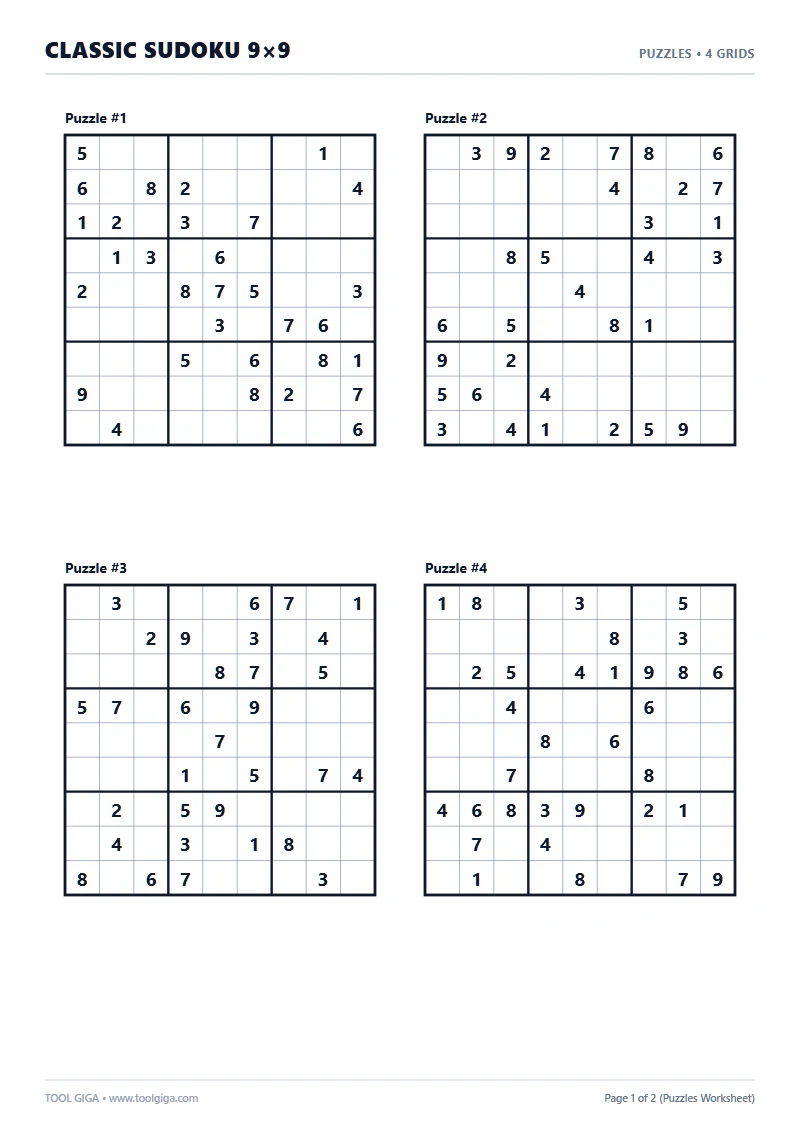
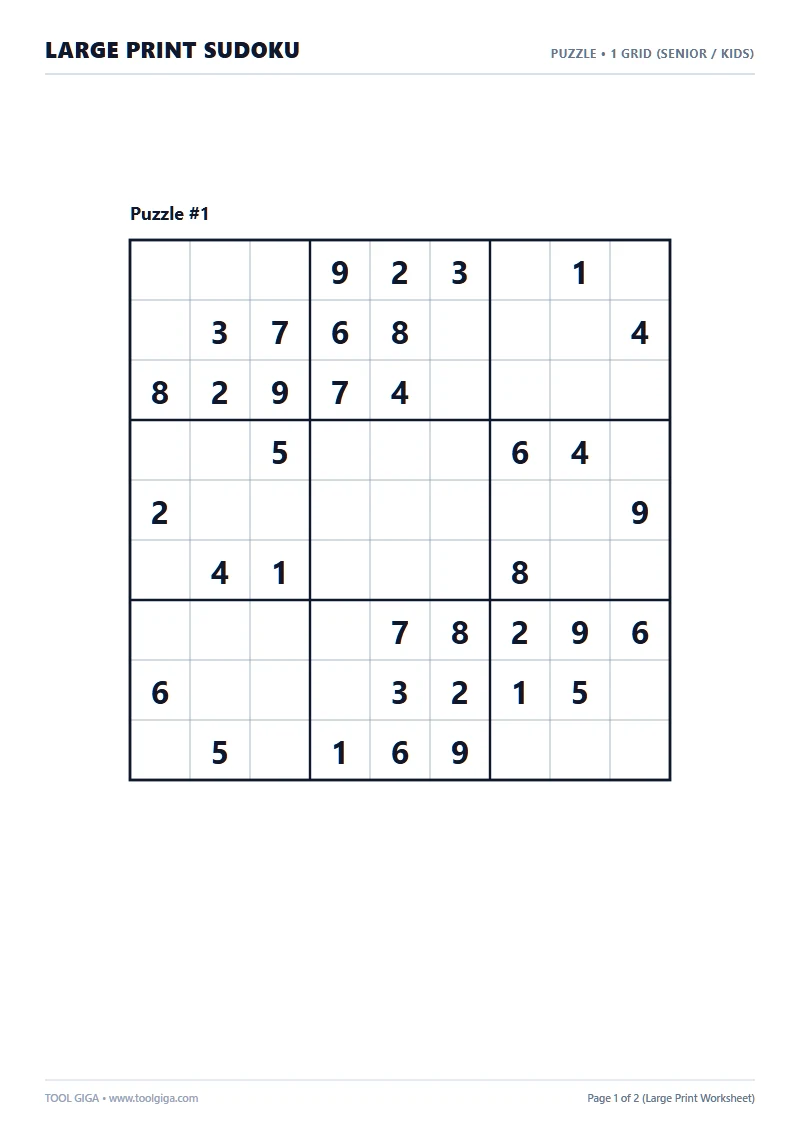
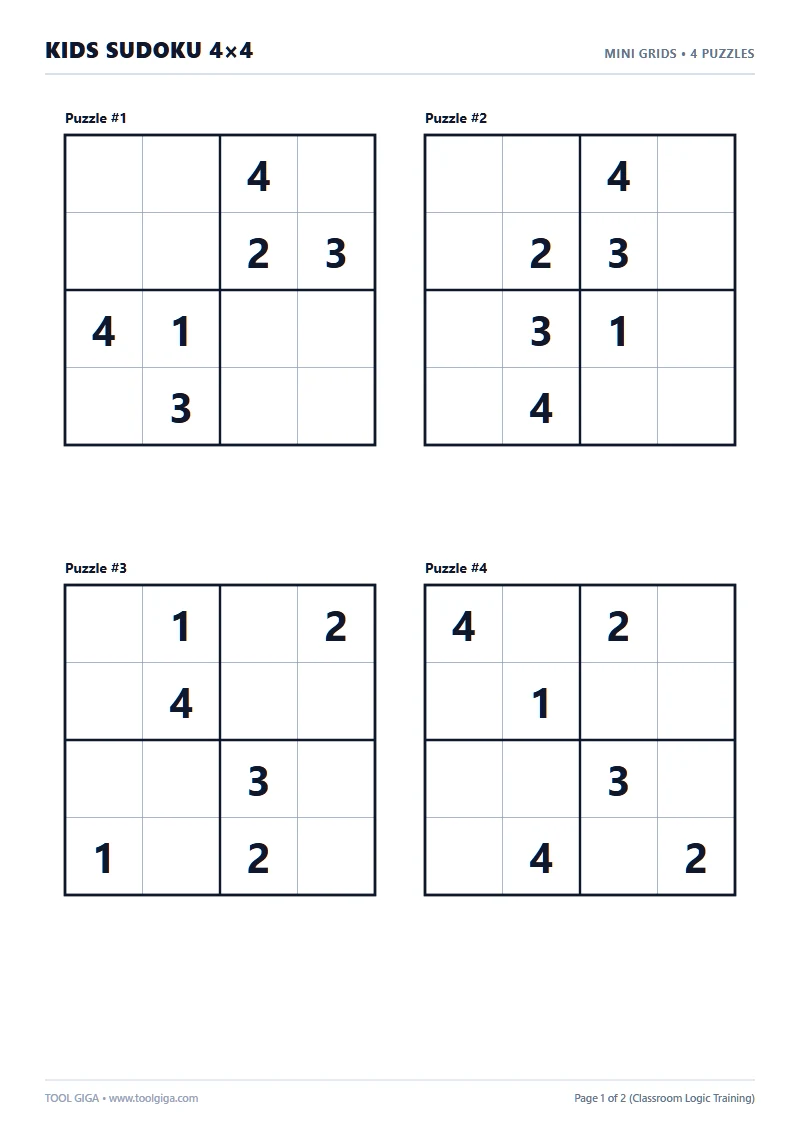
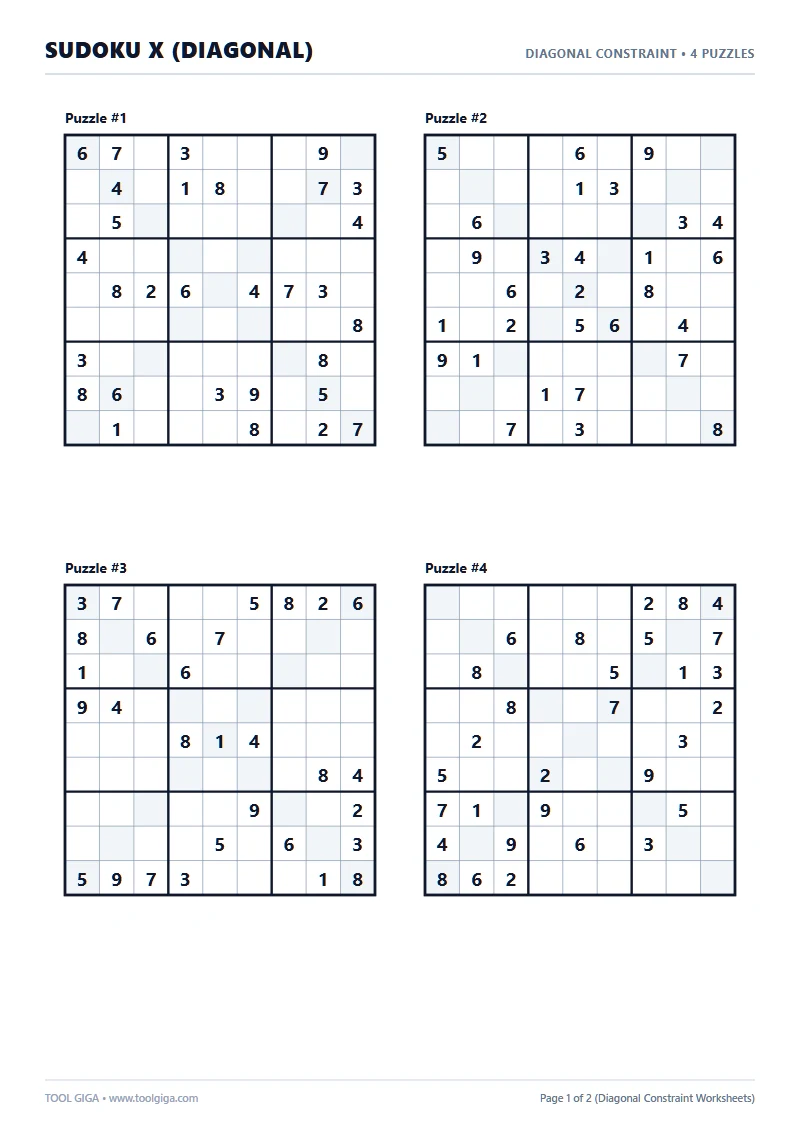
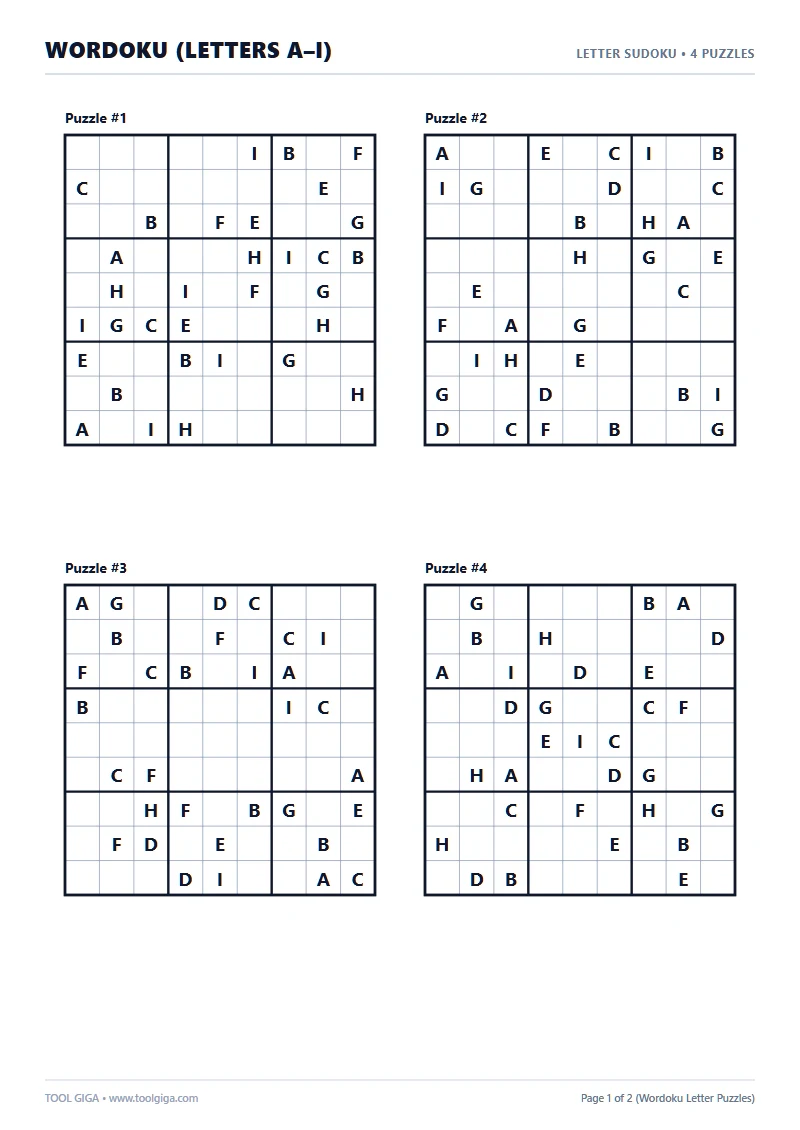
Printing raster bitmap images often bleeds through ordinary 80 gsm copy paper and drains black ink cartridges. Our generator outputs procedural hairline vector SVG paths formatted specifically for ISO A4 paper. You can arrange 1, 2, 4, or 6 puzzles per sheet for weekend travel, school math clubs, or senior center leisure. When "Include Answer Key" is checked, the browser automatically formats a second page containing miniature, completed solution grids separated by a clean CSS page break.