
What This Tool Does and How to Use It
This tool combines an instant Roman numeral converter with an A4 printable generator for school lessons and home study. Using the four tabs at the top, you can switch between reference tables, custom exercises, classroom wall posters, and quizzes:
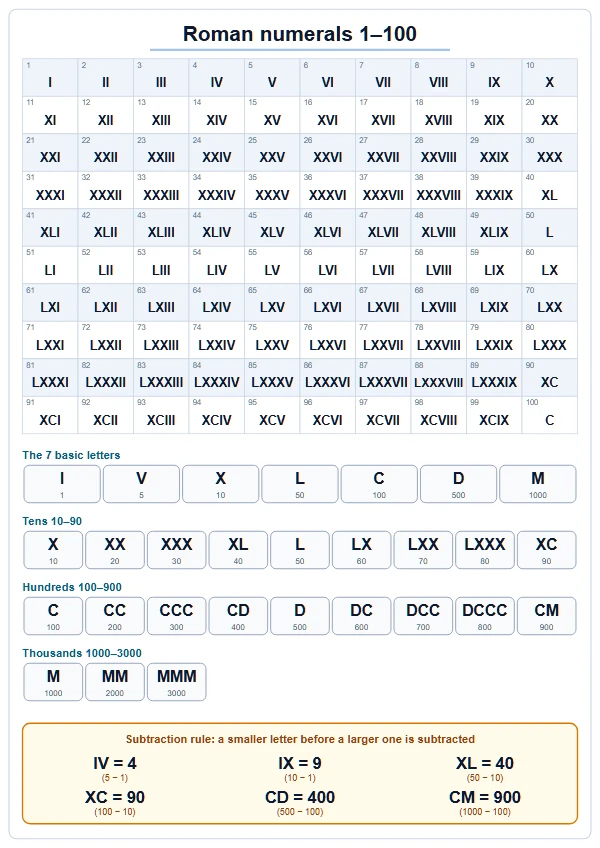
- 1. Chart 1–1000 & Converter (A4): Type any number from 1 to 3999 (or any valid Roman numeral from I to MMMCMXCIX) into the top box to see its conversion and step-by-step mathematical breakdown. Below the converter is a printable A4 reference sheet that can be set to a full 1–100 table with hundreds and thousands, a 1–20 visual chart for younger kids, a 1–50 grid, or 9 cut-out flashcards.
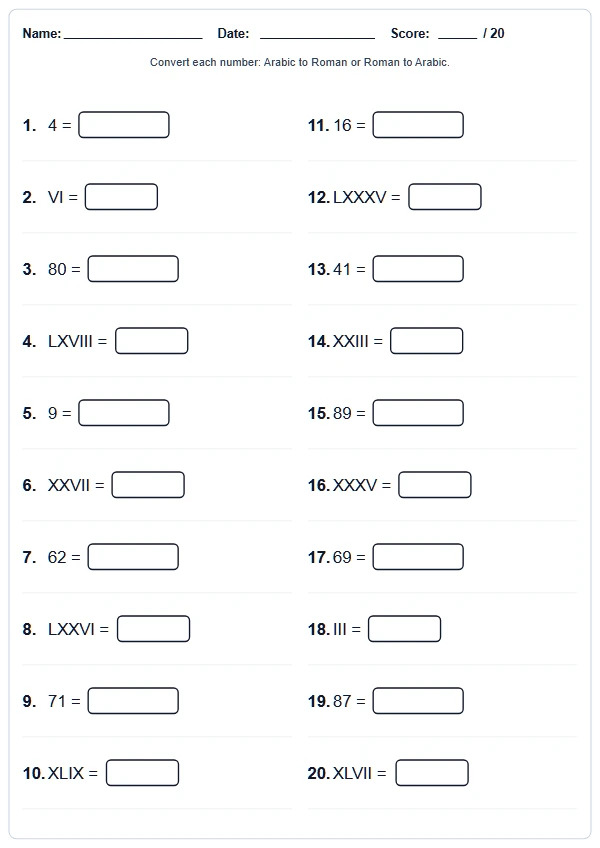
- 2. School Worksheets (A4 / PDF): Generates printable exercise sheets with 12, 20, 30, or 40 problems per page. You can choose Arabic-to-Roman conversion, Roman-to-Arabic conversion, mixed problems, addition and comparison exercises, or historical years and centuries across five difficulty ranges (up to 20, 50, 100, 1000, or 3999). Clicking Show answers displays the solution key in red directly on the sheet.
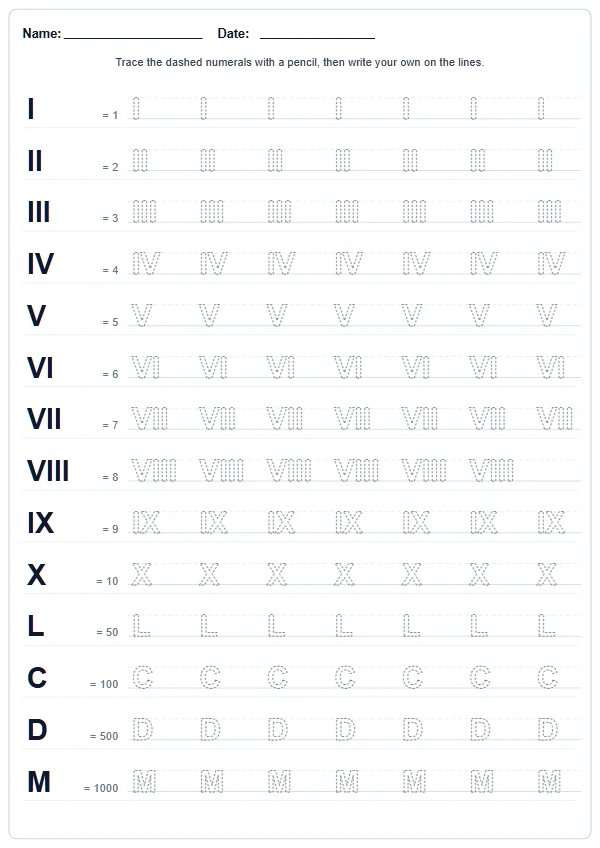
- 3. Full-Page Number Posters & Tracing (A4): Allows teachers and parents to print any single Roman numeral across an entire A4 page for classroom wall displays, print 2 or 4 large cards per sheet, or print a dotted-line handwriting tracing sheet for practicing I, V, X, L, C, D, and M.
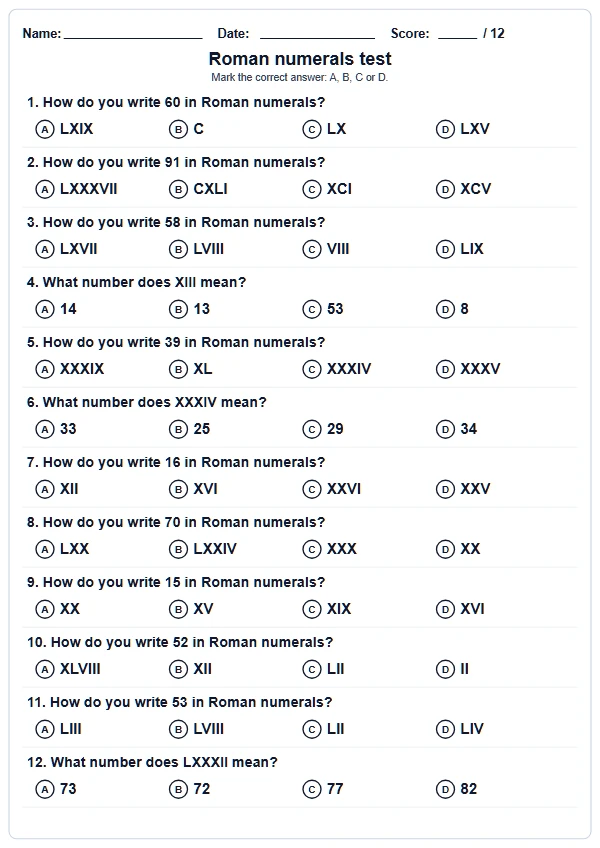
- 4. Interactive Quiz & A4 Test: Features a 10-question multiple-choice quiz right on the screen with instant rule explanations, plus a printable 12-question A4 bubble test for classroom assessments.
The 7 Basic Symbols and How the Rules Work
Unlike the modern Arabic decimal system, which uses ten digits (0–9) and place value, the Roman numeral system builds every number from just seven capital Latin letters:
- I = 1 (one)
- V = 5 (five)
- X = 10 (ten)
- L = 50 (fifty)
- C = 100 (one hundred, from the Latin word centum)
- D = 500 (five hundred)
- M = 1000 (one thousand, from the Latin word mille)
When teaching children to read and write Roman numerals, four core rules explain every number from 1 to 3999:
- Rule 1 – Addition (Bigger before Smaller): When a symbol of equal or lesser value appears after a larger symbol, their values are added together. For example, VI is 5 + 1 = 6, XII is 10 + 1 + 1 = 12, and CLV is 100 + 50 + 5 = 155.
- Rule 2 – Maximum of Three Repeats: The symbols I, X, C, and M can be repeated up to three times in a row (III = 3, XXX = 30, CCC = 300). The "five" symbols (V, L, and D) are never repeated because VV is already X (10) and LL is already C (100).
- Rule 3 – Subtraction (Smaller before Bigger): To avoid writing four identical letters in a row, a smaller unit placed immediately to the left of a larger unit is subtracted from it. Only six subtractive pairs exist in standard usage: IV (5 − 1 = 4), IX (10 − 1 = 9), XL (50 − 10 = 40), XC (100 − 10 = 90), CD (500 − 100 = 400), and CM (1000 − 100 = 900).
- Rule 4 – Decompose by Place Value: When converting a multi-digit number such as 1999, you never write MIM (2000 − 1). Instead, you break the number into thousands, hundreds, tens, and ones: 1000 (M) + 900 (CM) + 90 (XC) + 9 (IX) = MCMXCIX.
History and Origin: Shepherd Tally Sticks and Human Hands
Roman numerals did not begin as letters of the alphabet. Archaeological evidence shows that they evolved between the 8th and 6th centuries BC from the tally marks carved into wooden sticks by Etruscan and Italian shepherds counting livestock.
Instead of carving five identical vertical notches (|||||), which blur together when viewed from a distance, shepherds cut a single vertical notch for each animal (|, ||, |||, ||||) and marked every fifth notch with an angled double-cut resembling a V—mirroring the shape formed between the thumb and index finger of an open five-fingered hand. Every tenth notch was crossed all the way through like an X (two V symbols stacked point-to-point).
For larger numbers, the Etruscans and early Romans initially used special non-alphabetic geometric symbols derived from Western Greek Chalcidian signs: a three-pronged star for 100 and a circle bisected by a vertical line (Φ) for 1000. Over time, Roman stonecutters replaced these geometric tally marks with the closest-looking letters of the Latin alphabet: the vertical notch became I, the angled five-mark became V, the crossed ten-mark became X, the bottom half of the bisected 100-star became L (50), the curved hundred-mark merged with C (matching centum), half of the Φ symbol for 1000 became D (500), and the full Φ symbol evolved into M (matching mille).
Why Clocks Write IIII Instead of IV, and Why There Is No Zero
Two historical puzzles fascinate students learning Roman numerals for the first time:
1. Why did the Romans write IIII on the Colosseum and on clock faces? During the Roman Republic and early Empire, the subtractive rule (IV for 4) was rarely used on public monuments. The seventy-six numbered entrance arches of the Flavian Amphitheatre (the Colosseum, built in 80 AD) are carved with IIII for Gate 4, VIIII for Gate 9, and XLIIII for Gate 44. Ancient Romans also avoided carving IV on sundials and public stones because IV were the first two letters of IVPPITER (Jupiter), the king of the Roman gods. On modern analog clock dials, watchmakers still prefer IIII over IV for visual symmetry: doing so divides the dial into three balanced groups of four numbers—four numbers with I (I, II, III, IIII), four with V (V, VI, VII, VIII), and four with X (IX, X, XI, XII)—where IIII visually counterbalances the wide VIII on the opposite side of the face.
2. Why is there no Roman numeral for 0 (Zero) or numbers above 3999? Because Roman numerals are an additive tally system rather than a positional system, they do not need a zero placeholder to distinguish 10 from 100 (those are simply X and C). When medieval scholars needed to express "nothing", they wrote the Latin word nulla ("none") or its initial N. For numbers of 4,000 and above, Romans used the vinculum—a horizontal bar drawn above a numeral that multiplied its value by 1,000 (so V with an overline equaled 5,000, and M with an overline equaled 1,000,000).