
How the 3-Mode Greek Alphabet Quiz, 80-SVG Reference Catalog & Isopsephy Scribe Work
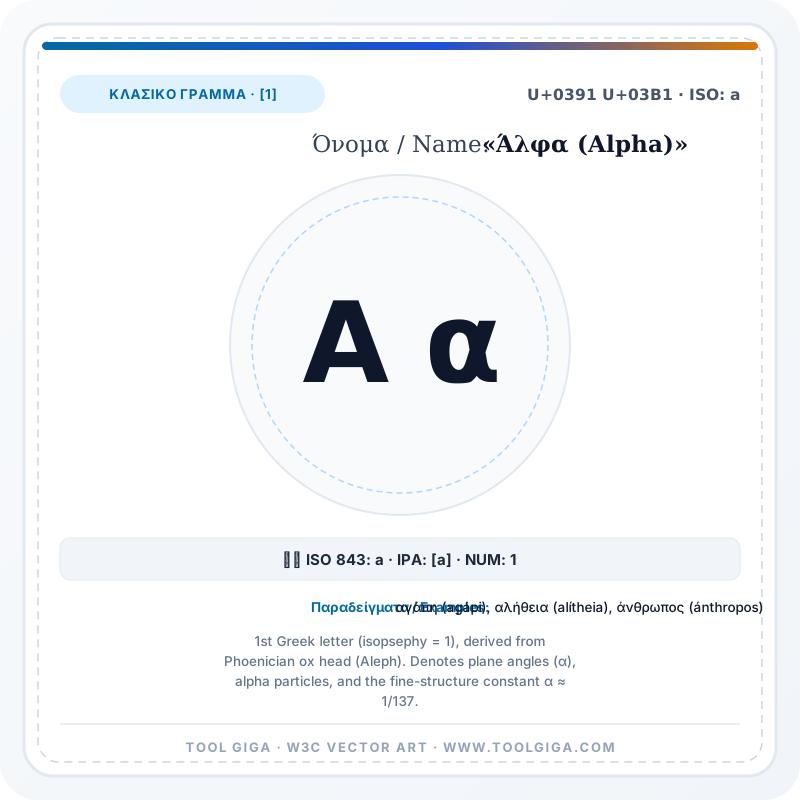
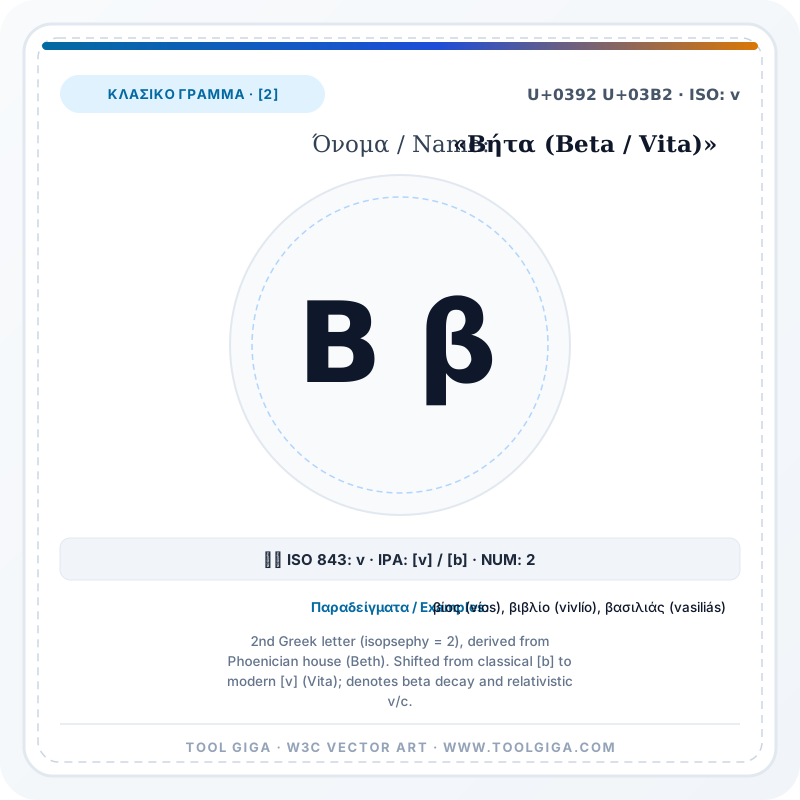
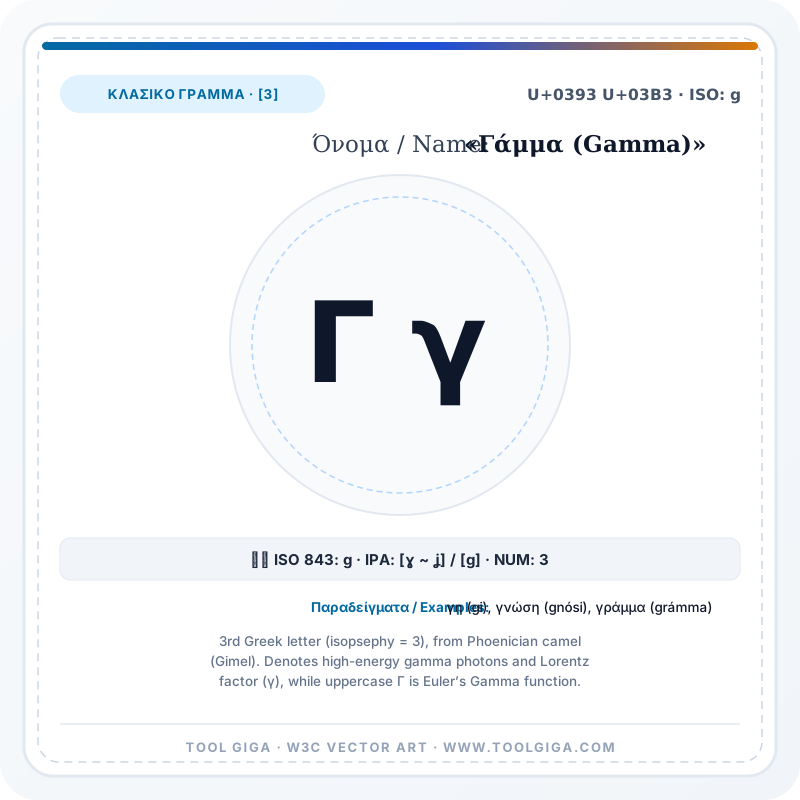
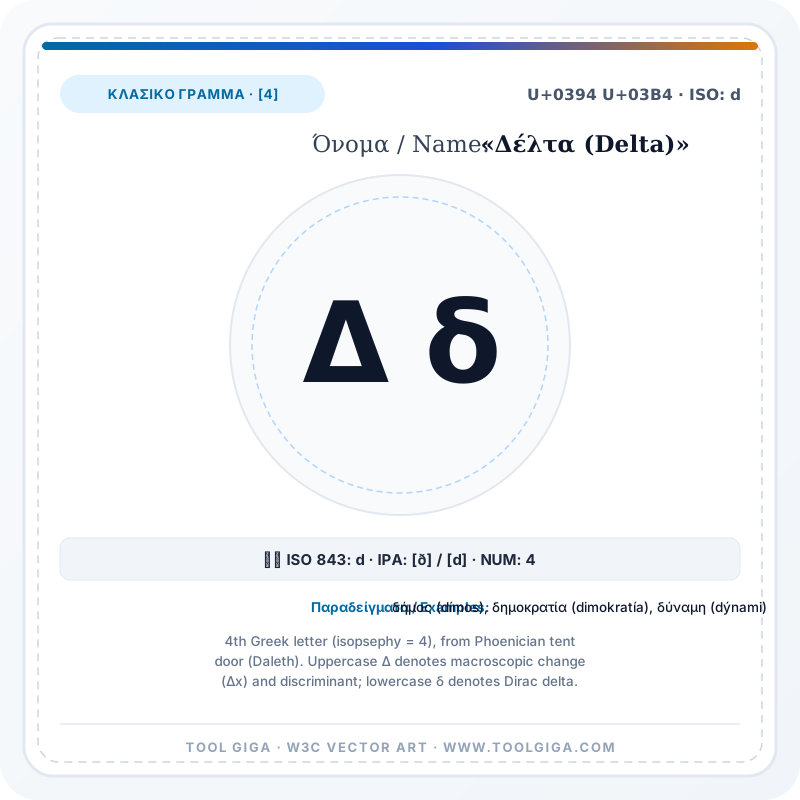
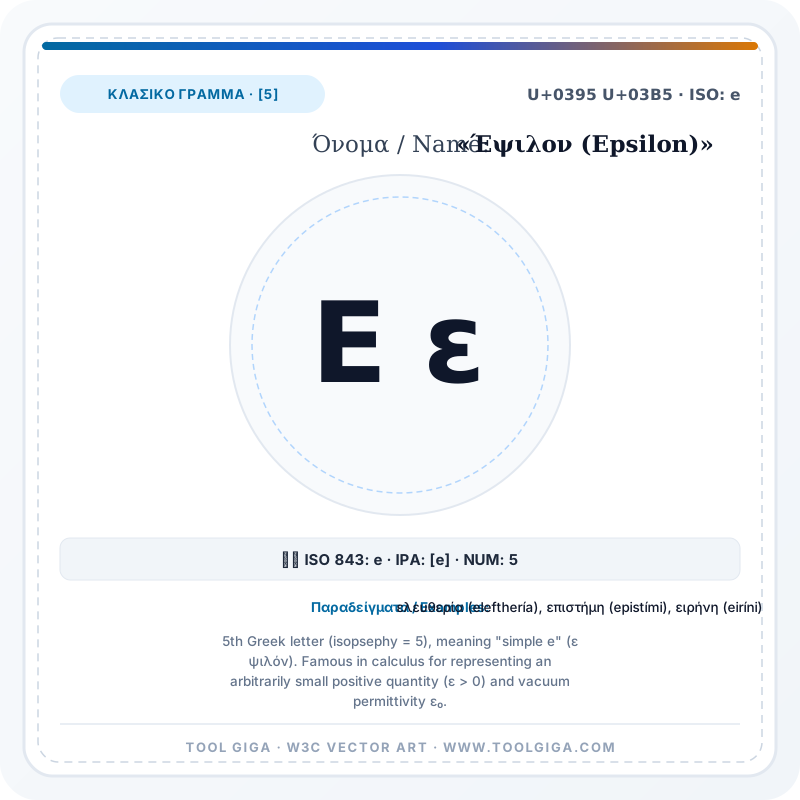
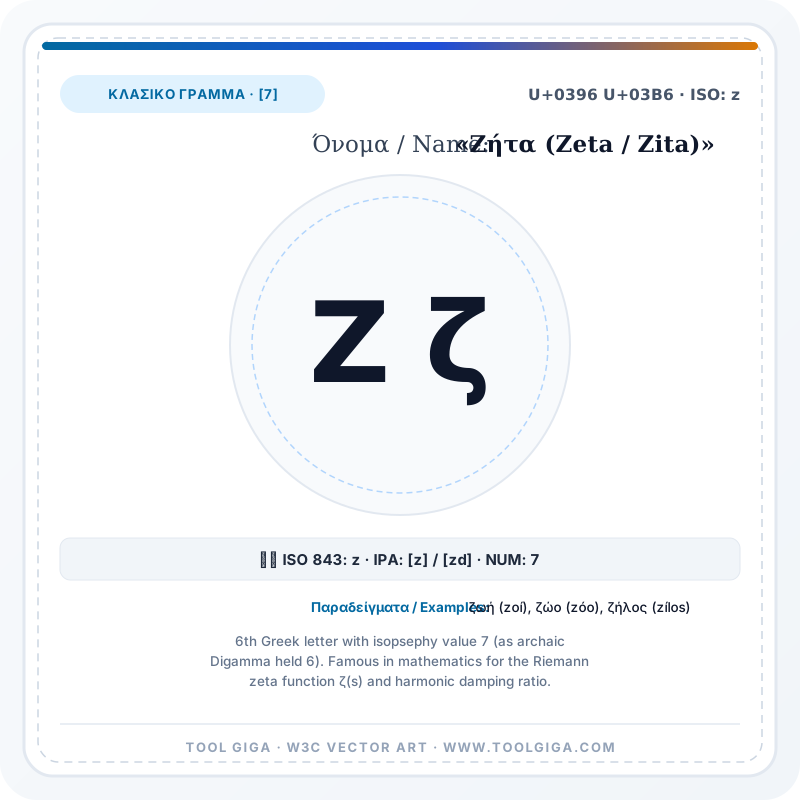
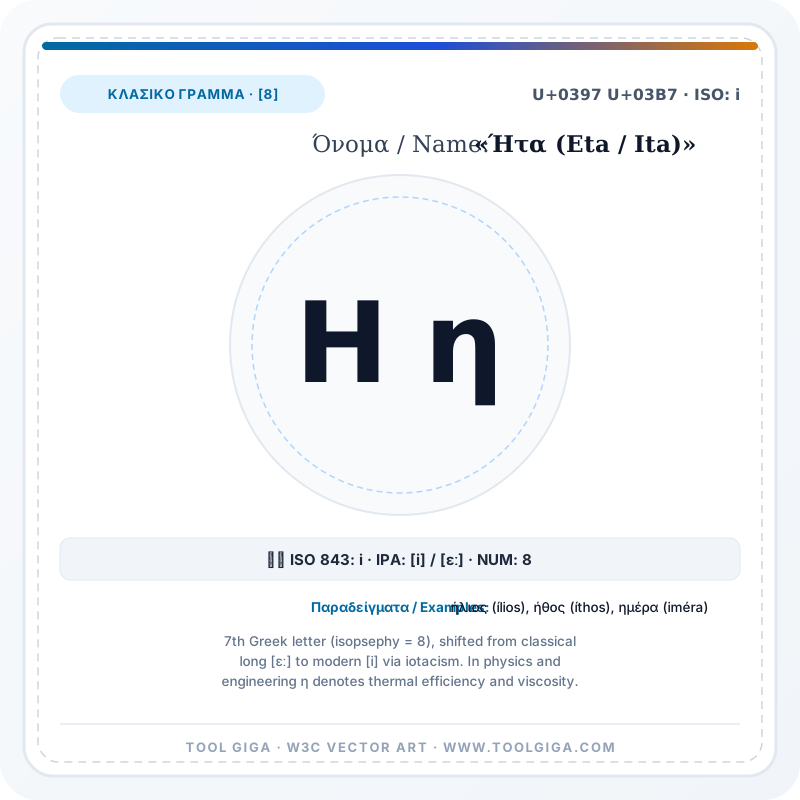
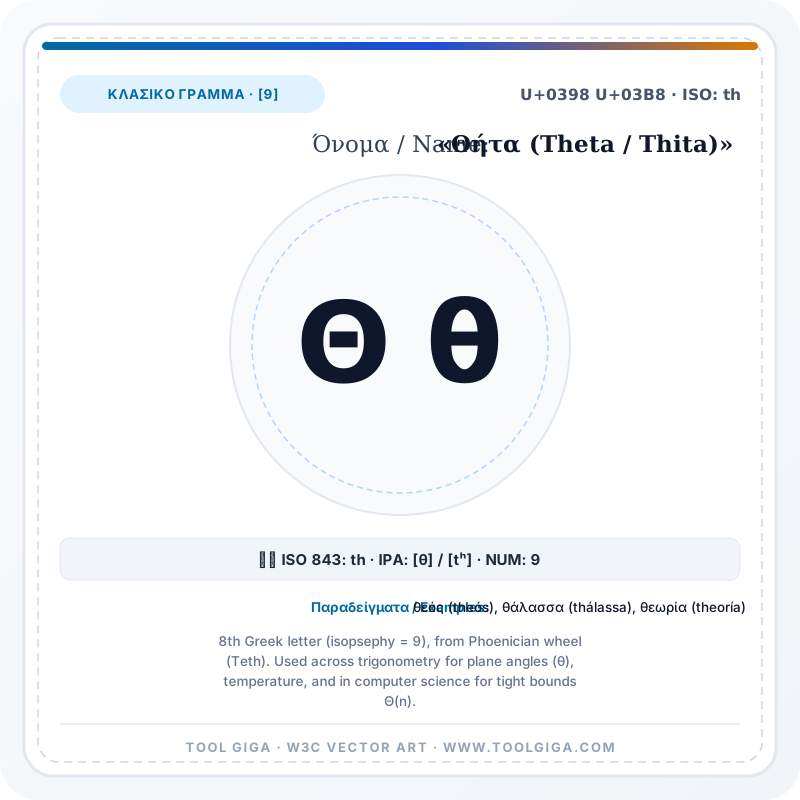
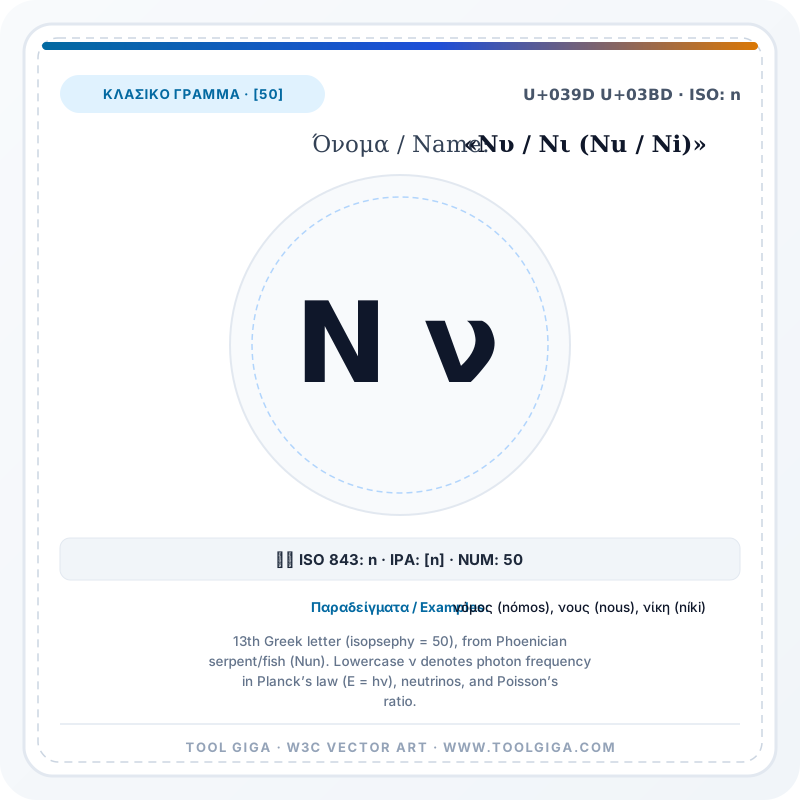
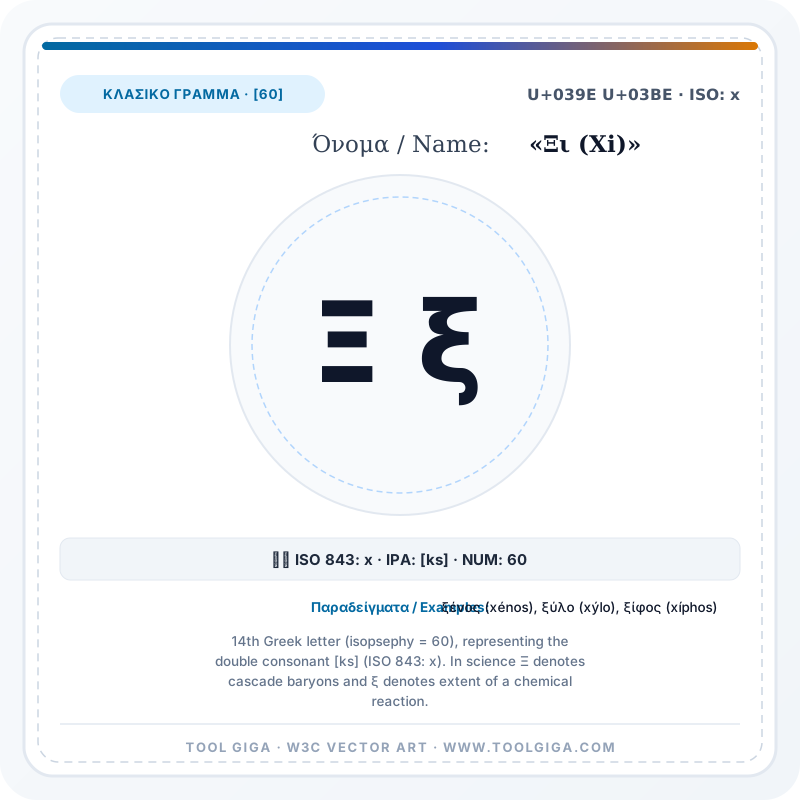
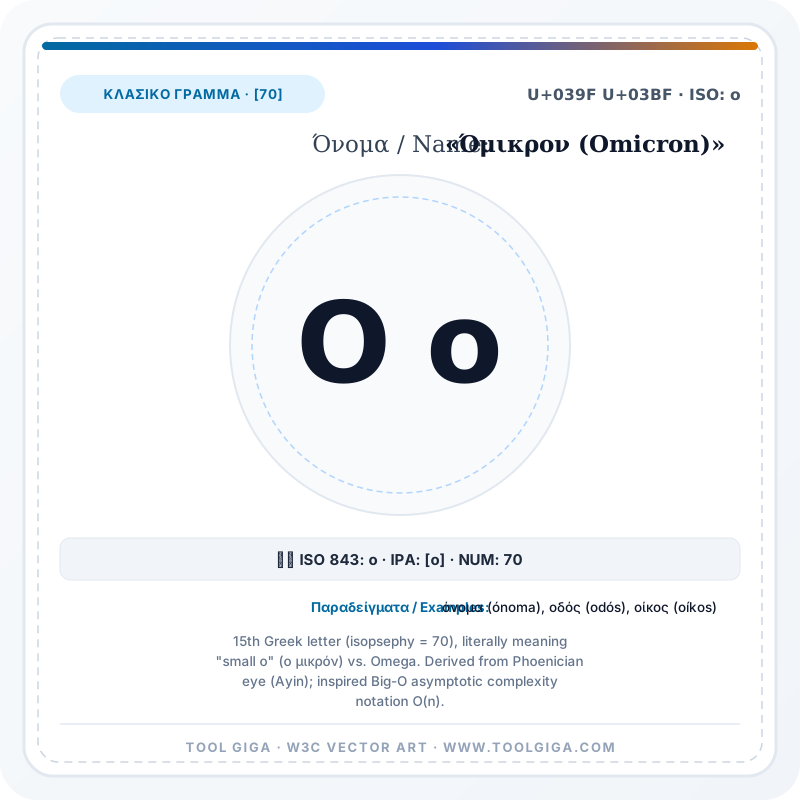
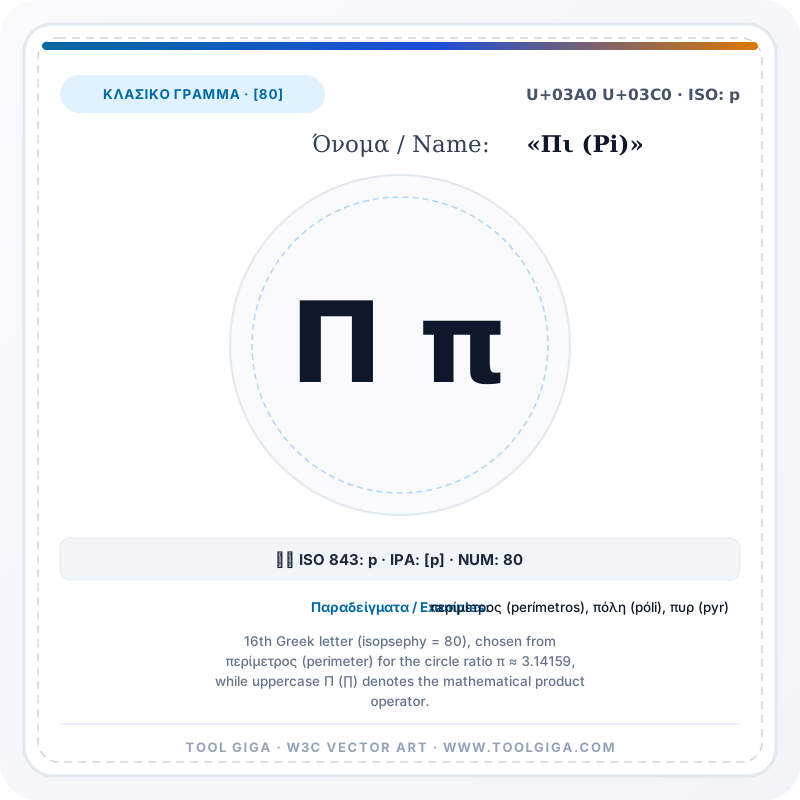
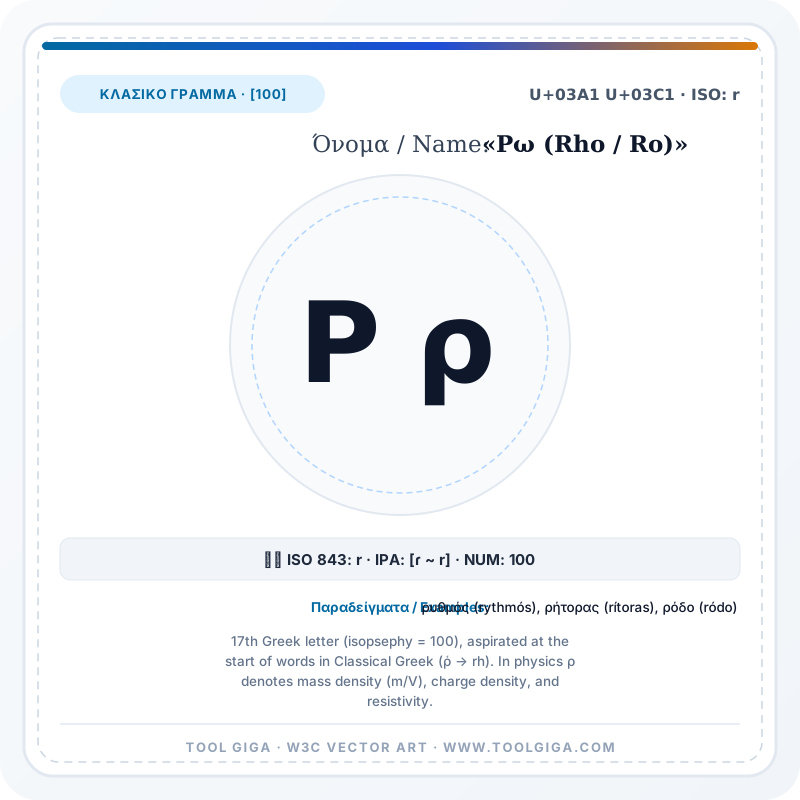
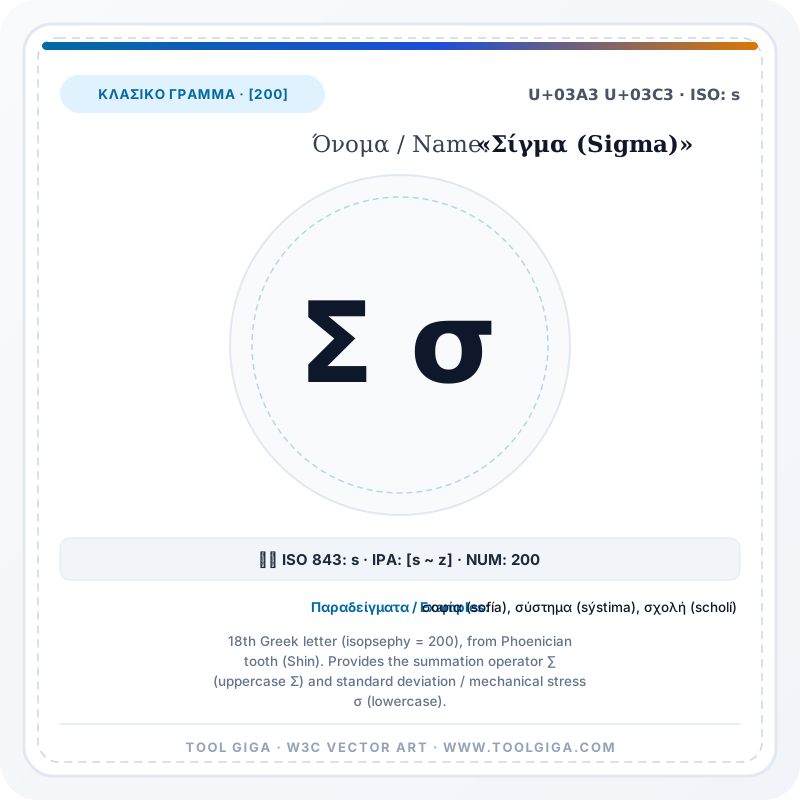
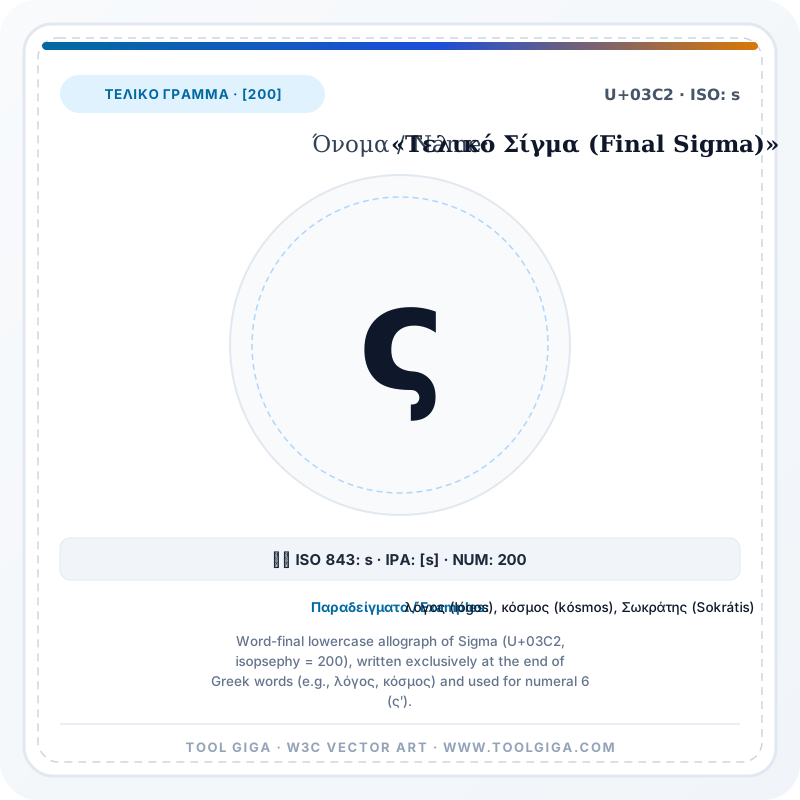
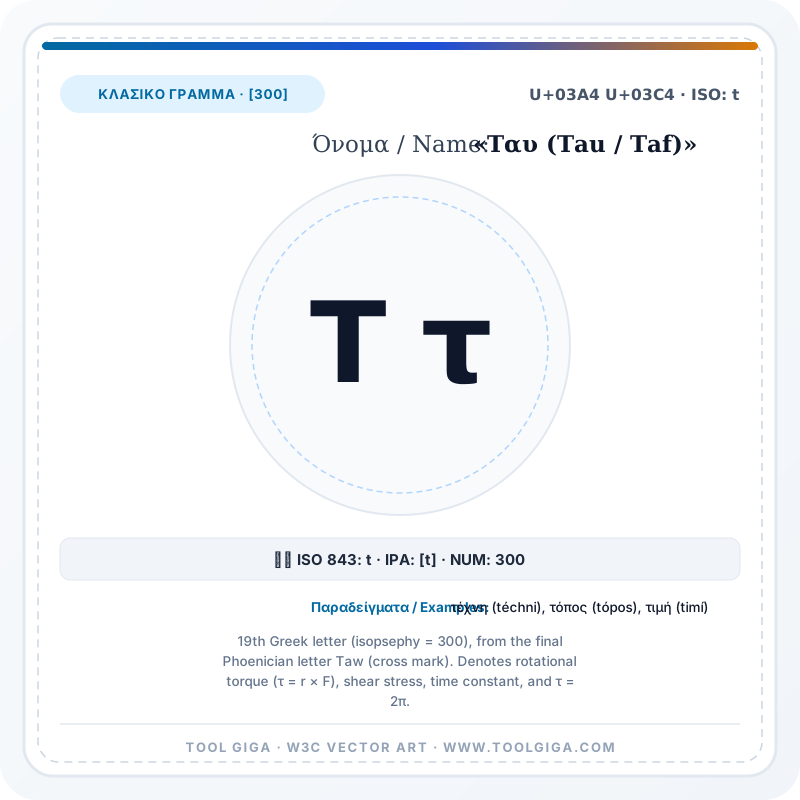
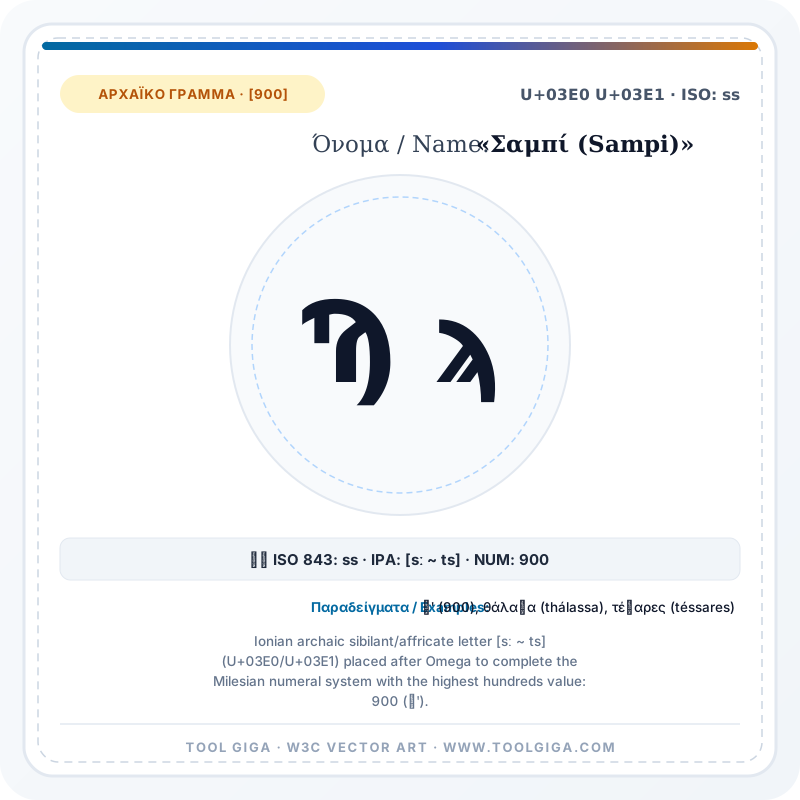
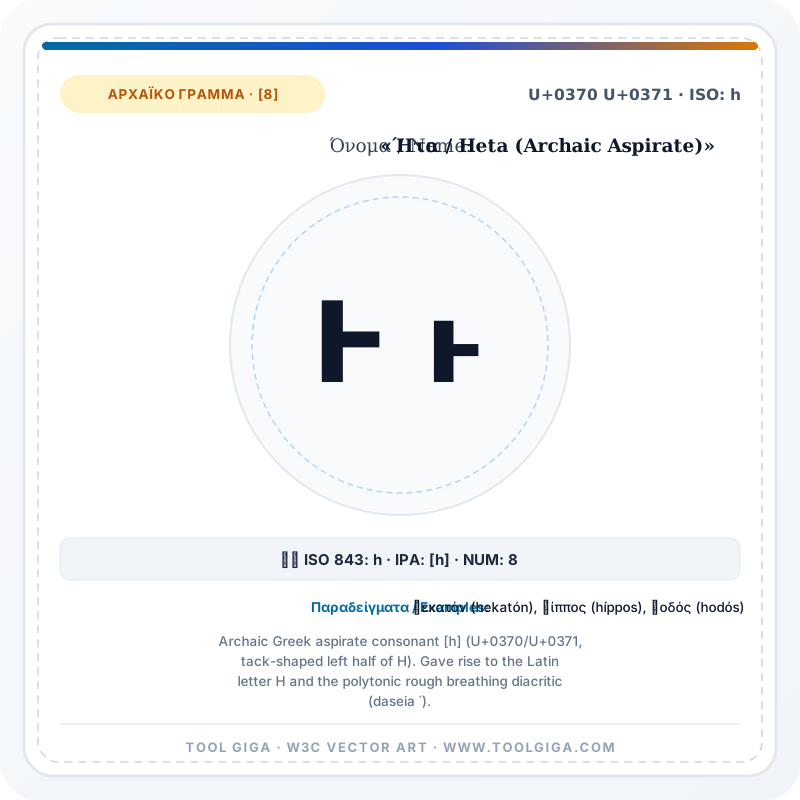
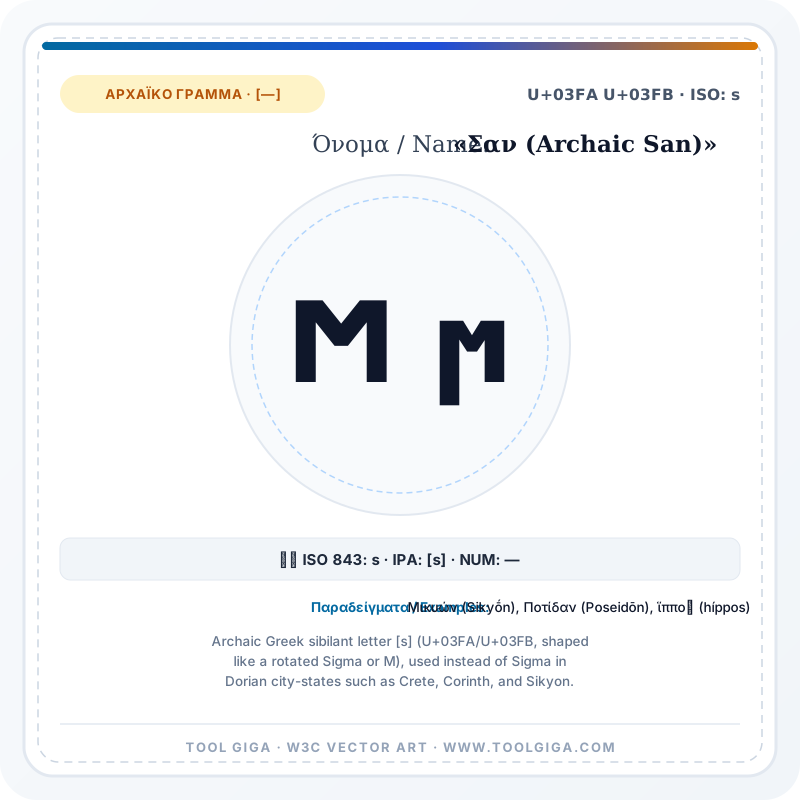
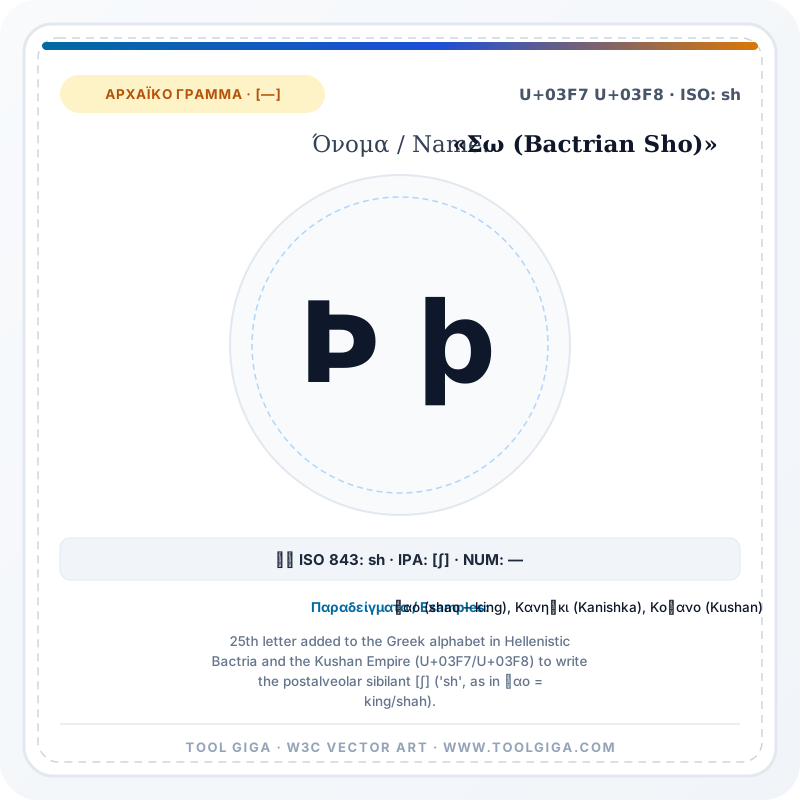
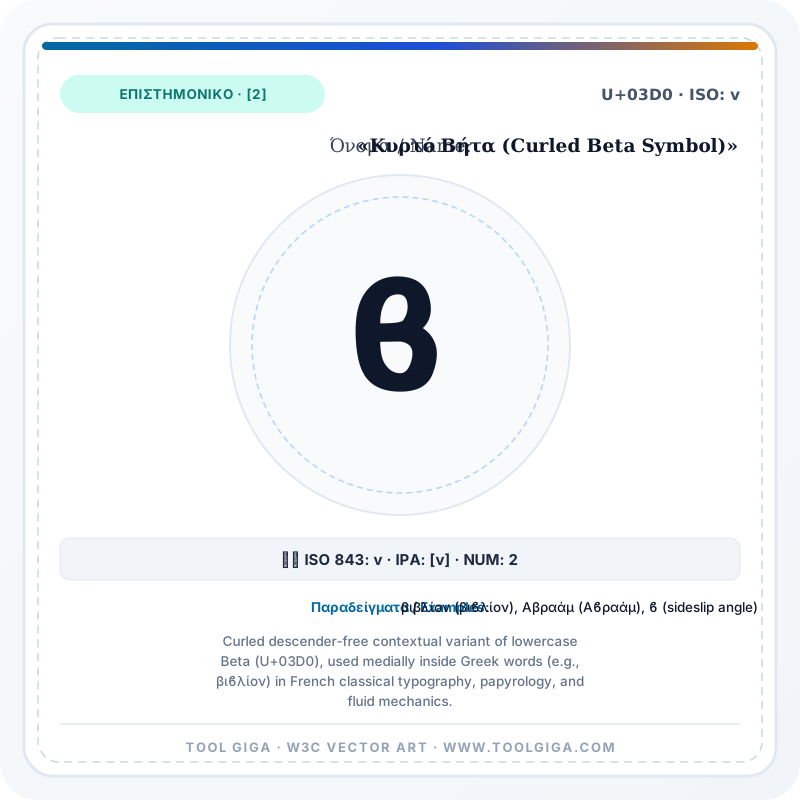
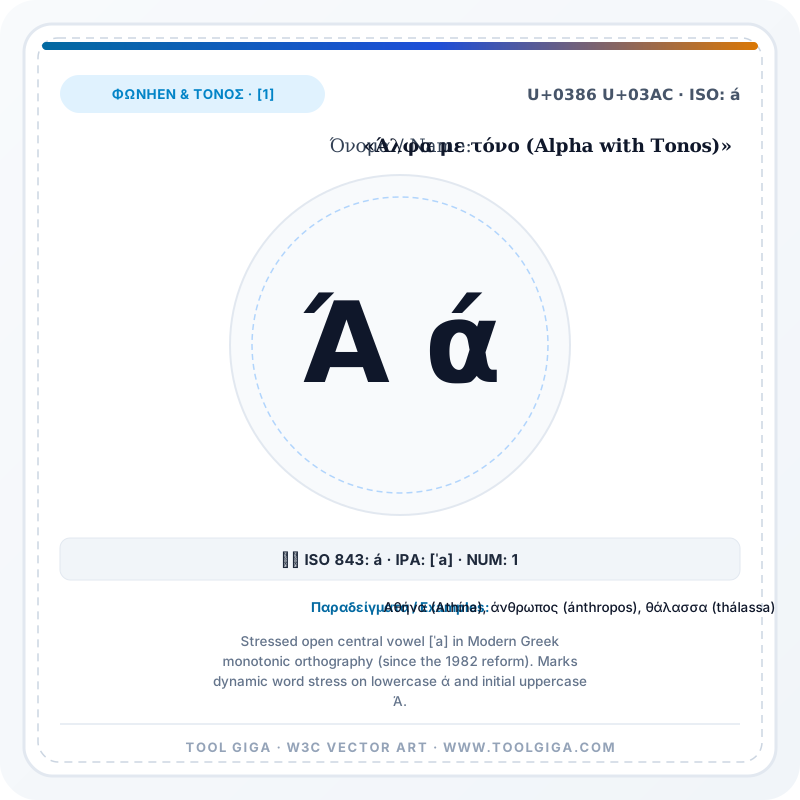
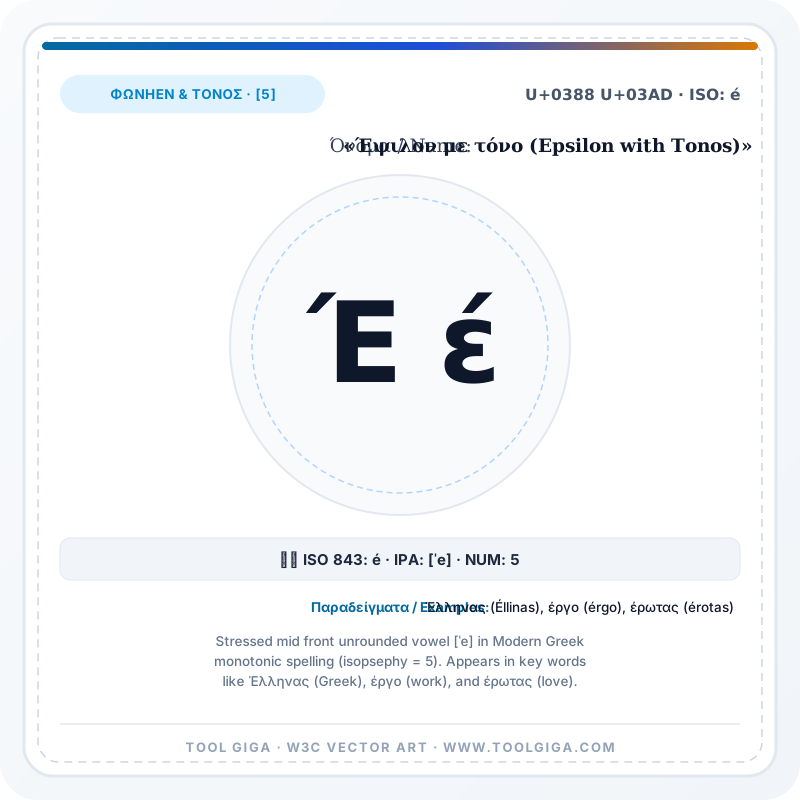
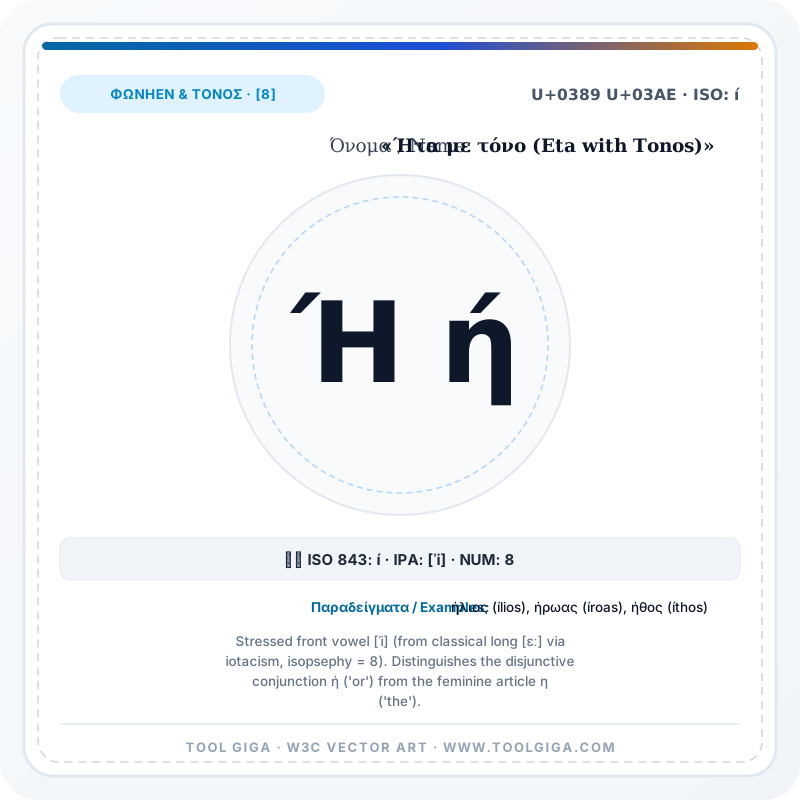
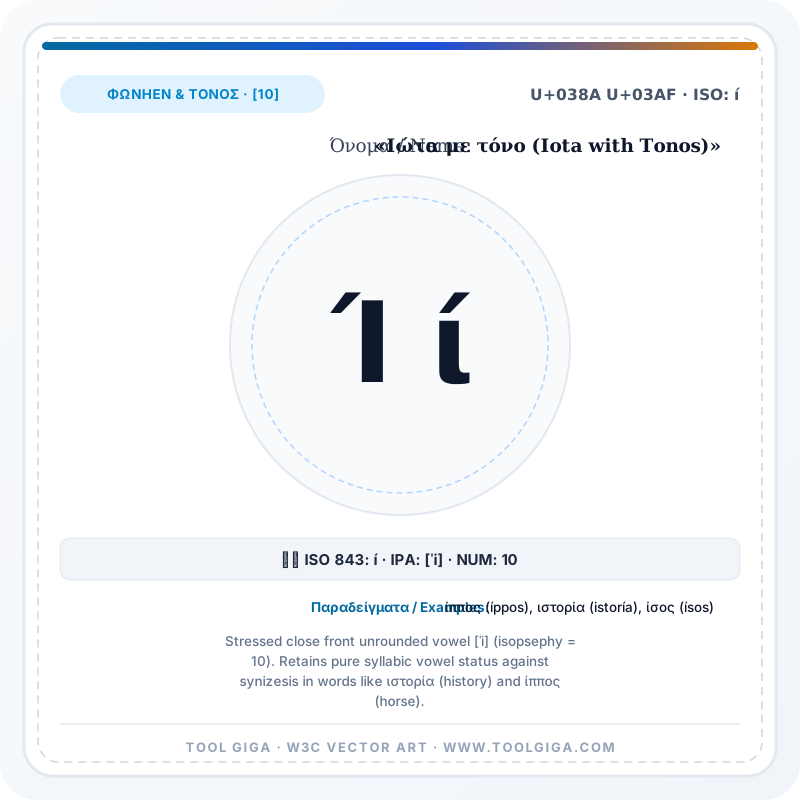
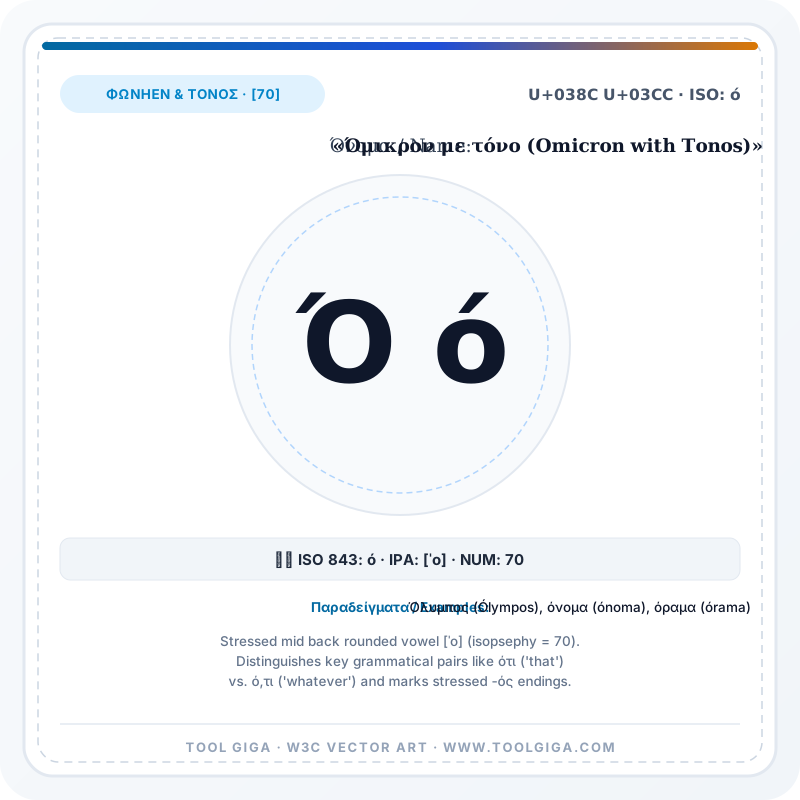
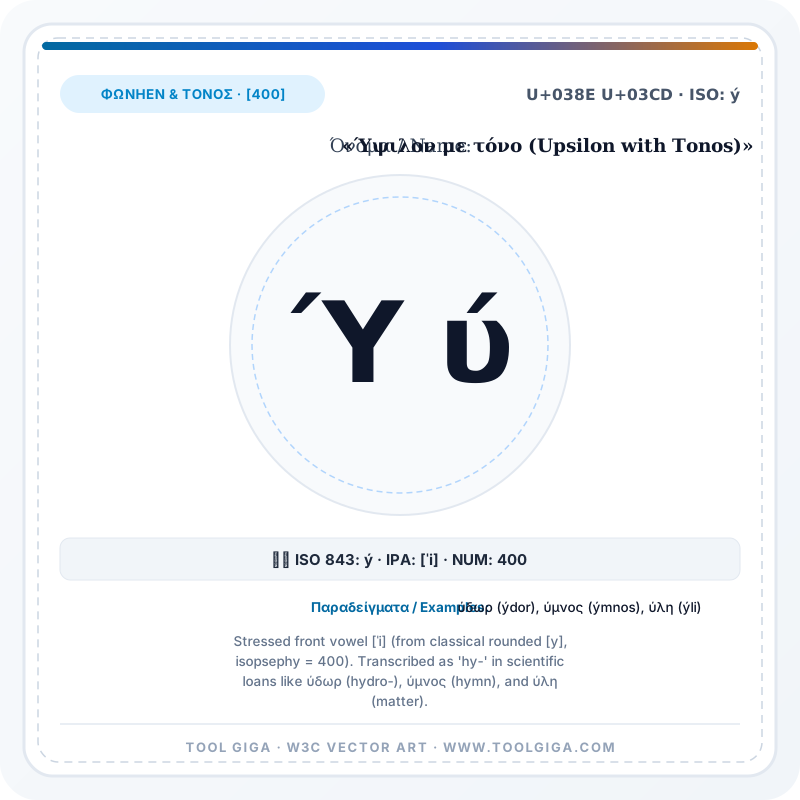
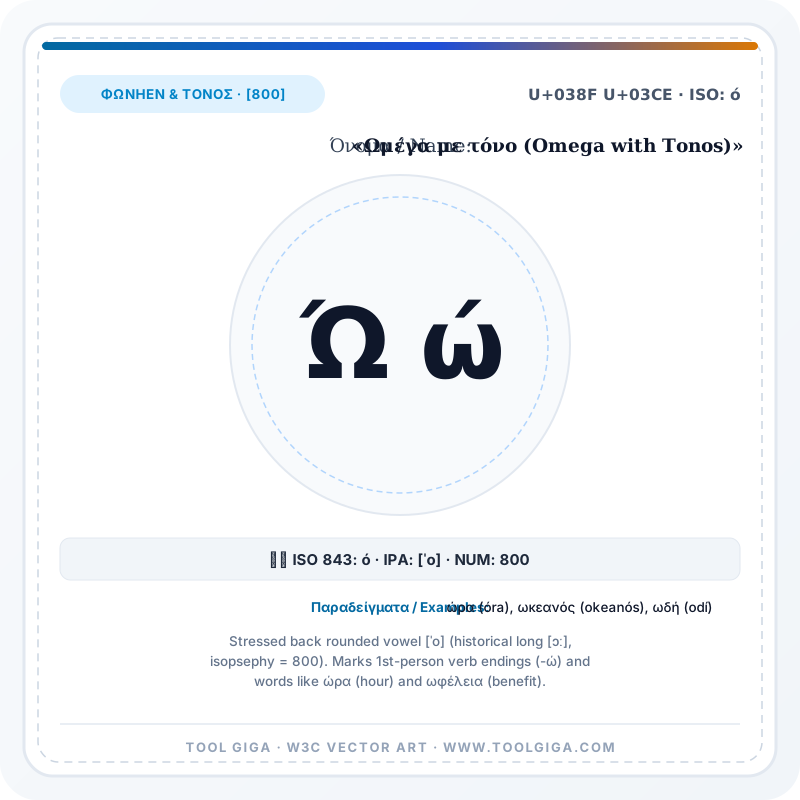
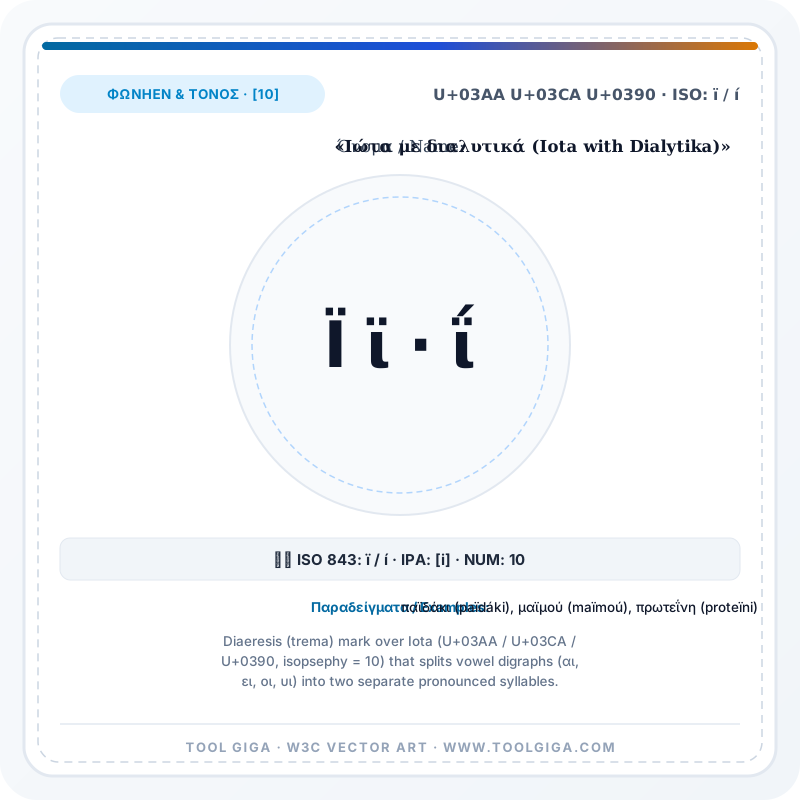
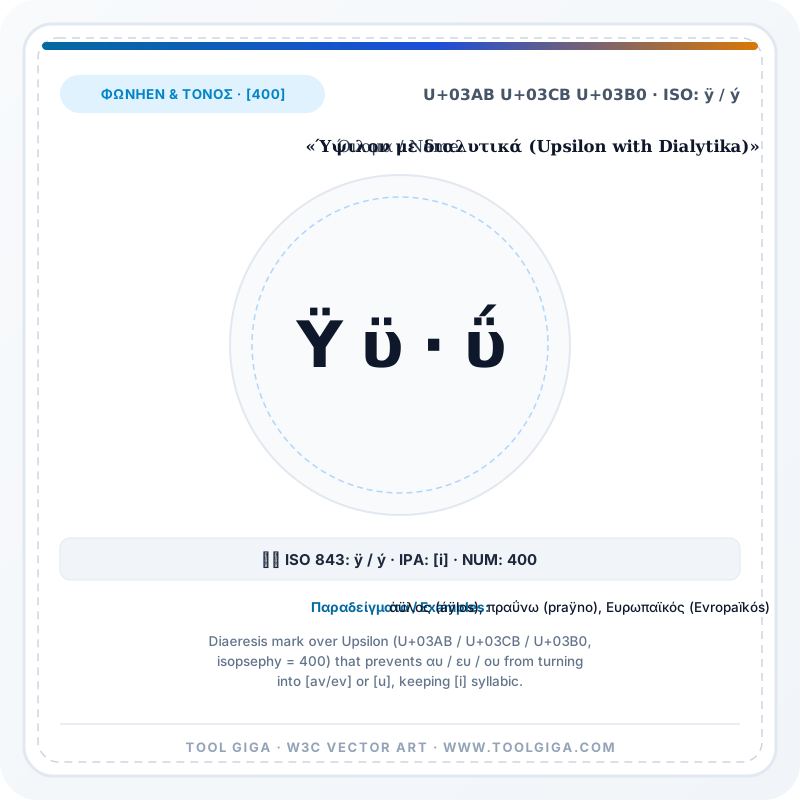
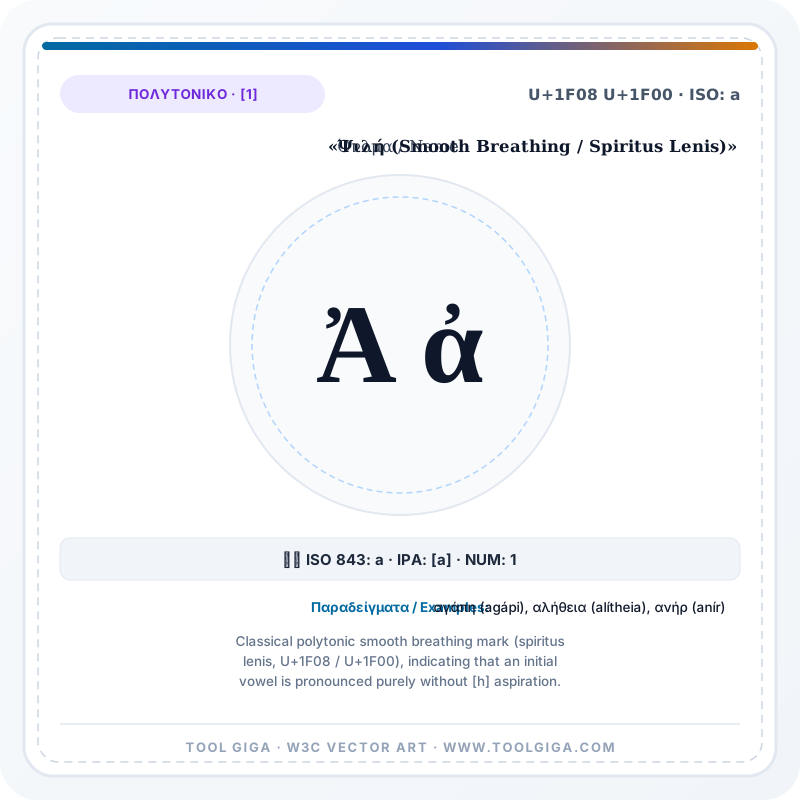
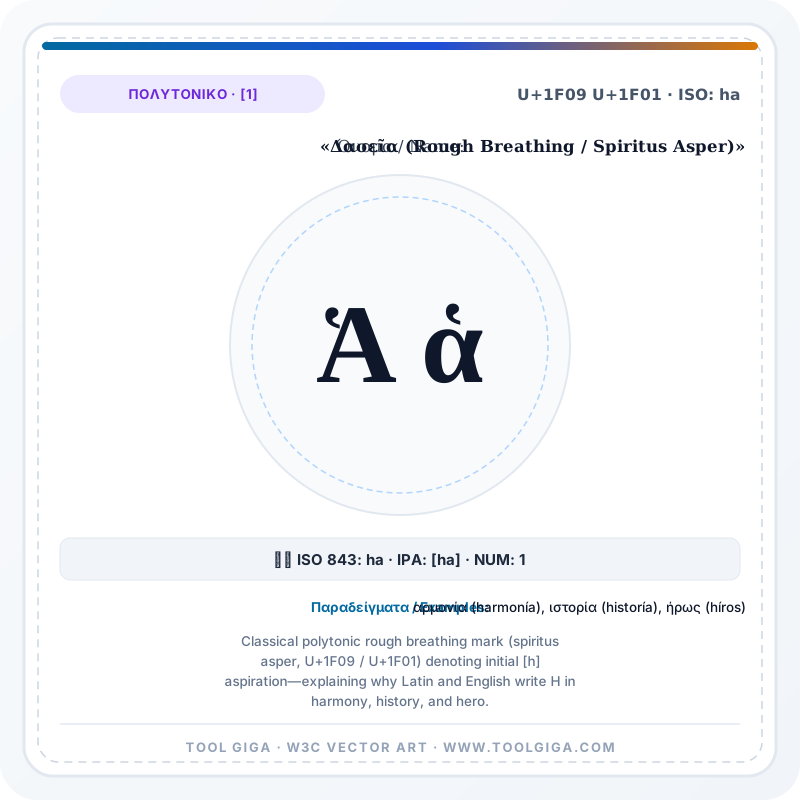
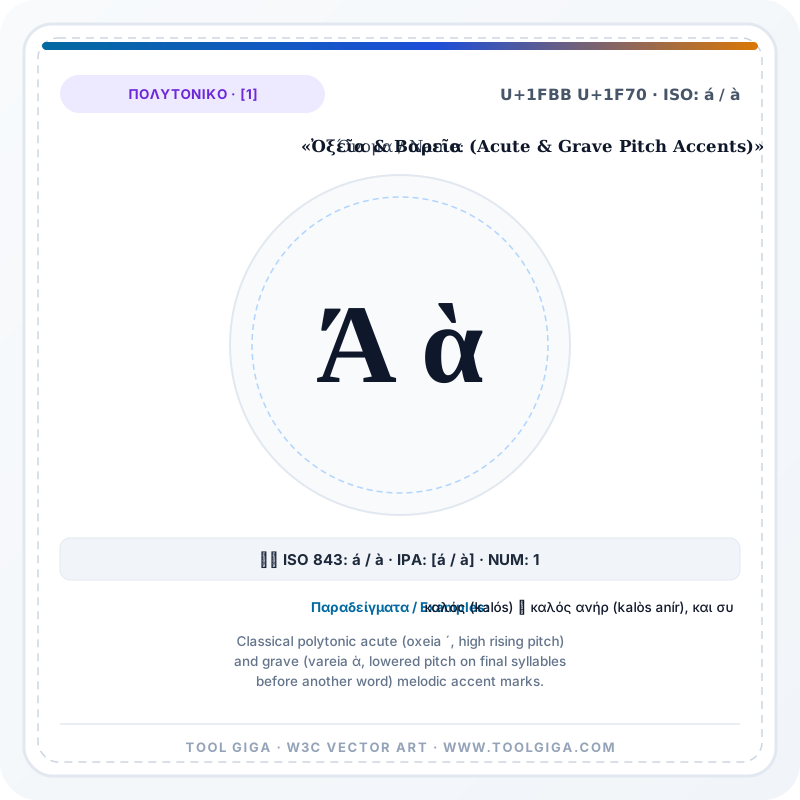
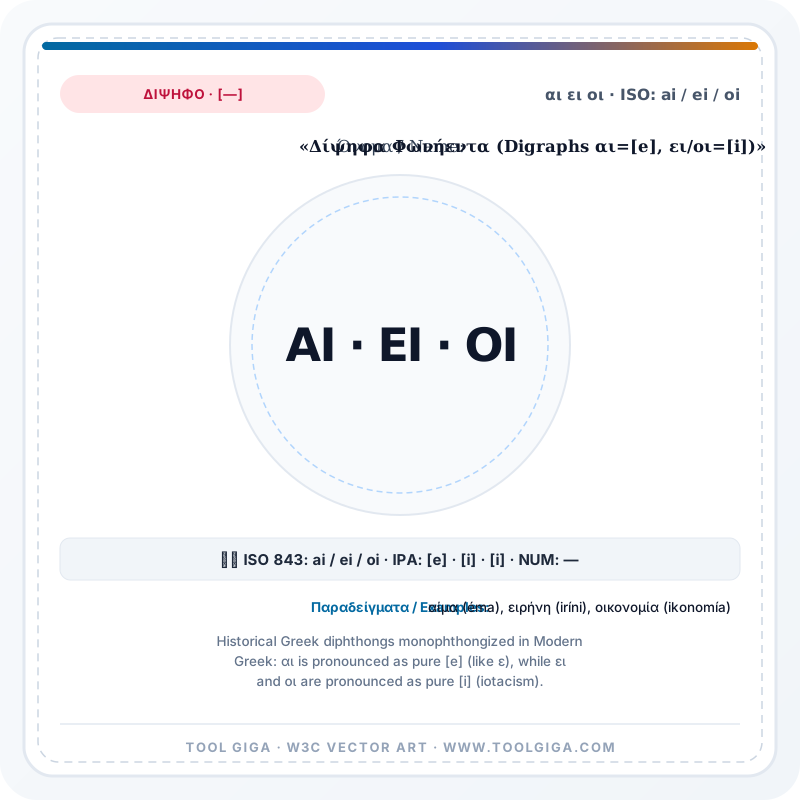
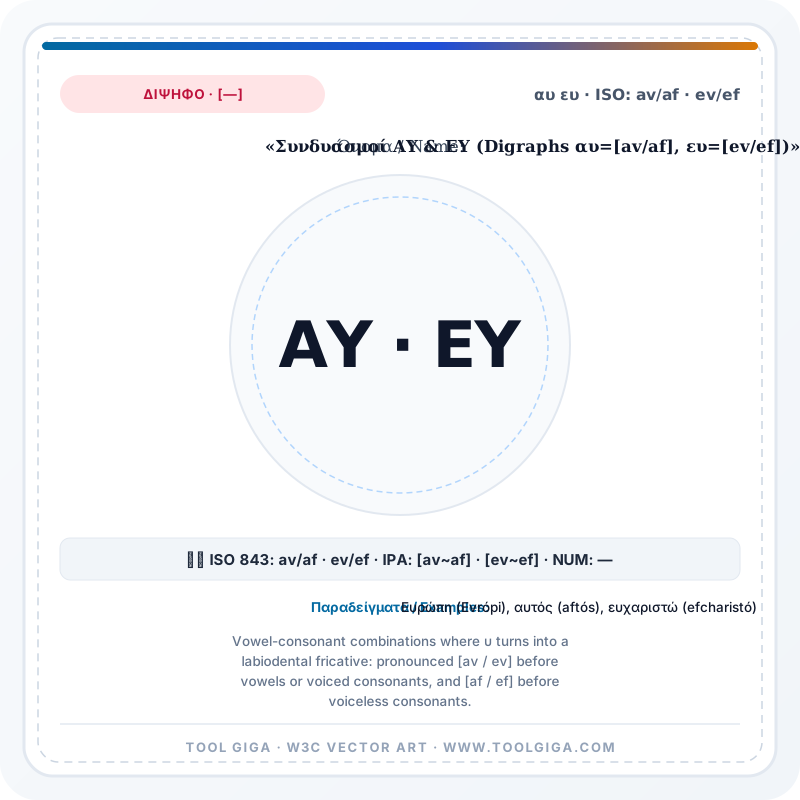
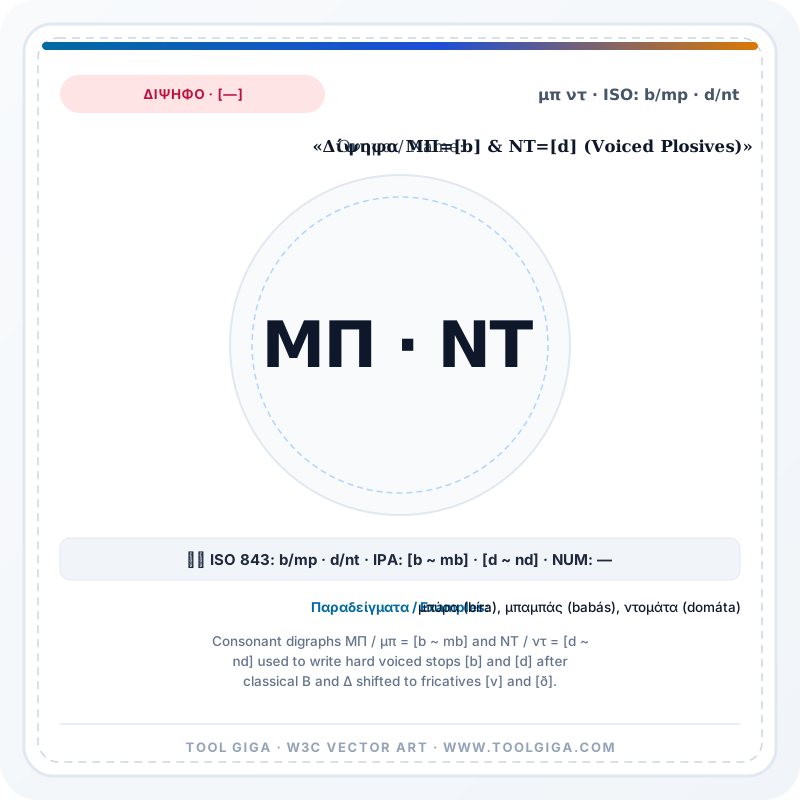
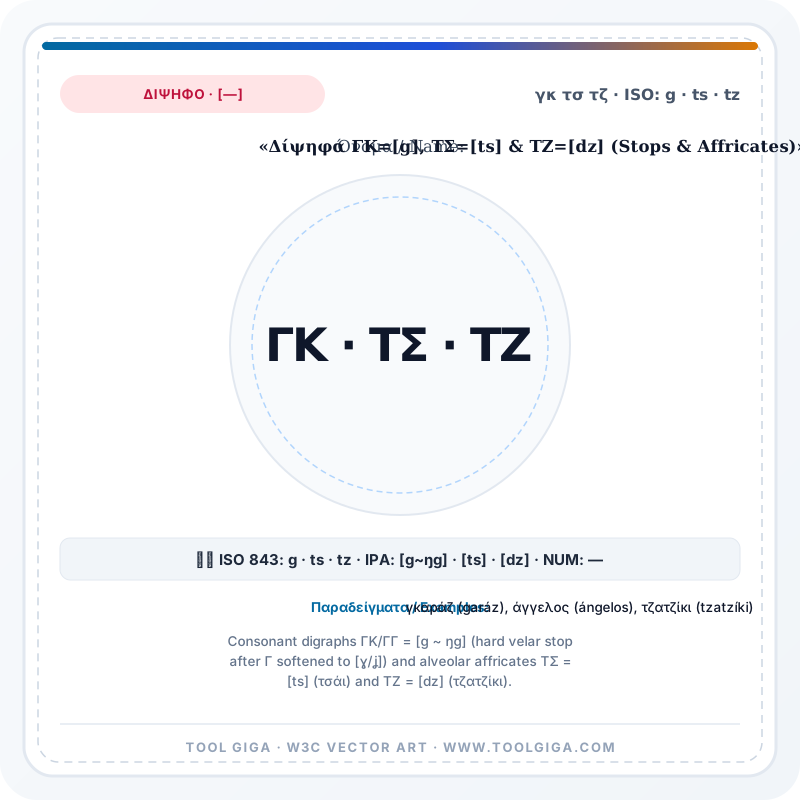
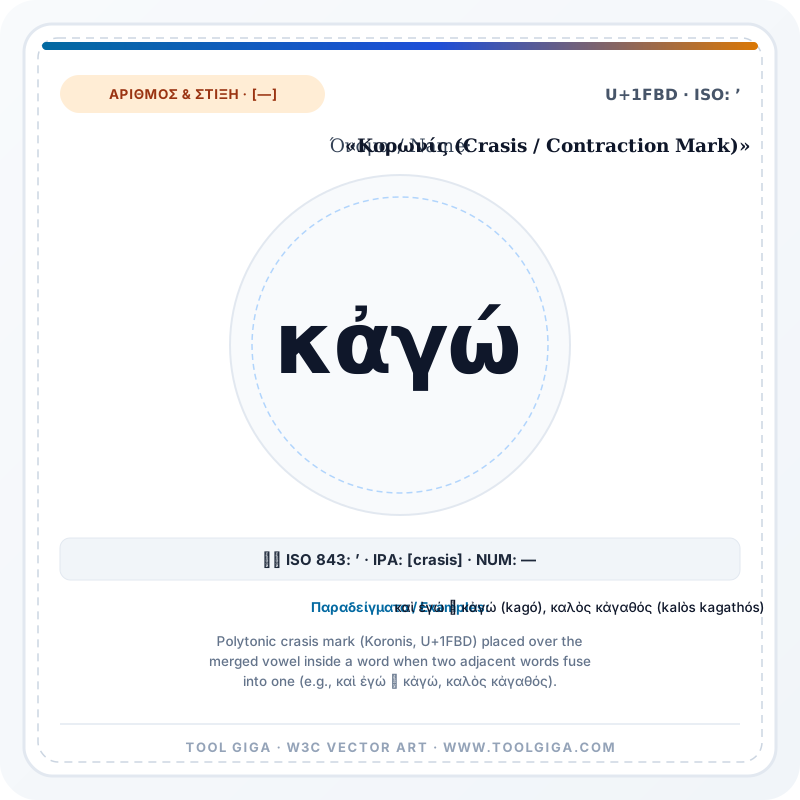
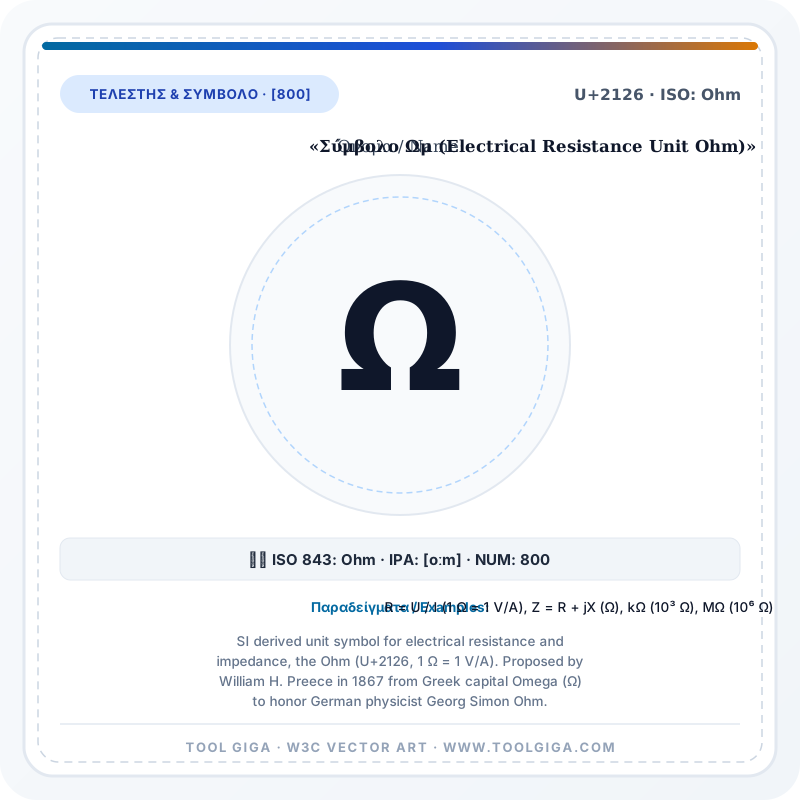
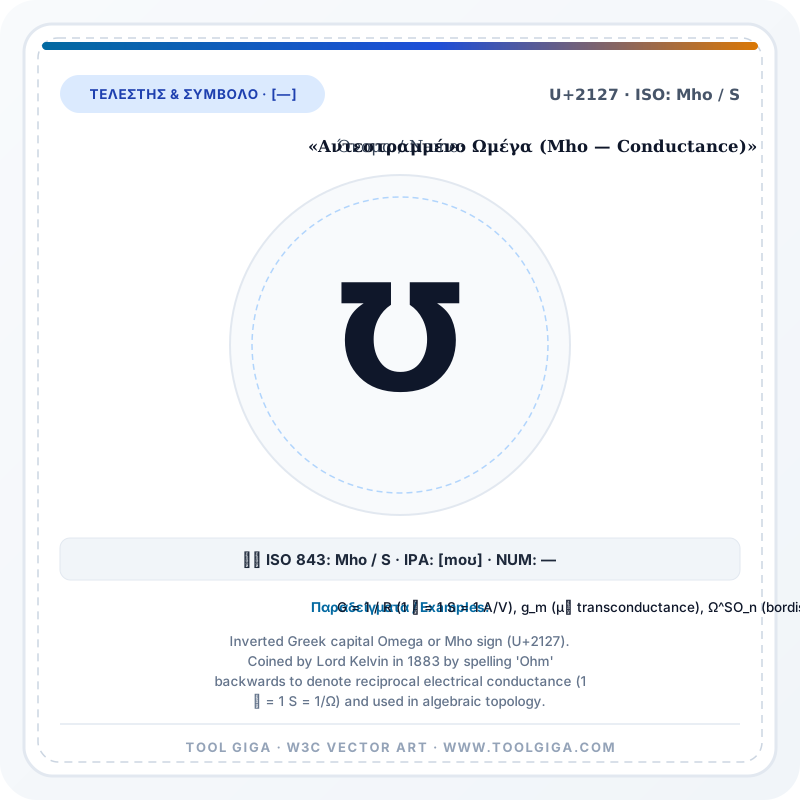
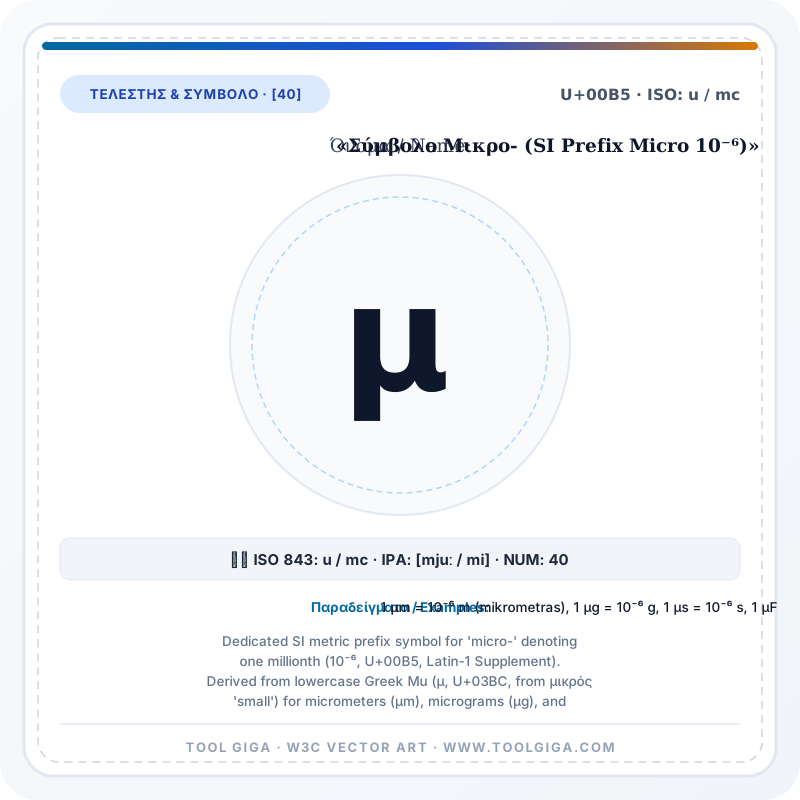
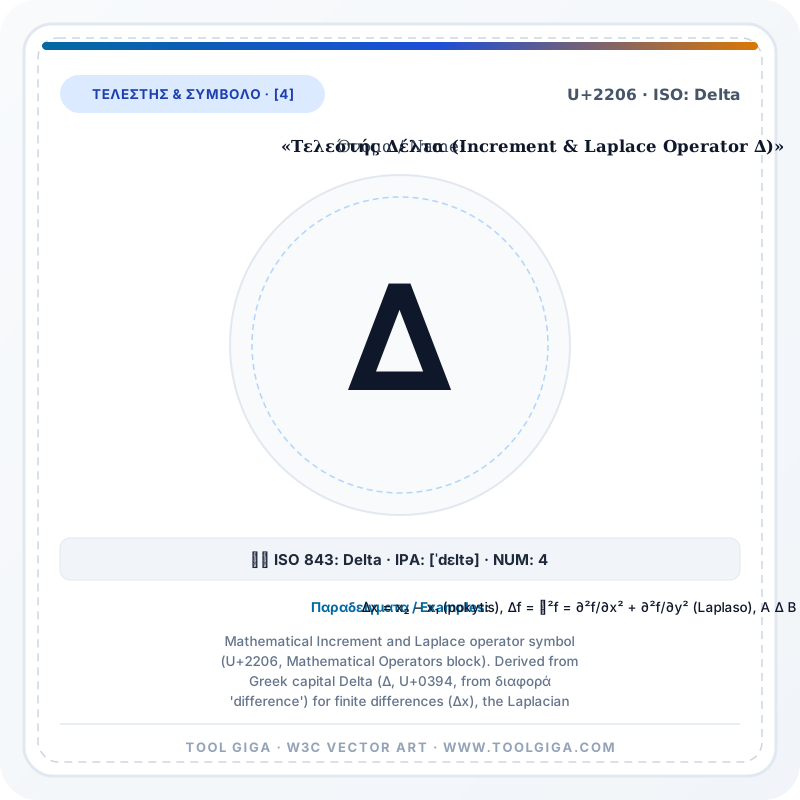
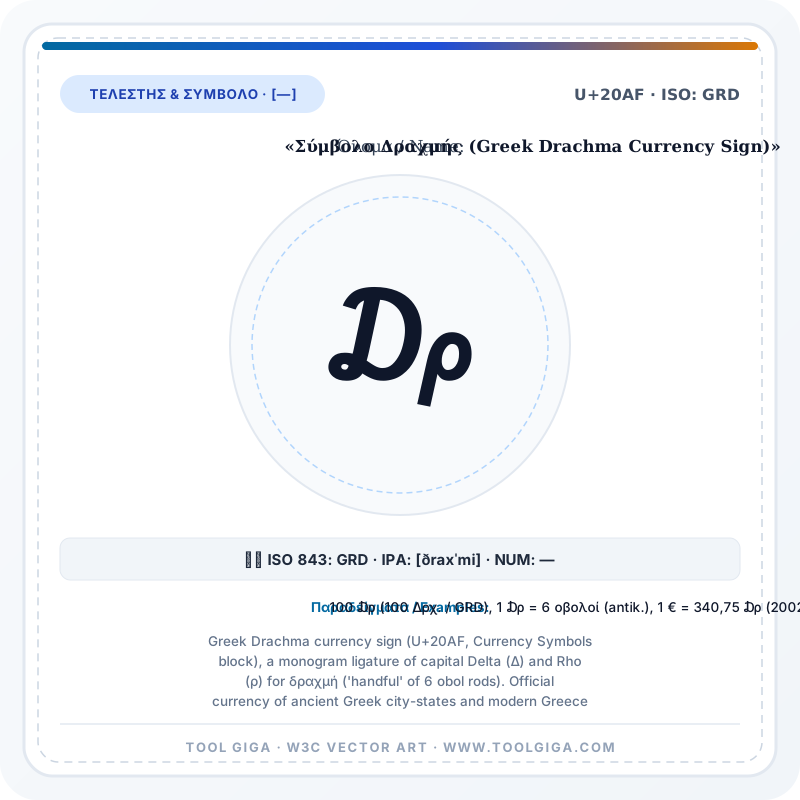
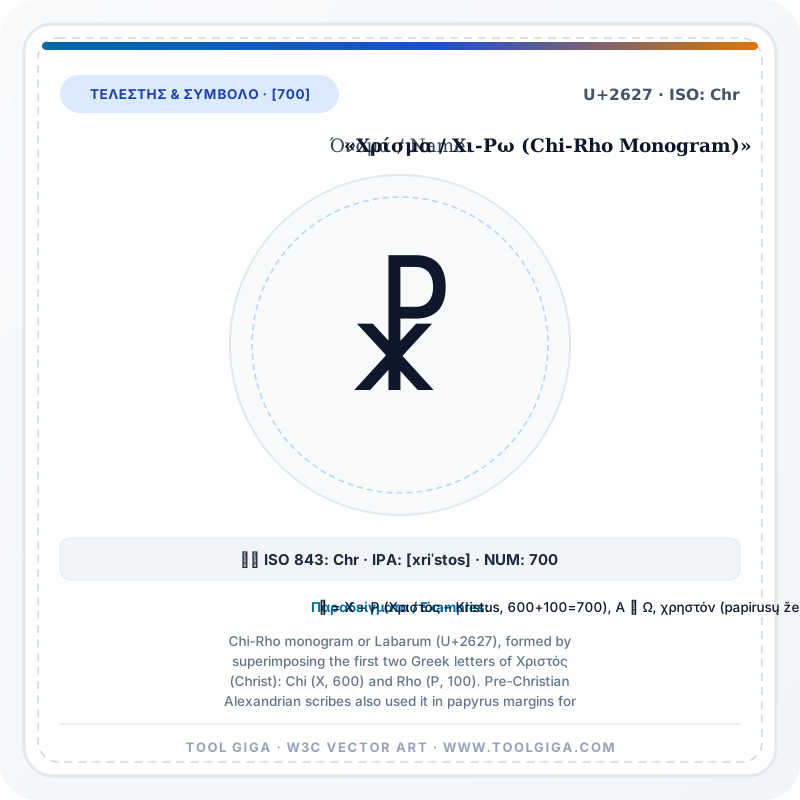
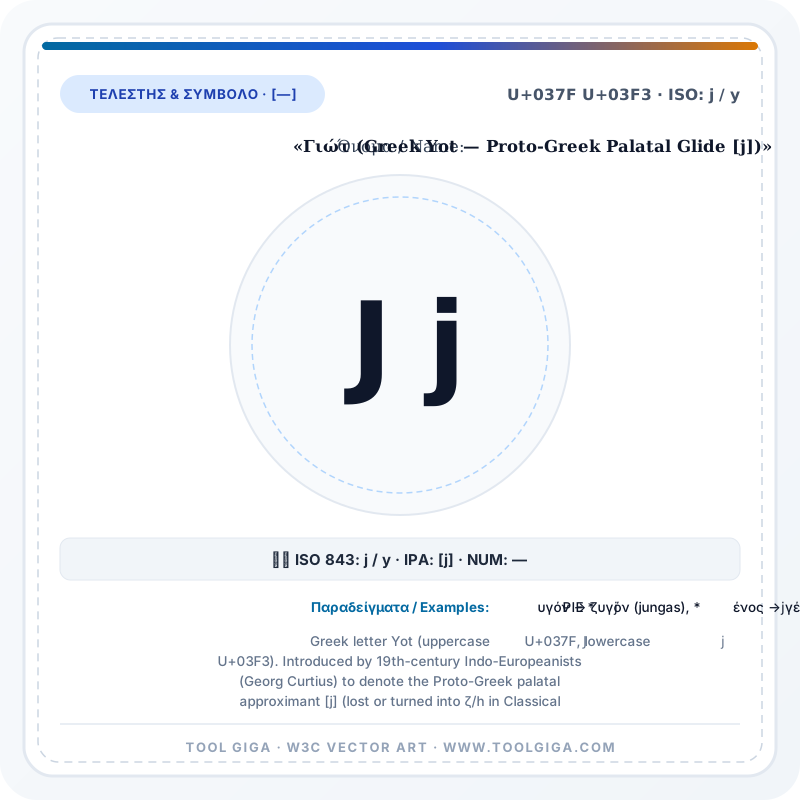
The Greek Alphabet & Scientific Symbols Tool combines an interactive 80-sign examination engine, a printable W3C vector reference catalog, an A4 calligraphy tracing worksheet generator, and a Milesian isopsephy (Greek gematria) calculator in a single zero-dependency interface. Every sign is illustrated by a dedicated 800×800 W3C SVG vector card displaying its uppercase and lowercase glyphs, Unicode code points, ISO 843 transliteration, International Phonetic Alphabet (IPA) transcription, Milesian numerical value, and real-world lexical or mathematical examples.
- Mode 1 — Interactive Greek Alphabet & Symbols Quiz: Choose all 80 signs or filter by any of the 8 specialized categories (Classical Letters
Α–Ω, Archaic Epigraphic Numerals, Scientific Variants, Monotonic Tonos & Dialytika Vowels, Polytonic Breathings & Pitch Accents, Modern Greek Digraphs, Numerals & Punctuation, or Mathematical Operators & Monograms). Before you answer, a spoiler-free Mystery Medallion shows only the raw glyph so card metadata never gives away the answer. Selecting one of the four length-balanced options immediately reveals the full800×800vector card, grades your response, displays an encyclopedic explanation, and lets you play native Greek audio (el-GR) or launch an A4 tracing worksheet for that sign. - Mode 2 — Complete 80-Symbol Catalog & A4 Calligraphy Tracing Generator (
?mode=catalog): Search instantaneously across all 80 cards by Greek glyph, English or Greek letter name, Unicode hex code (such asU+03A9orU+2207), isopsephy number, or scientific role (such as Lorentz factor, wave function, or Laplace operator). Clicking any card opens a detailed inspection modal with one-click character copying, pronunciation playback, single-sign A4 poster printing, and a customizable A4 Calligraphy & Tracing Worksheet Modal offering 3 practice modes (Tracing Outlines, First-Column Sample + Outlines, and Solid Reference Sheet) across 3 grid densities (24, 35, or 54 cells per A4 page). - Mode 3 — Greek Name Scribe & Milesian Isopsephy Calculator (
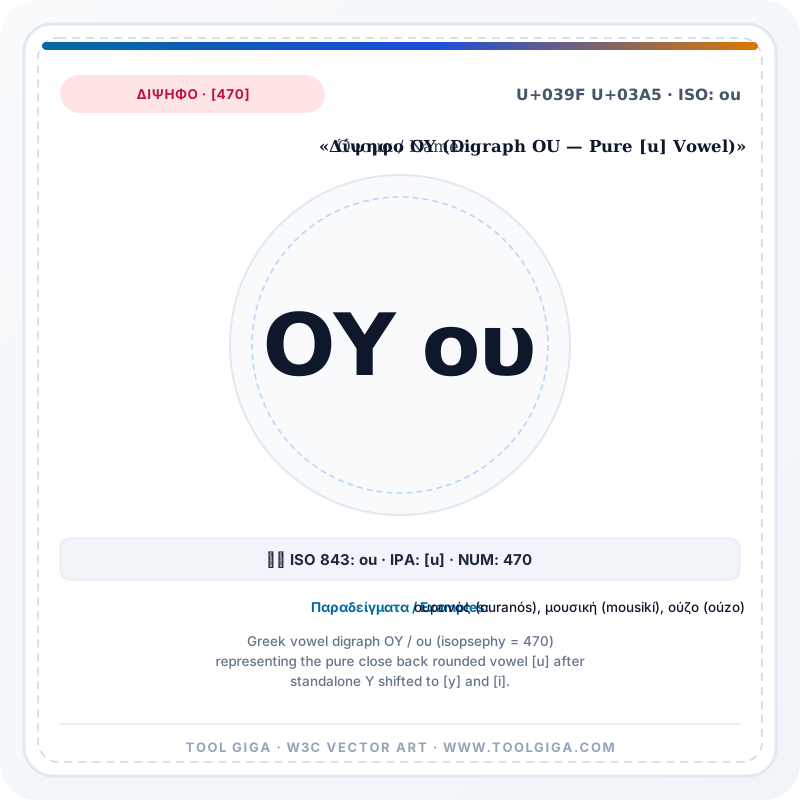
?mode=scribe): Enter any personal name, scientific term, or classical phrase in Latin or Greek letters. The transliteration engine converts digraphs (ph → φ,th → θ,ch → χ,ps → ψ,ou → ου), automatically converts word-final lowercase sigma into terminalς(U+03C2), computes the exact Milesian isopsephy sum of every letter, formats the total as an authentic Greek numeral with Dexia Keraia (ʹ) and Aristeri Keraia (͵), and renders a visual card breakdown of every character.
From the Phoenician Abjad to the First True Alphabet (~800 BCE & the 403 BCE Euclidean Reform)
Around 800 BCE, Greek merchants and scribes trading across the eastern Mediterranean (at ports such as Al-Mina in Syria and Pithekoussai in Euboea) adapted the 22-letter North-West Semitic Phoenician abjad. In Phoenician—as in Hebrew and Arabic—only consonants were written down, while readers supplied vowel sounds from context. In Indo-European Greek, however, vowel distinctions in grammatical endings and verb stems were indispensable for distinguishing meaning. The anonymous Greek adaptor solved this problem through a brilliant phonological repurposing of five Phoenician consonants that had no exact counterpart in Greek:
- Aleph (
ʾālep, glottal stop[ʔ], “ox”) ➔ Alpha (Α α): Repurposed for the open vowel[a]and[aː]. - He (
hē,[h], “window/jubilation”) ➔ Epsilon (Ε ε): Repurposed for the short mid front vowel[e](later named E psilon, “bare E”). - Heth (
ḥēt, pharyngeal fricative[ħ], “courtyard wall”) ➔ Heta / Eta (Η η): In western Greek dialects (and via Etruscan into LatinH), Heta kept the aspirate value[h]; in eastern Ionian Greek (which was psilotic and dropped[h]), it was repurposed for the long open-mid vowel[ɛː](Eta). - Yodh (
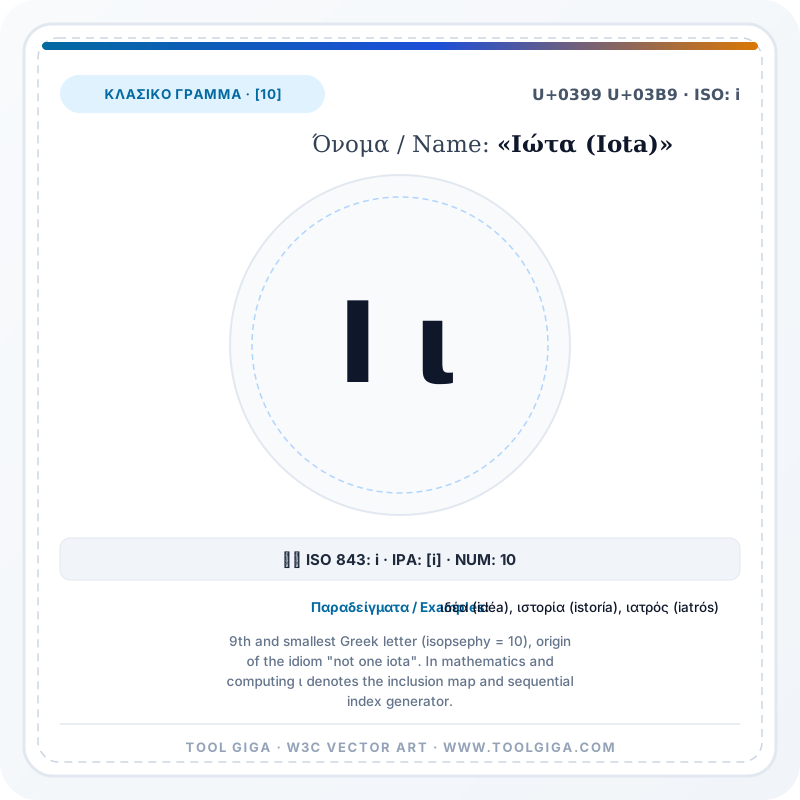
yōd, palatal glide[j], “hand/arm”) ➔ Iota (Ι ι): Because Proto-Greek had already lost initial[j](evolving into[h]orζ), Yodh was assigned to the close front vowel[i]and[iː]. - Ayin (
ʿayin, pharyngeal approximant[ʕ], “eye”) ➔ Omicron (Ο ο): Turned into the short back rounded vowel[o](O mikron, “small O”). - Waw (
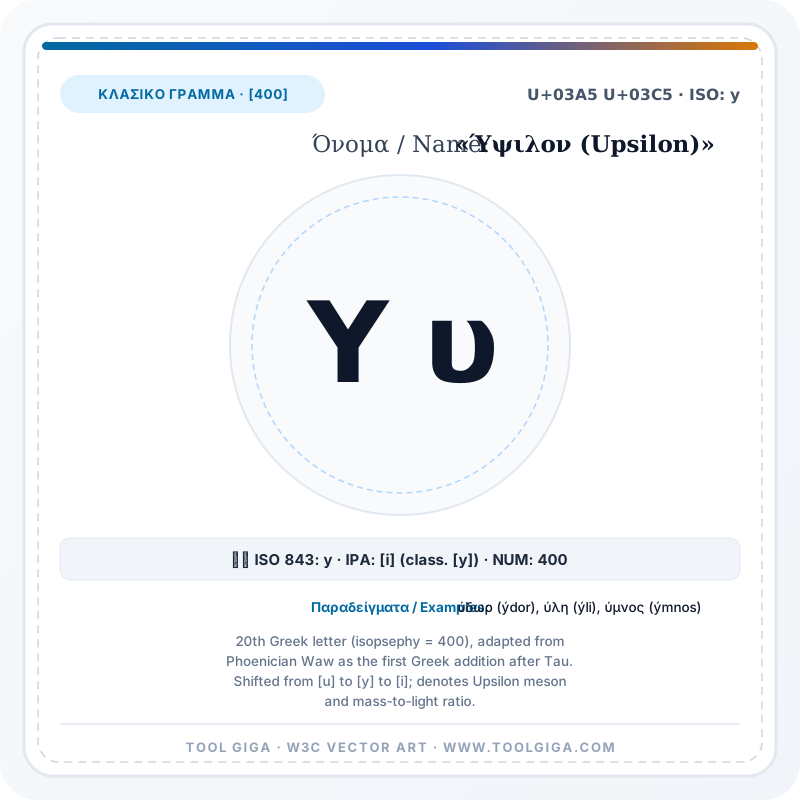
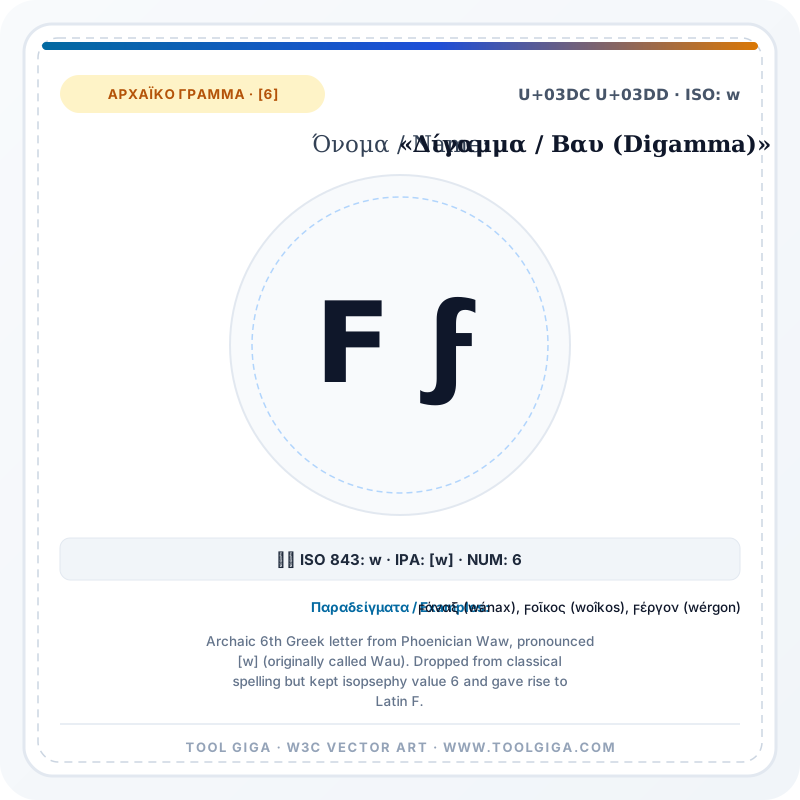
wāw, bilabial[w], “hook/peg”) ➔ Digamma (Ϝ) & Upsilon (Υ υ): Borrowed twice—sixth in the alphabet as the consonant Digamma (Ϝ = [w], ancestor of LatinF) and appended at the end after Tau (Τ, the 22nd and final Phoenician letter) as the vowel Upsilon (Υ = [u / y]).
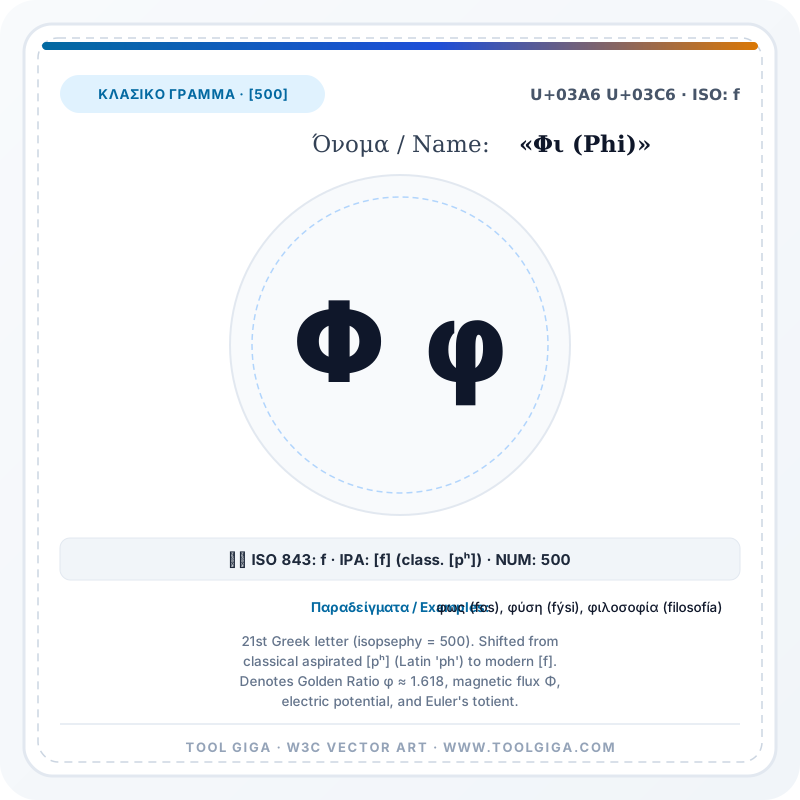
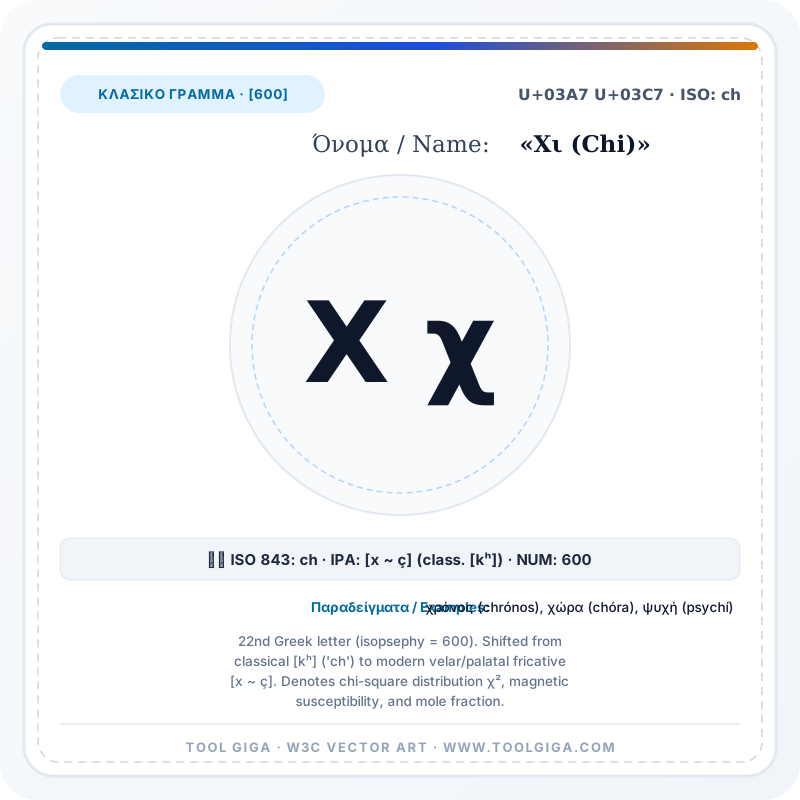
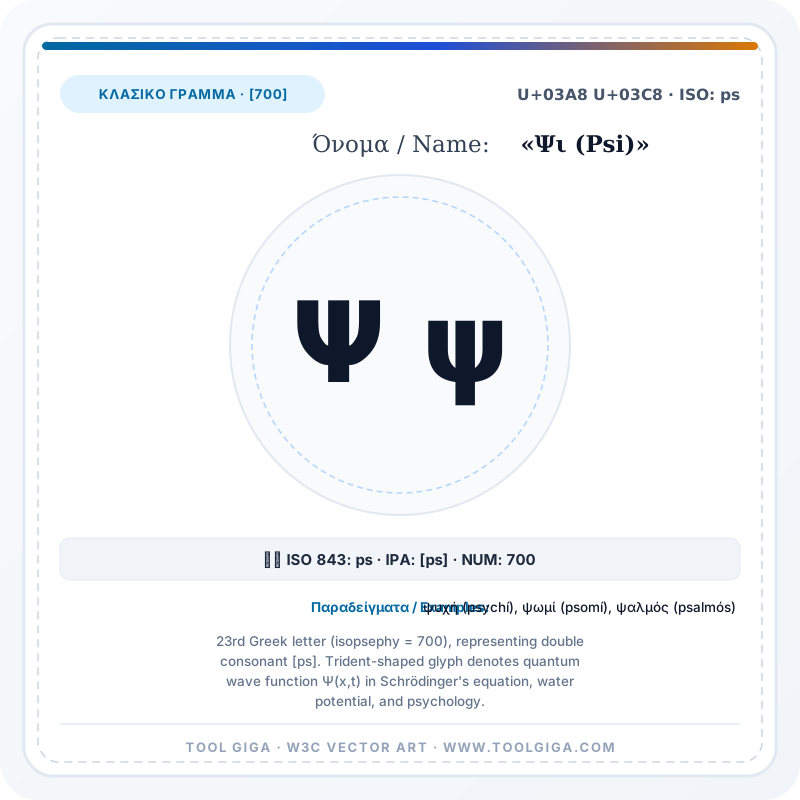
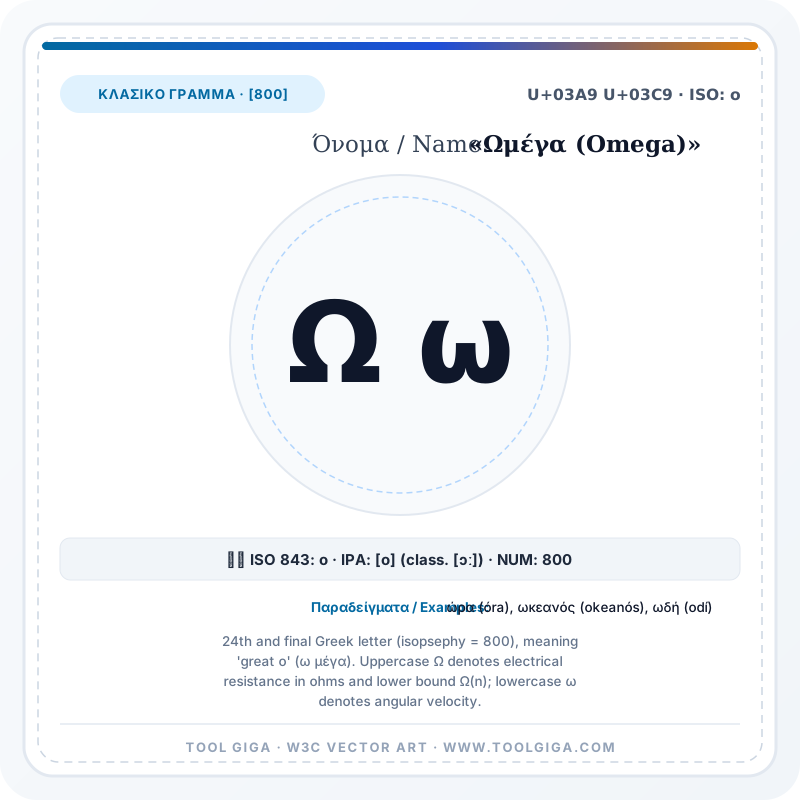
Following Upsilon, the Greeks invented four supplemental letters of their own: Phi (Φ φ) for aspirated [pʰ], Chi (Χ χ) for aspirated [kʰ], Psi (Ψ ψ) for the cluster [ps], and—first in the Ionian cities of Asia Minor—Omega (Ω ω, “great O”), created by opening the bottom of Omicron (Ο) and adding side feet to mark the long vowel [ɔː]. In 403/402 BCE, under the archonship of Eucleides (following a decree proposed by Archinus), Athens officially replaced its old local Attic epichoric script with the 24-letter Ionian alphabet of Miletus, establishing the canonical 24-letter sequence from Alpha to Omega used worldwide ever since.
Why Physics, Mathematics & Engineering Speak Greek: Standard Letters vs. Technical Unicode Variants
When Renaissance and Enlightenment mathematicians—led by Viète, Descartes, Leibniz, Johann Bernoulli, Leonhard Euler, and Carl Friedrich Gauss—exhausted the 26 Latin letters for variables, coordinates, and functions, they systematically assigned the 24 Greek letters to physical constants, angles, operators, and tensors. In modern STEM notation, uppercase and lowercase Greek letters carry distinct, universally standardized meanings:
- Exact Mathematical & Physical Roles: Lowercase Alpha (
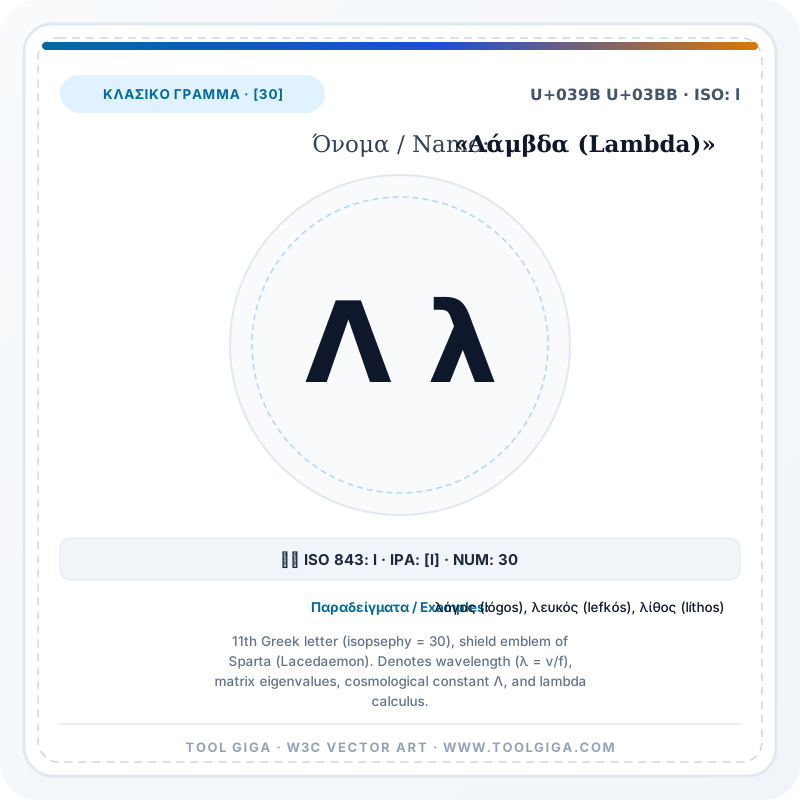
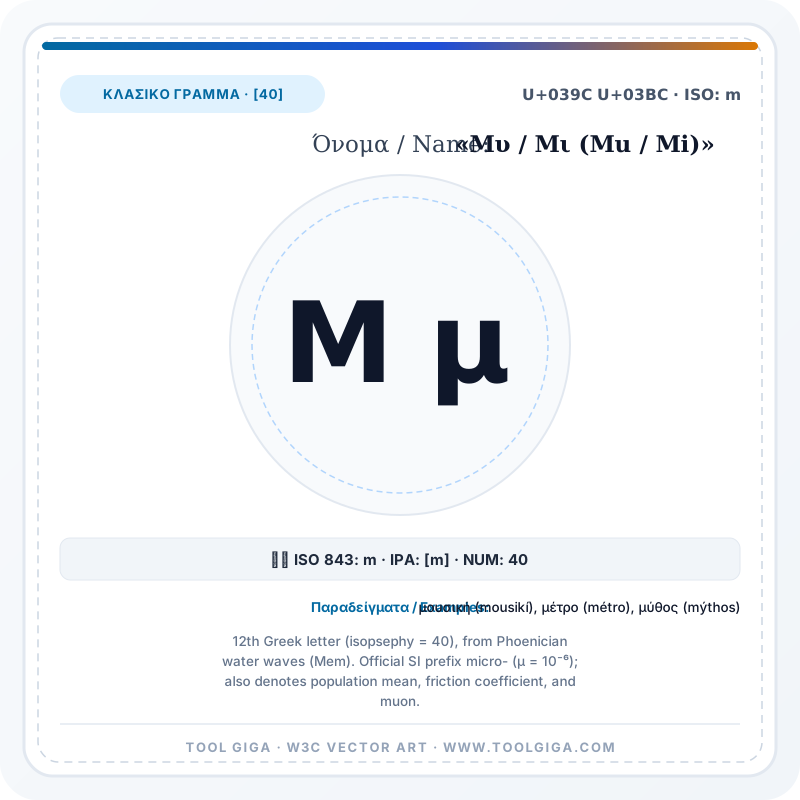
α) denotes plane angles, alpha radiation (⁴He²⁺nuclei), and the electromagnetic fine-structure constant (α ≈ 1/137.036); Beta (β) denotes relativistic velocityv/cand beta decay electrons; Gamma (Γ γ) represents Euler’s factorial extensionΓ(n) = (n−1)!, the Lorentz factorγ, and high-energy photons; Delta (Δ δ) marks macroscopic finite changes (Δx), the Kronecker delta (δᵢⱼ), and the Dirac delta distribution; Lambda (Λ λ) marks wavelength (λ = v/f), eigenvalues, and Einstein’s cosmological constant (Λ); Mu (μ) marks the SI prefix micro- (10⁻⁶), friction coefficients, magnetic permeability (μ₀), and the muon lepton; Pi (Π π) represents Archimedes’ circle ratio (π ≈ 3.14159) and Gauss’s iterated product (∏); Sigma (Σ σ ς) represents Euler’s summation (∑), standard deviation (σ), normal mechanical stress, and electrical conductivity; Psi (Ψ ψ) represents Schrödinger’s quantum wave functionΨ(r,t); and Omega (Ω ω) represents electrical resistance in Ohms, angular velocity (ω = 2πf), and asymptotic lower bounds. - Why Unicode Separates Text Letters from Technical Variant Glyphs (
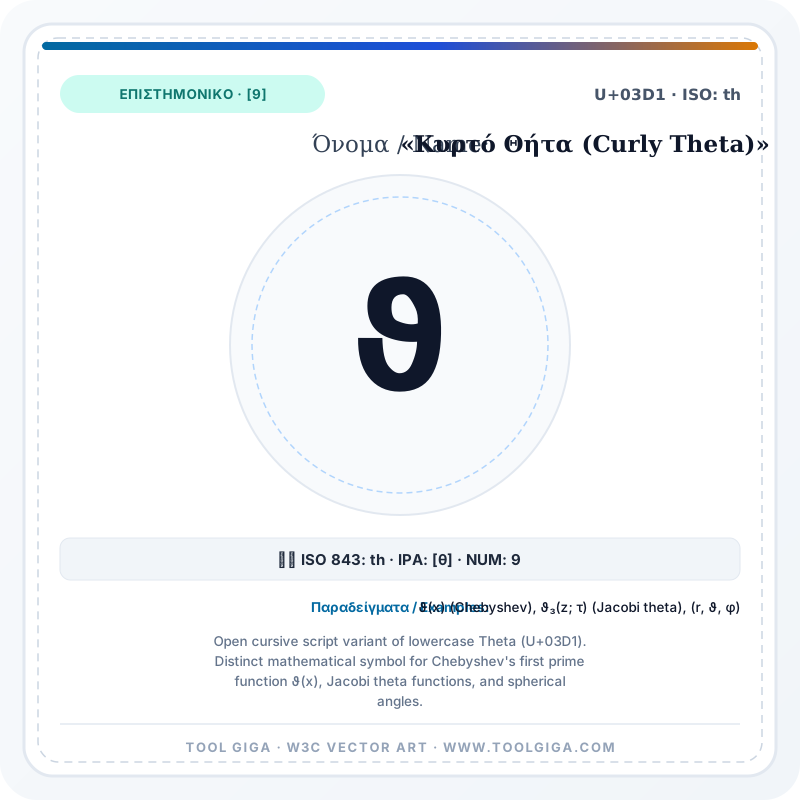
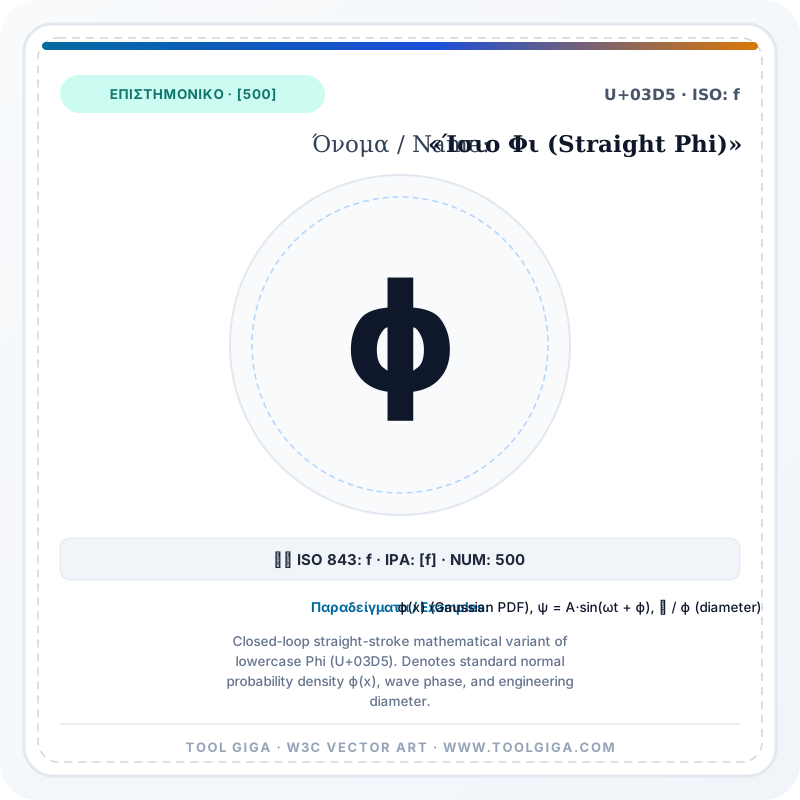
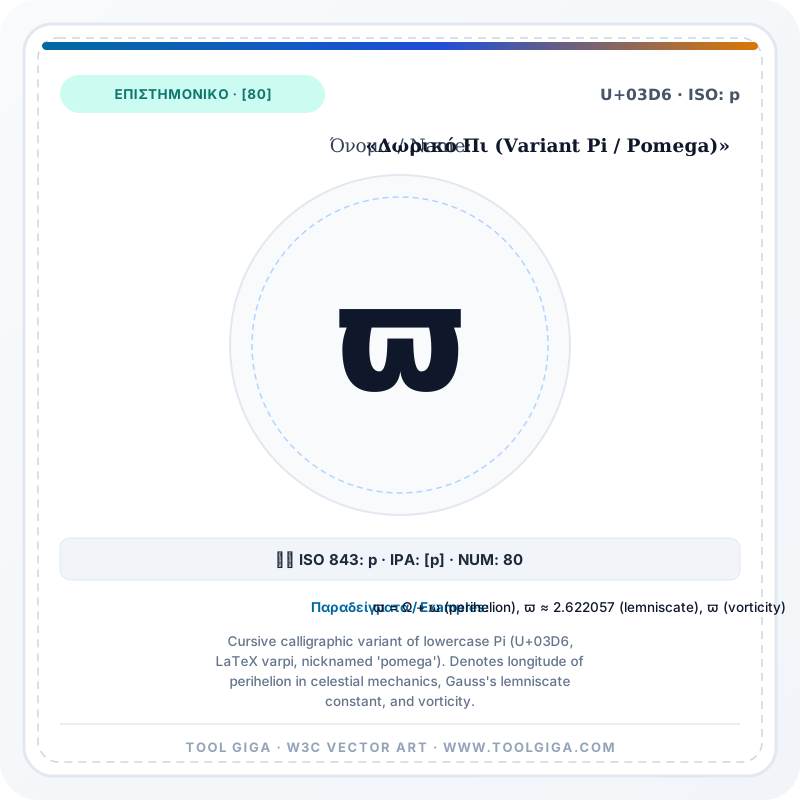
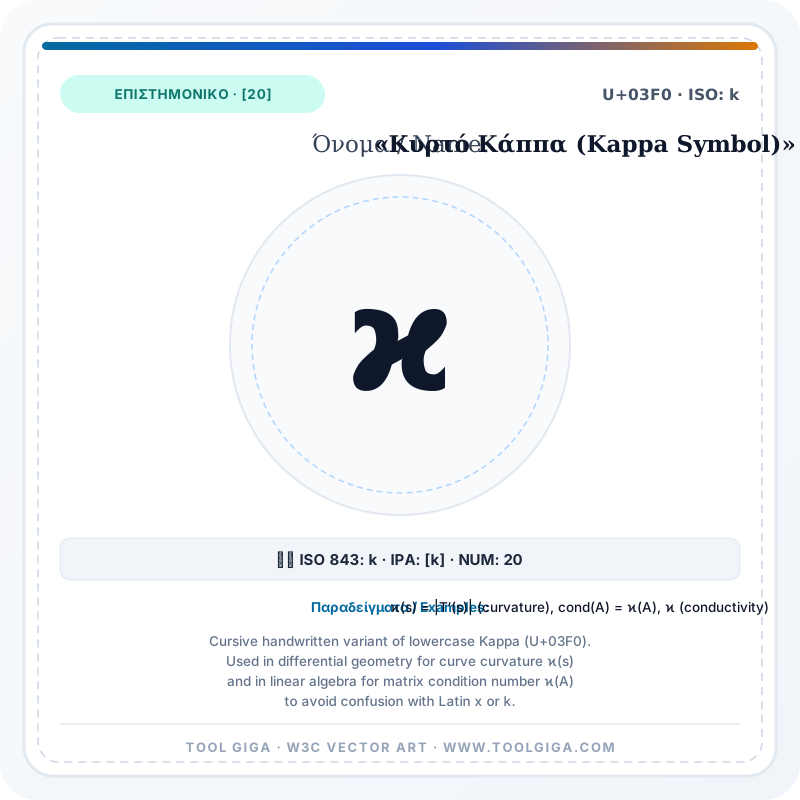
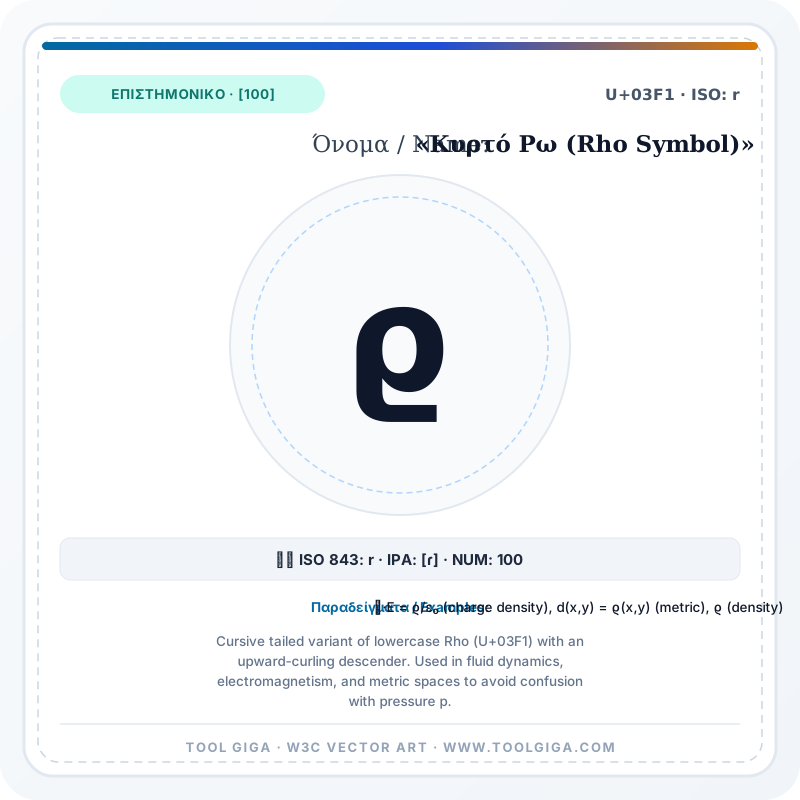
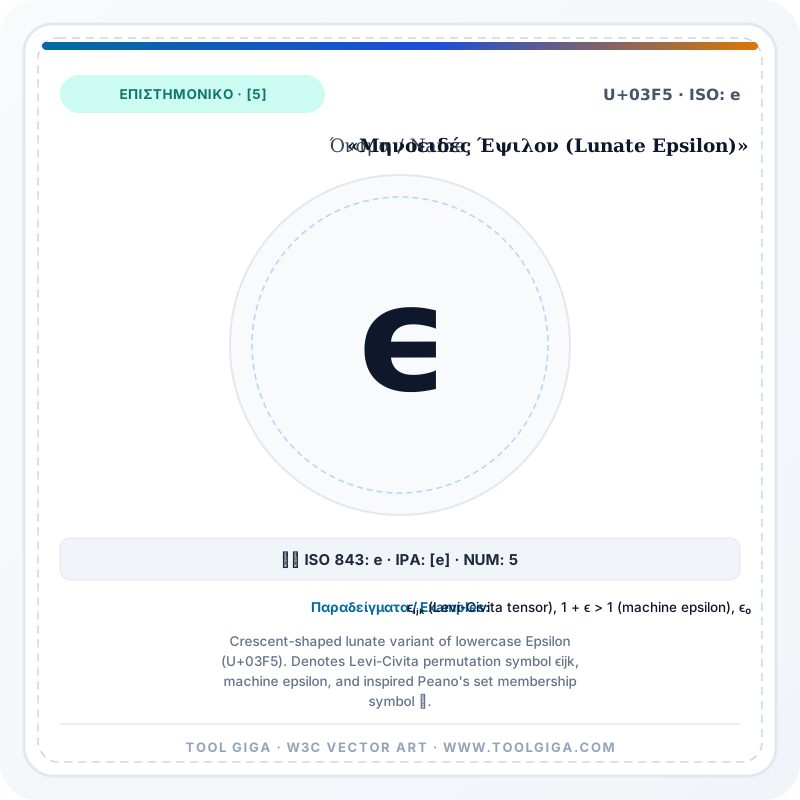
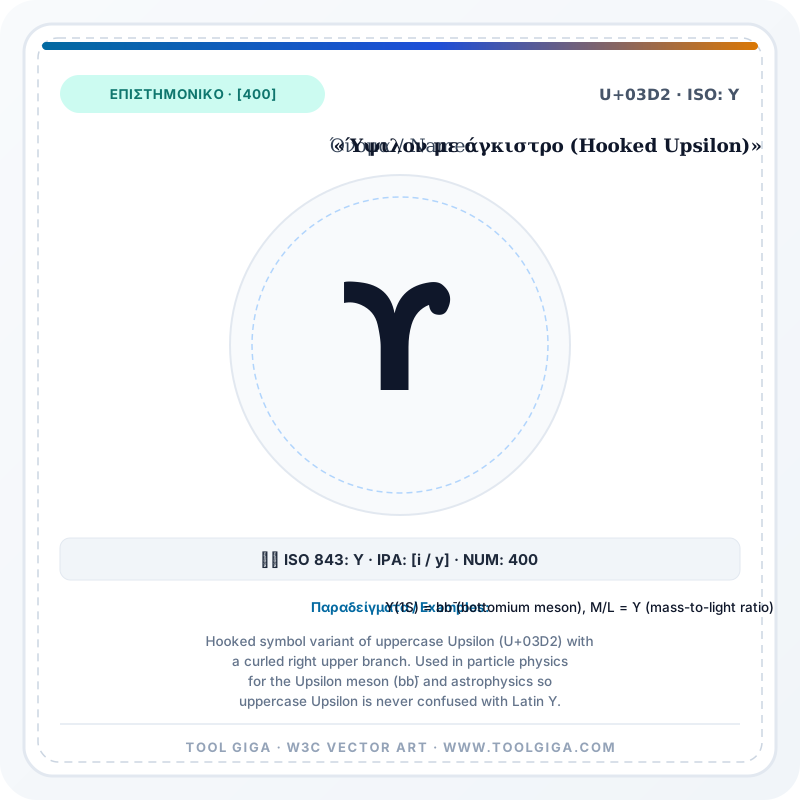
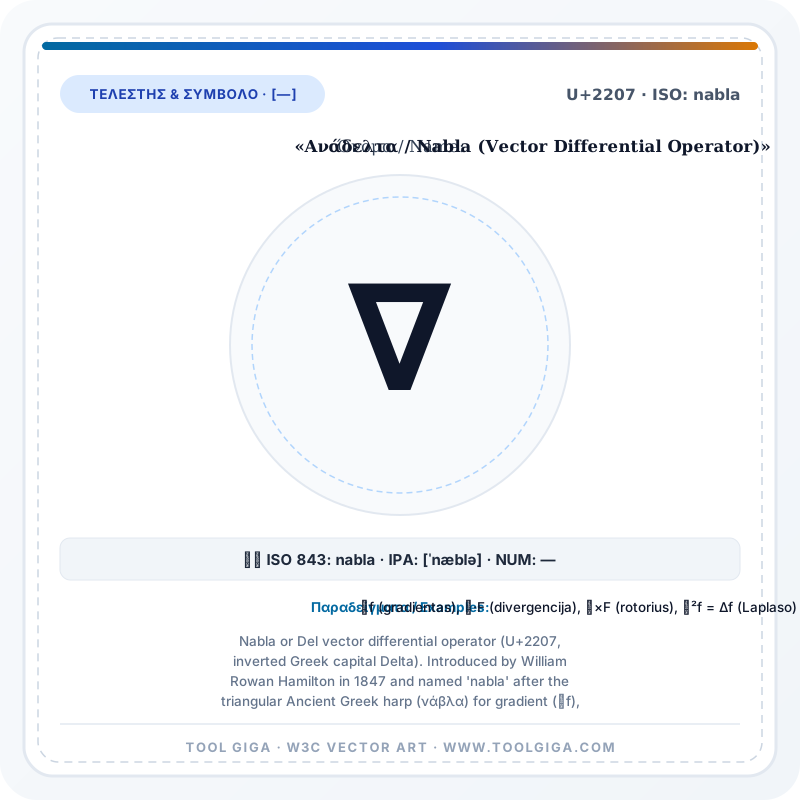
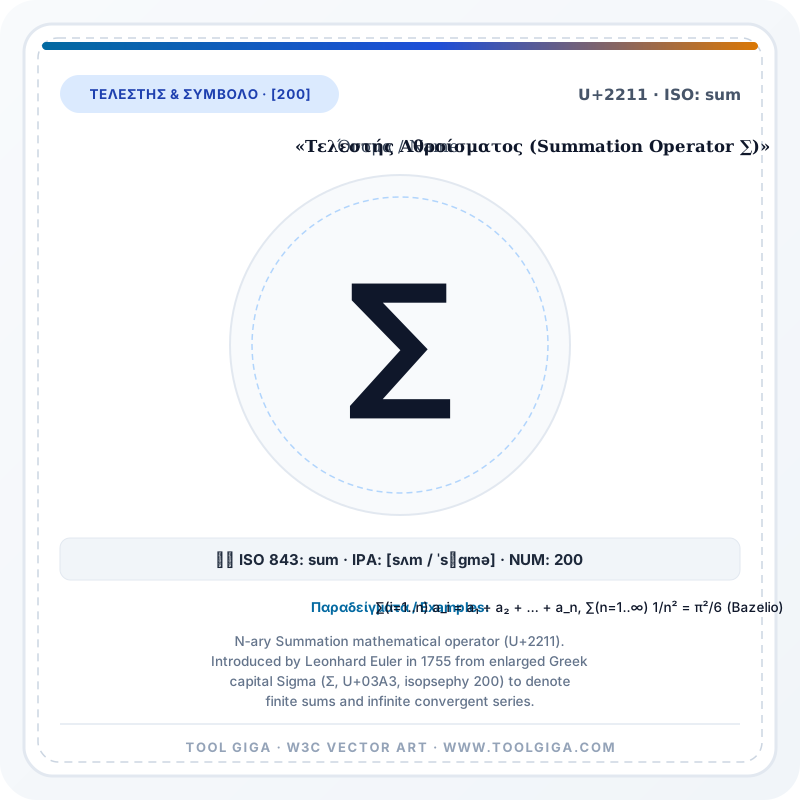
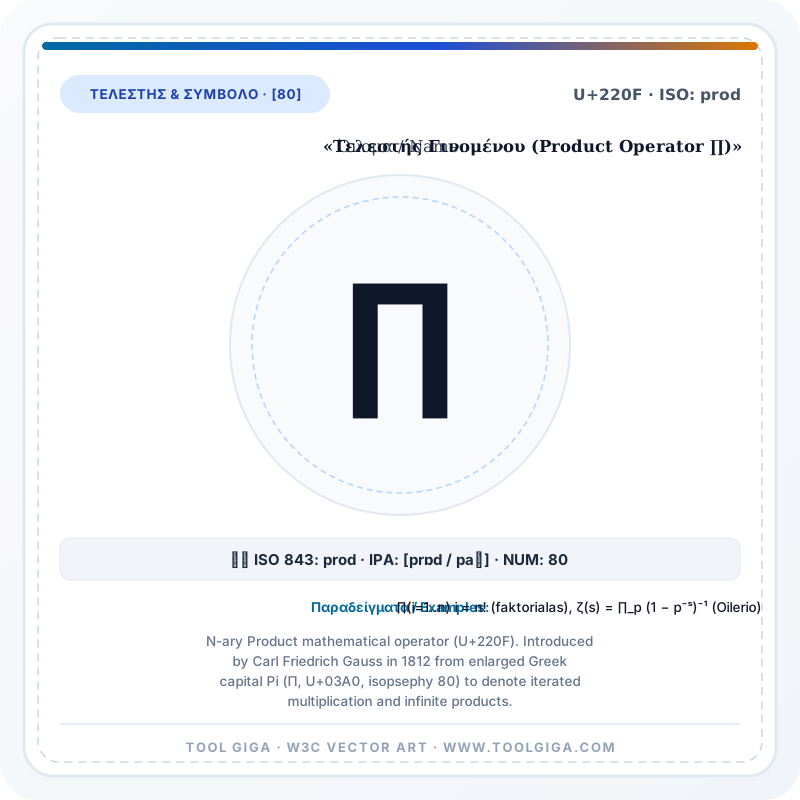
U+03D1..U+03F5&U+2126..U+2211): In ordinary prose typography, open and closed handwriting styles of a Greek letter are interchangeable font choices. In mathematics, physics, and TeX/LaTeX, however, two historical handwriting shapes of the same Greek letter are often used side-by-side in the same equation to denote two completely different quantities! Thus Unicode encodes dedicated technical symbol variants: Curly Theta (ϑ,U+03D1) for Jacobi elliptic functions vs. closedθ(U+03B8); Straight Phi (ϕ,U+03D5) for wave phase and Gaussian probability density vs. loopyφ(U+03C6) for the golden ratio1.618; Omega-Pi (ϖ,U+03D6) for longitude of perihelion and fluid vorticity; Lunate Epsilon (ϵ,U+03F5) for the Levi-Civita tensor vs.ε(U+03B5); and Hooked Upsilon (ϒ,U+03D2) with a curled upper horn so uppercase Greek Upsilon (denoting thebb̄bottomium meson and mass-to-light ratioϒ = M/L) is never confused with Latin capitalY. Similarly, mathematical operators Increment/Laplace∆(U+2206), Nabla∇(U+2207, named after the ancient harp νάβλα), N-ary Summation∑(U+2211), and N-ary Product∏(U+220F) have dedicated code points in the Mathematical Operators block to guarantee fixed operator geometry and index placement.
Milesian Isopsephy (Greek Numerals), Archaic Letters (ϛ, ϟ, ϡ) & Polytonic Diacritics
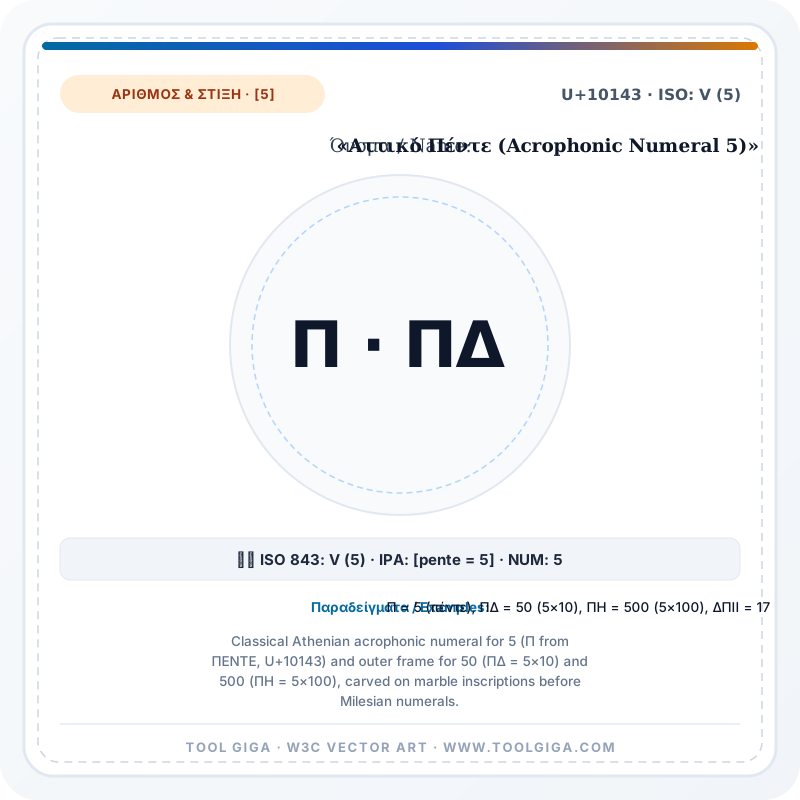
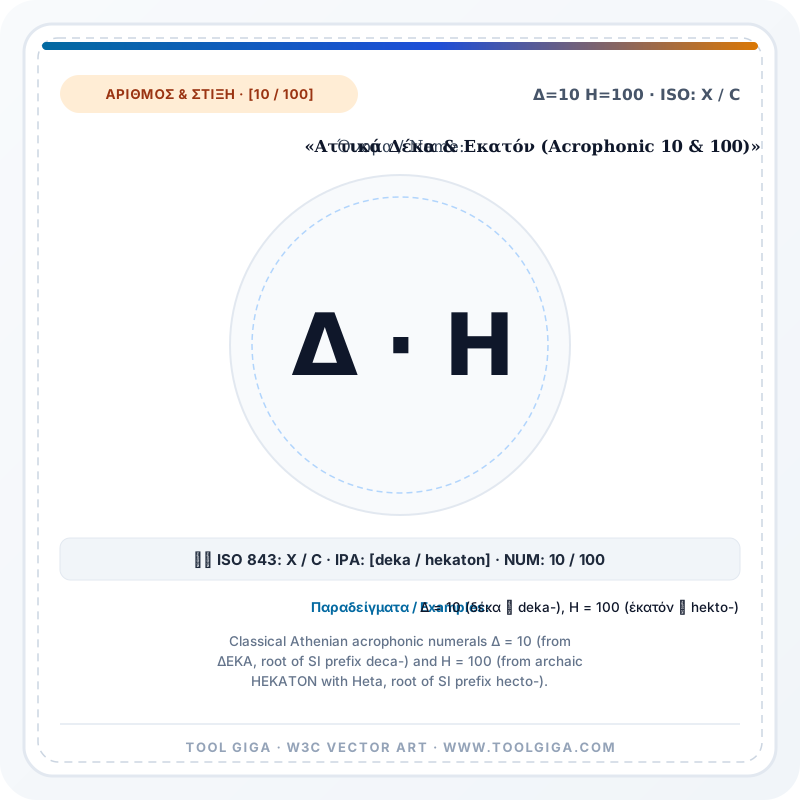
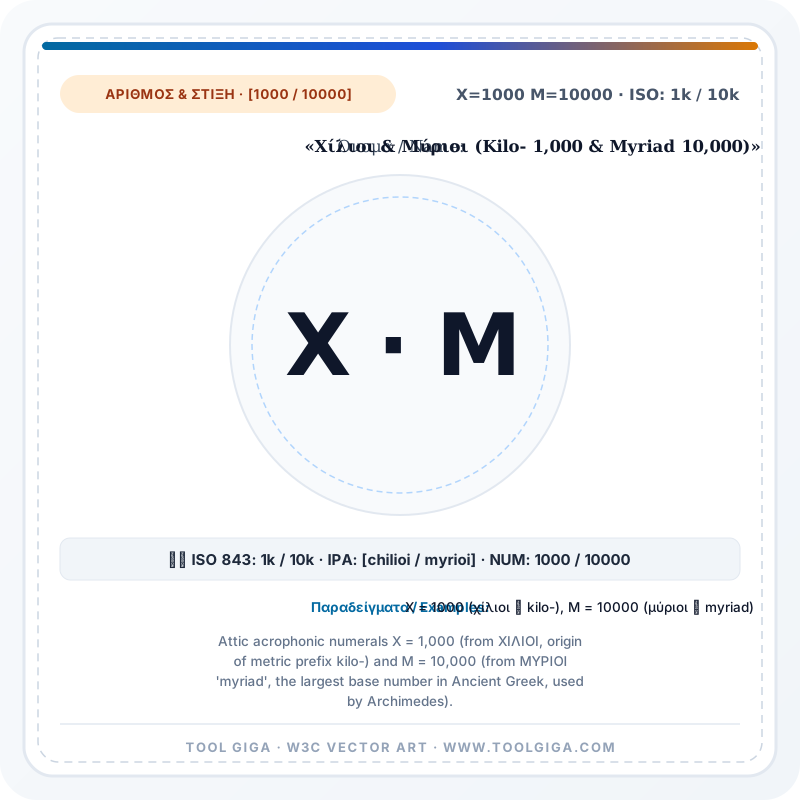
Before Hindu–Arabic numerals reached Europe, ancient Greeks used two distinct numeral systems: Attic acrophonic numerals (carved on Athenian marble tribute lists, where Π = 5 from pente, Δ = 10 from deka, Η = 100 from hekaton, Χ = 1000 from chilioi, and Μ = 10,000 from myrioi) and the alphabetic Milesian (Ionian) numeral system, which assigns a decimal value to every letter of the alphabet—a practice known in Greek as isopsephy (ἰσοψηφία, literally “equal pebble count”, from psēphos, the counting pebble that also gave English the verb calculate).
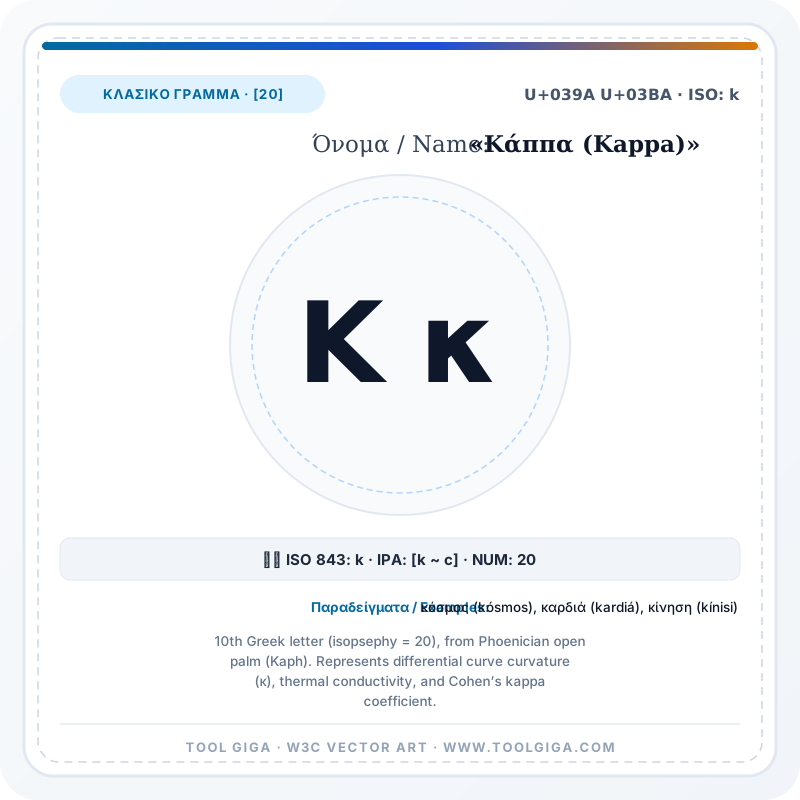
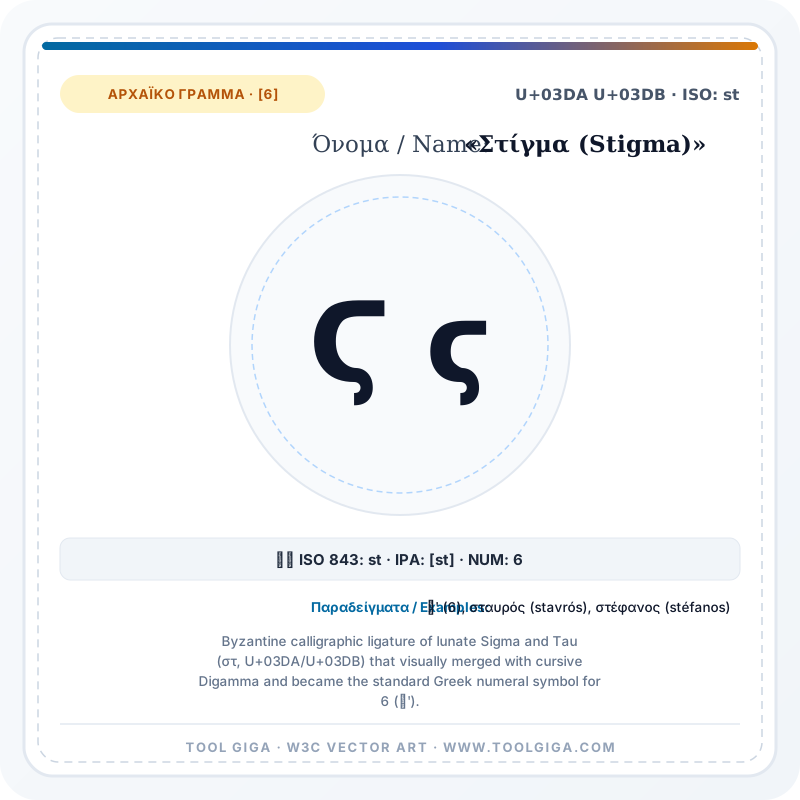
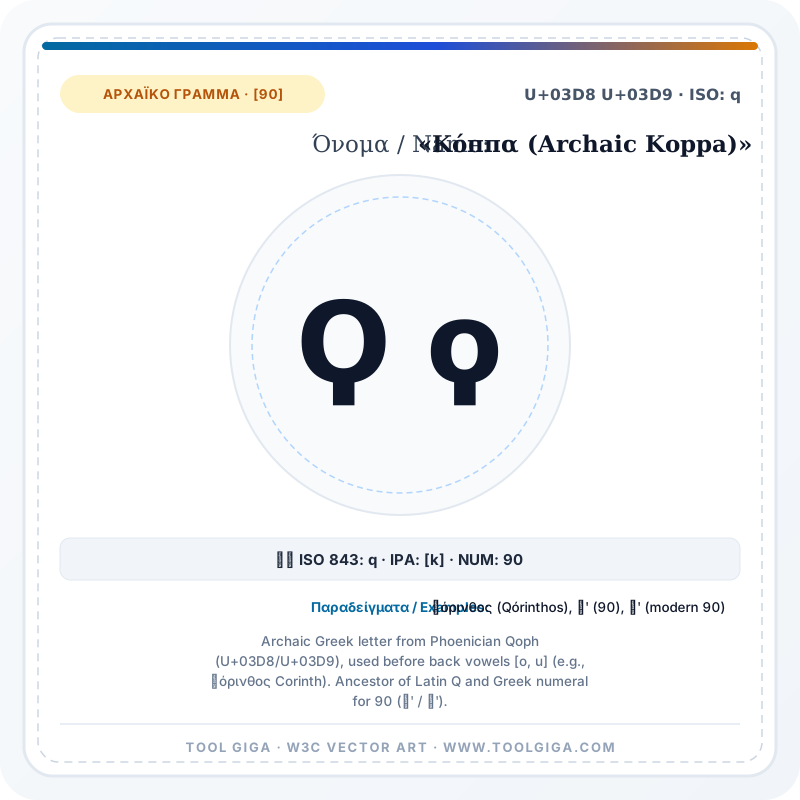
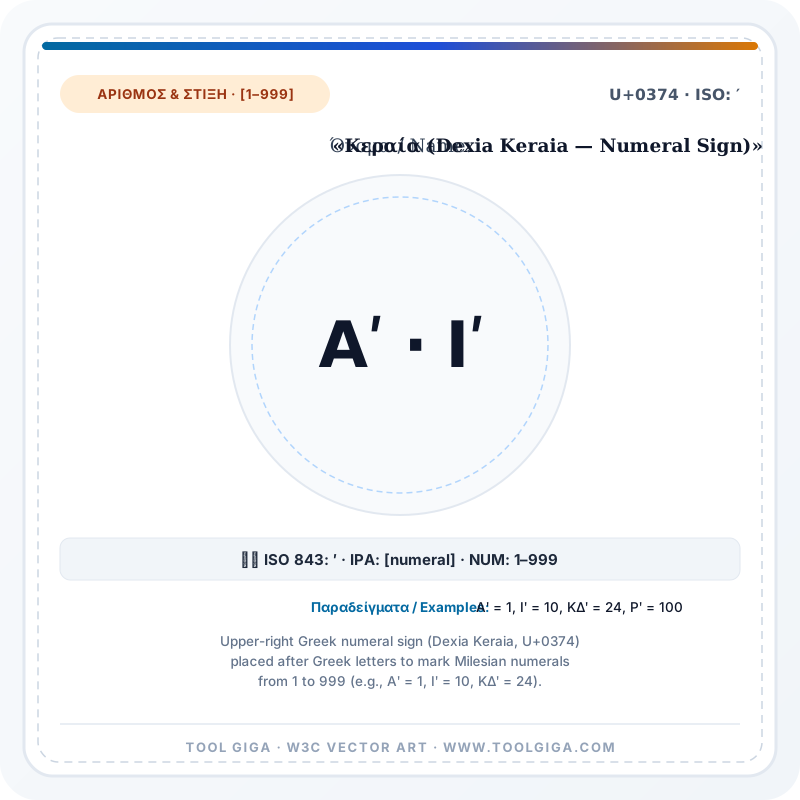
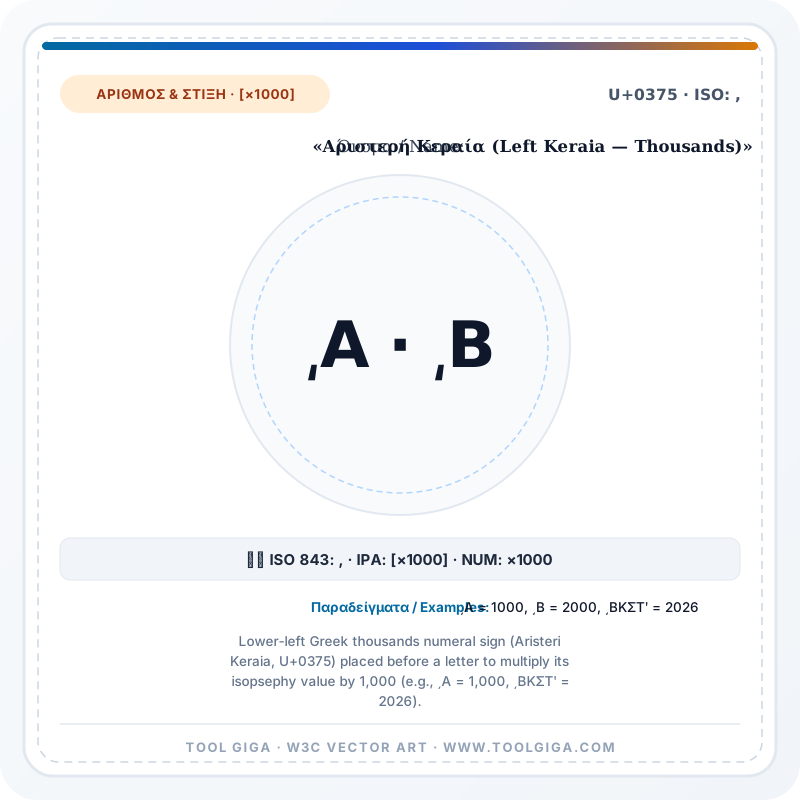
To represent all nine units (1–9), nine tens (10–90), and nine hundreds (100–900), a decimal alphabetic system requires 3 × 9 = 27 signs. Because the classical Greek alphabet had only 24 letters, Greek mathematicians preserved three obsolete archaic letters exclusively in their original alphabetical slots as numerals: Digamma / Stigma (Ϝ / ϛ = 6) between Epsilon (5) and Zeta (7); Koppa (Ϙ / ϟ = 90) between Pi (80) and Rho (100); and Sampi (Ϡ / ϡ = 900) after Omega (800). A right upper horn called the Dexia Keraia (ʹ, U+0374) is placed after a letter group to mark numbers from 1 to 999 (e.g., ΚΔʹ = 24, ΡΝΓʹ = 153), while a lower-left stroke called the Aristeri Keraia (͵, U+0375) multiplies a letter’s value by 1,000 (e.g., ͵ΒΚΣΤʹ = 2026).
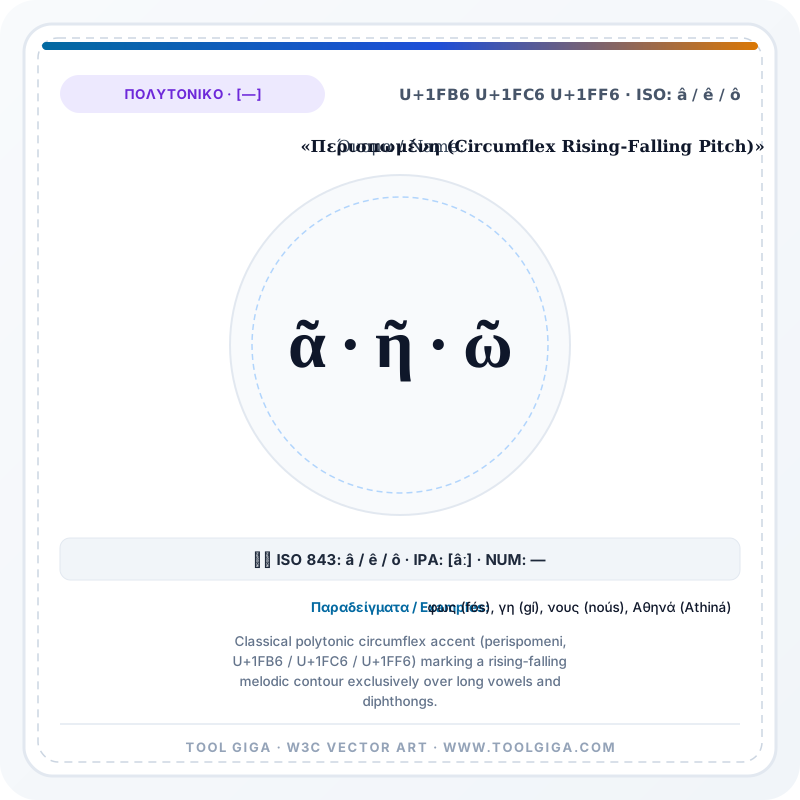
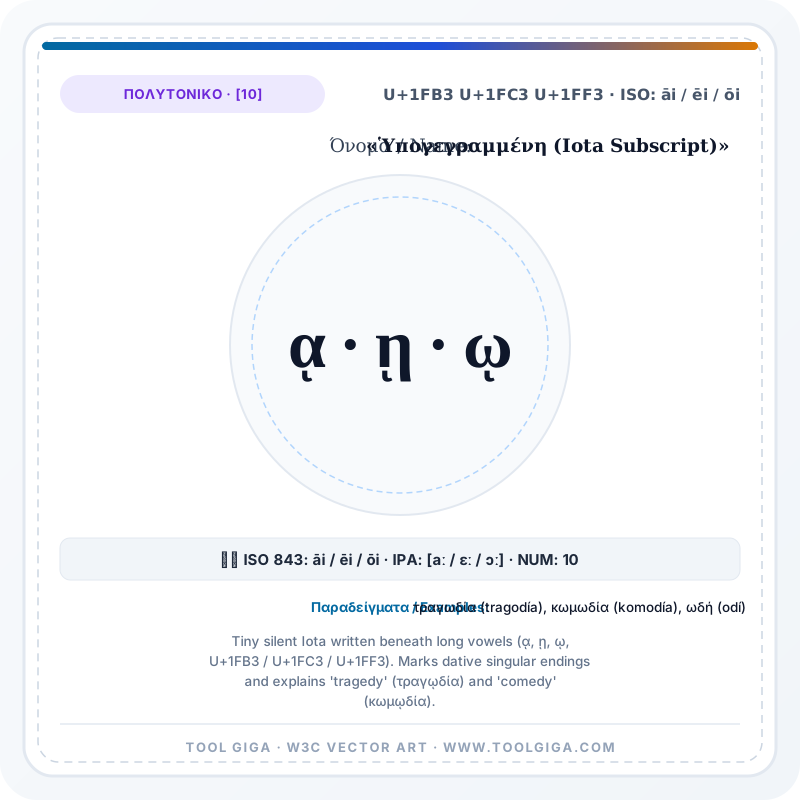
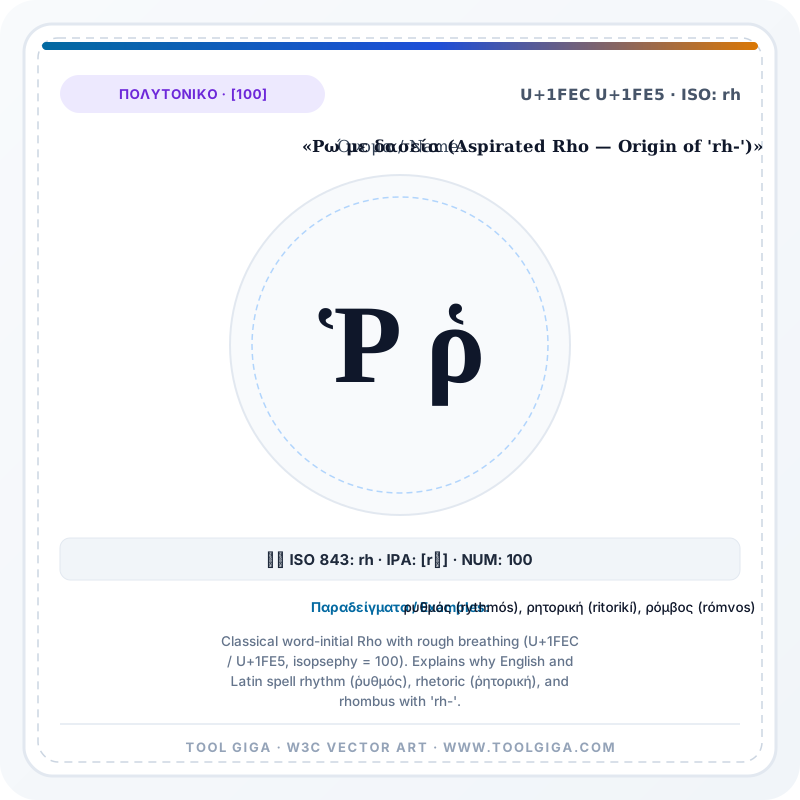
Around 200 BCE, Aristophanes of Byzantium, head librarian of Alexandria, introduced the polytonic diacritical system to preserve classical pronunciation and prosody: the smooth breathing (psili, ἀ) for unaspirated initial vowels, the rough breathing (daseia, ἁ = [ha] and ῥ = [r̥])—which explains why Greek loanwords with rough breathing are spelled with h- and rh- in English (harmony, history, horizon, rhythm, rhetoric, rhombus)—and the three melodic pitch accents (acute oxeia ά, grave vareia ὰ, and circumflex perispomeni ᾶ). In 1982, Greece officially adopted the simplified monotonic orthography, replacing the three pitch accents and two breathings with a single stress mark (tonos) and the diaeresis (dialytika ϊ, ϋ).