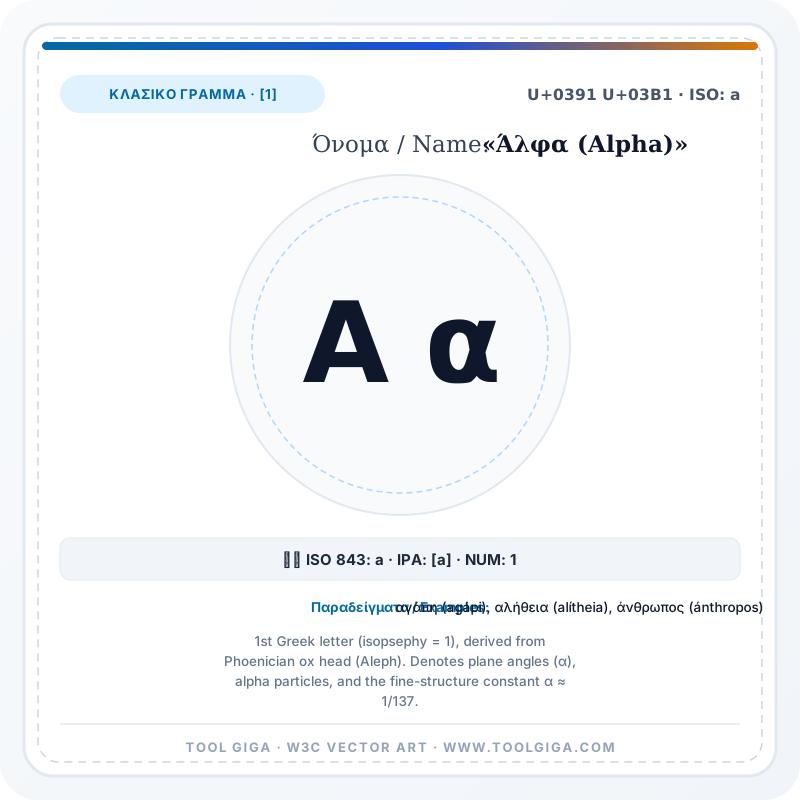
#1 · U+0391 / U+03B1
[1]
Greek Letter Α α (Alpha) — Beginning, Ox Head & Angles [1]
ISO 843: a · IPA: [a] · Isopsephy: 1 · Angles (α), Alpha Particle & Beginning (Άλφα)
#2 · U+0392 / U+03B2
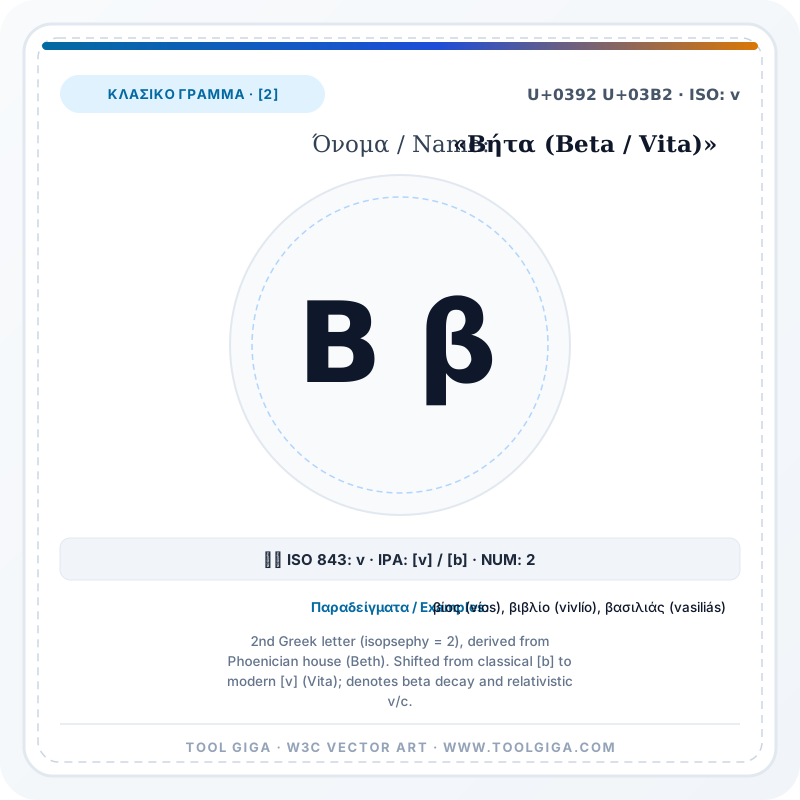
[2]
Greek Letter Β β (Beta / Vita) — House, Beta Decay & Relativistic Speed [2]
ISO 843: v (class. b) · IPA: [v] / [b] · Isopsephy: 2 · Beta Decay & v/c Ratio (Βήτα)
#3 · U+0393 / U+03B3
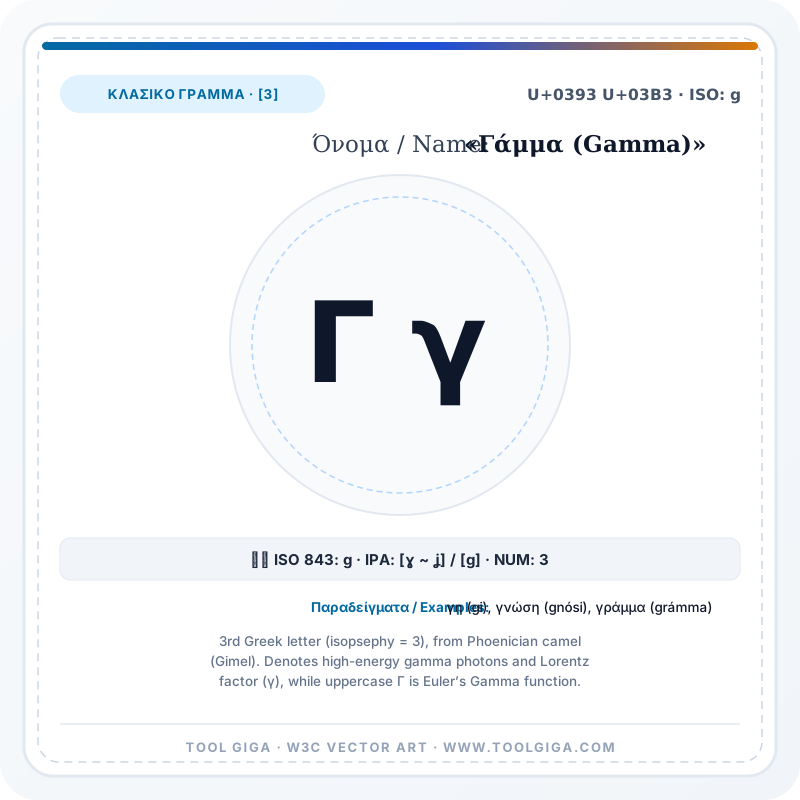
[3]
Greek Letter Γ γ (Gamma) — Gamma Rays, Lorentz Factor & Euler Function [3]
ISO 843: g · IPA: [ɣ ~ ʝ] / [ɡ] · Isopsephy: 3 · Gamma Photons & Euler Γ(z) (Γάμμα)
#4 · U+0394 / U+03B4
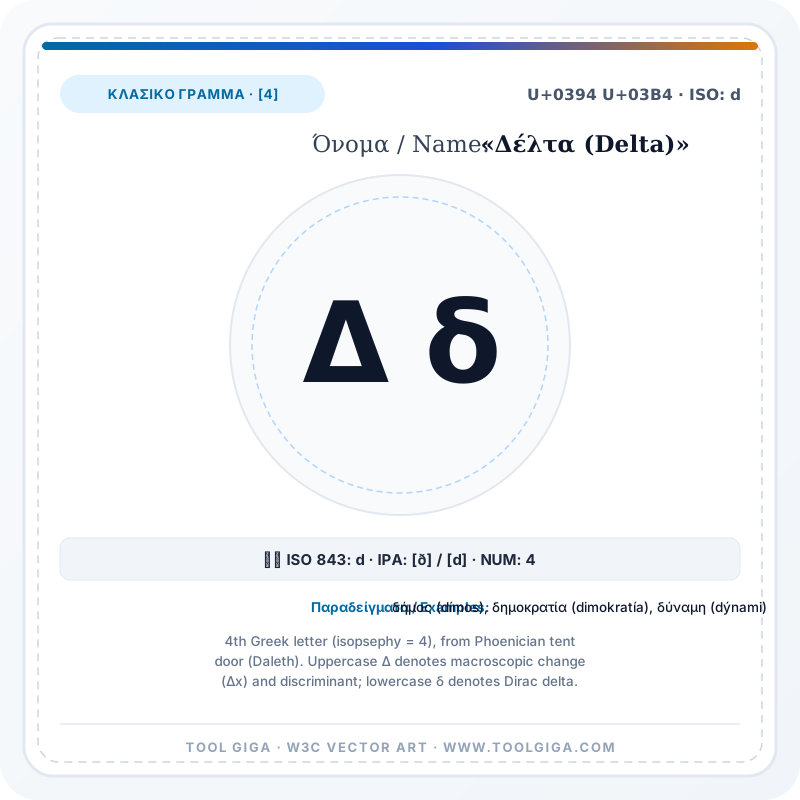
[4]
Greek Letter Δ δ (Delta) — Change (Δx), Discriminant & River Delta [4]
ISO 843: d · IPA: [ð] / [d] · Isopsephy: 4 · Change (Δx), Discriminant & Dirac δ (Δέλτα)
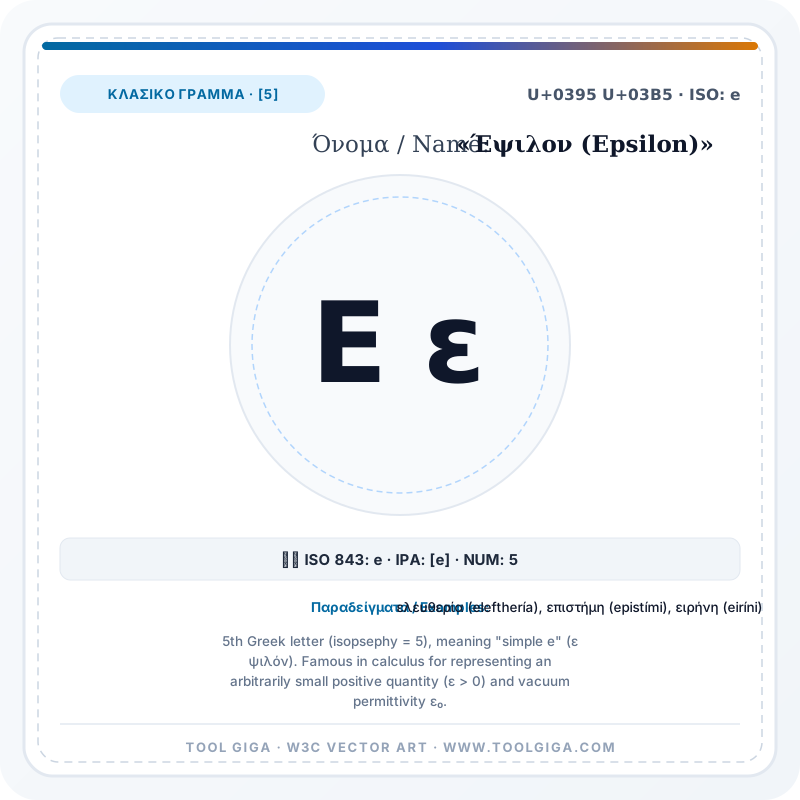
#5 · U+0395 / U+03B5
[5]
Greek Letter Ε ε (Epsilon) — Pure Short E, Infinitesimal (ε > 0) & Permittivity [5]
ISO 843: e · IPA: [e] · Isopsephy: 5 · Infinitesimal (ε > 0) & Vacuum Permittivity ε₀ (Έψιλον)
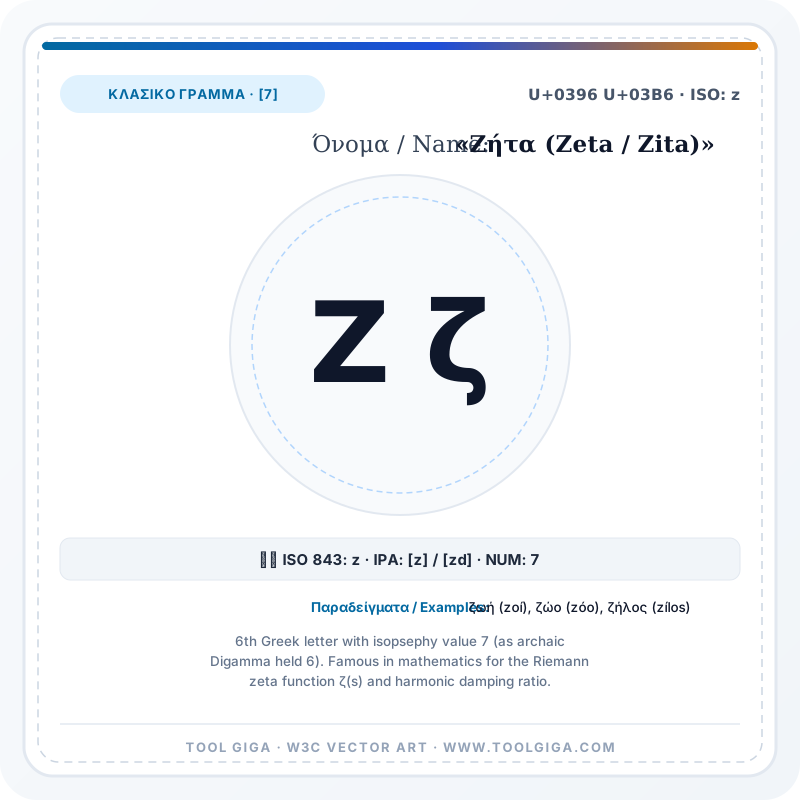
#6 · U+0396 / U+03B6
[7]
Greek Letter Ζ ζ (Zeta / Zita) — Riemann Zeta Function ζ(s) & Damping Ratio [7]
ISO 843: z · IPA: [z] / [zd] · Isopsephy: 7 · Riemann Zeta ζ(s) & Damping (Ζήτα)
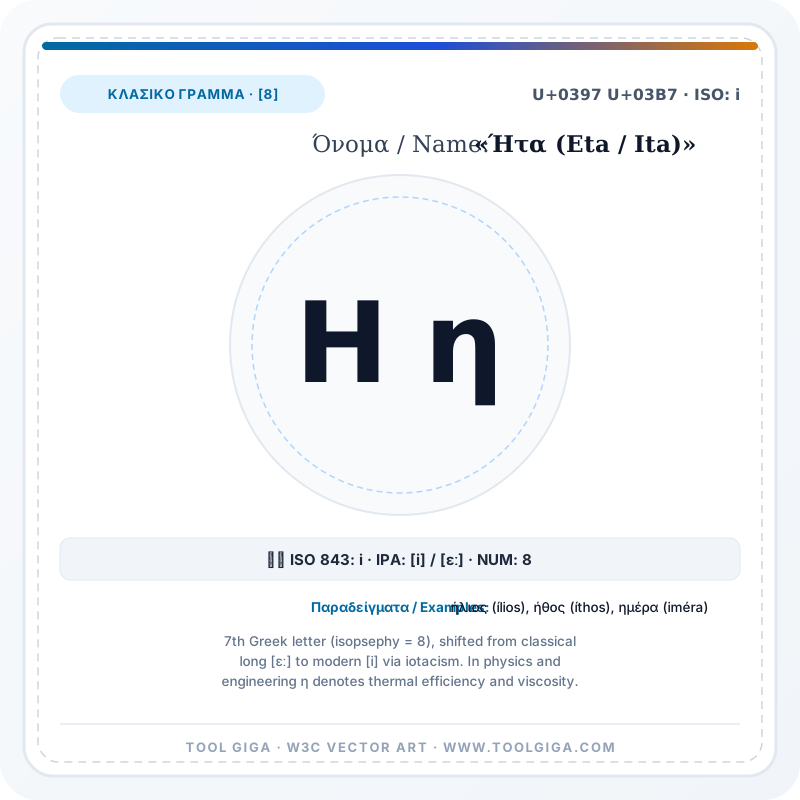
#7 · U+0397 / U+03B7
[8]
Greek Letter Η η (Eta / Ita) — Efficiency (η), Viscosity & Long E / I [8]
ISO 843: i (class. ē) · IPA: [i] / [ɛː] · Isopsephy: 8 · Efficiency (η) & Viscosity (Ήτα)
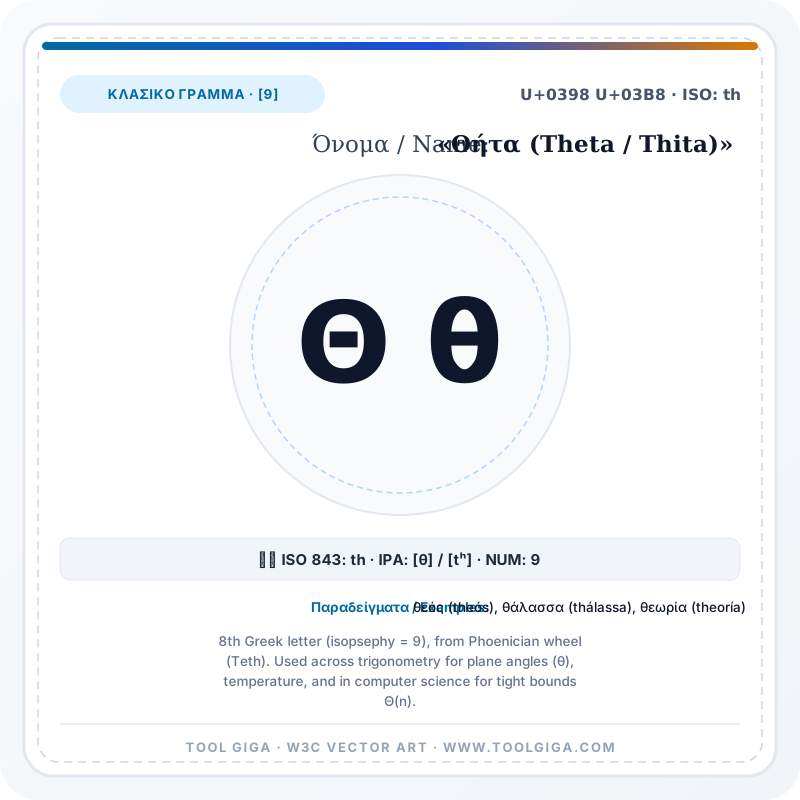
#8 · U+0398 / U+03B8
[9]
Greek Letter Θ θ (Theta / Thita) — Angles (θ), Big-Theta Θ(n) & Wheel [9]
ISO 843: th · IPA: [θ] / [tʰ] · Isopsephy: 9 · Angles (θ), Big-Theta Θ(n) & EEG Waves (Θήτα)
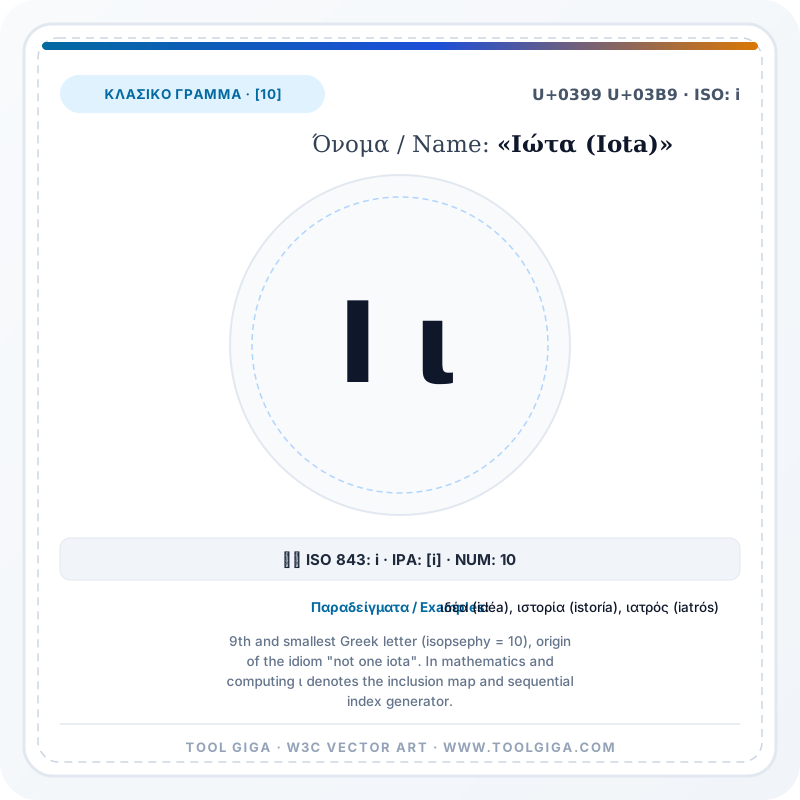
#9 · U+0399 / U+03B9
[10]
Greek Letter Ι ι (Iota) — Smallest Letter ('Not One Iota') & Index [10]
ISO 843: i · IPA: [i] · Isopsephy: 10 · 'Not One Iota', Iota Subscript & Index (Ιώτα)
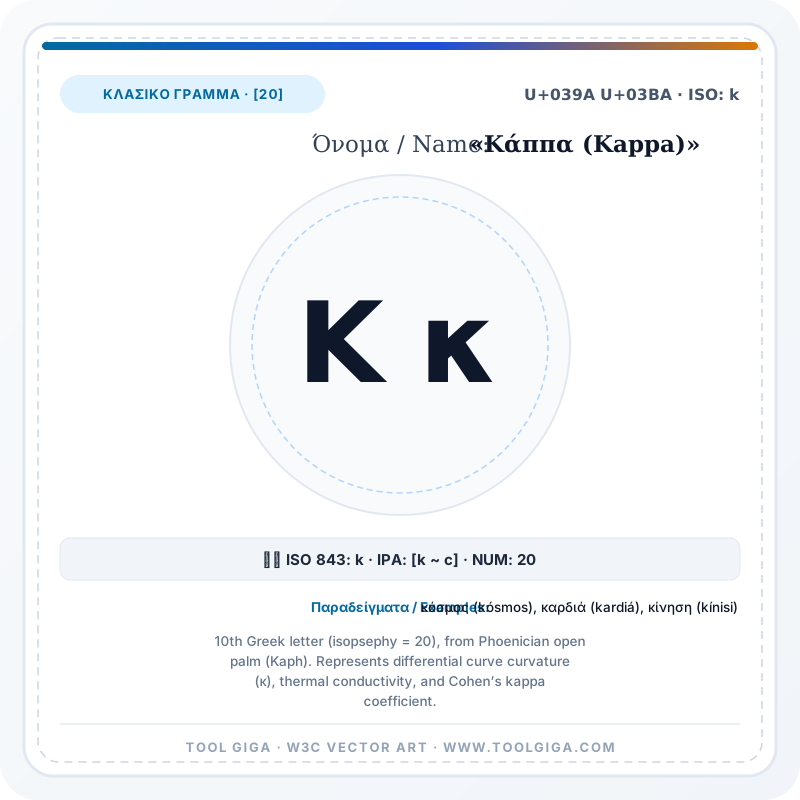
#10 · U+039A / U+03BA
[20]
Greek Letter Κ κ (Kappa) — Open Palm, Curvature (κ) & Cosmos [20]
ISO 843: k · IPA: [k ~ c] · Isopsephy: 20 · Curvature (κ) & Thermal Conductivity (Κάππα)
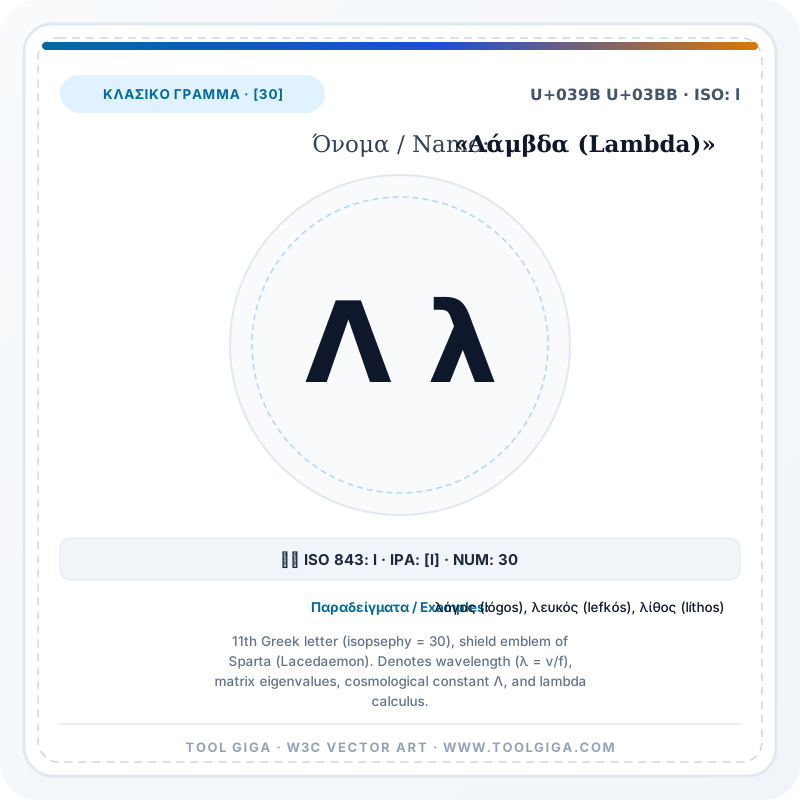
#11 · U+039B / U+03BB
[30]
Greek Letter Λ λ (Lambda) — Wavelength (λ), Eigenvalues & Spartan Emblem [30]
ISO 843: l · IPA: [l] · Isopsephy: 30 · Wavelength (λ = v/f), Eigenvalue & Lambda Calculus (Λάμβδα)
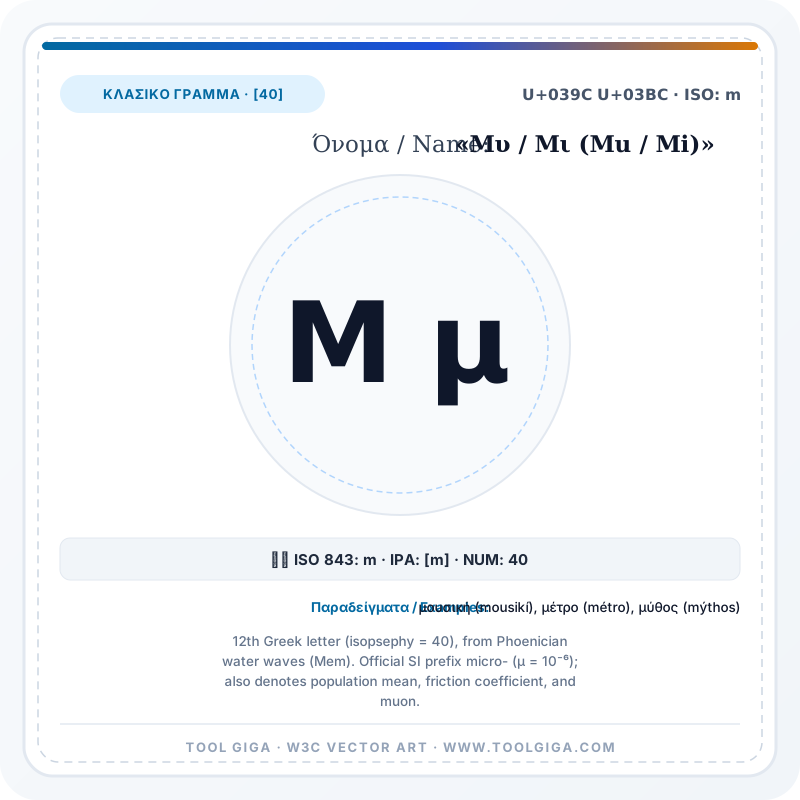
#12 · U+039C / U+03BC
[40]
Greek Letter Μ μ (Mu / Mi) — SI Micro- (10⁻⁶), Mean (μ), Friction & Water [40]
ISO 843: m · IPA: [m] · Isopsephy: 40 · SI micro- (10⁻⁶), Mean (μ) & Friction (Μυ / Μι)
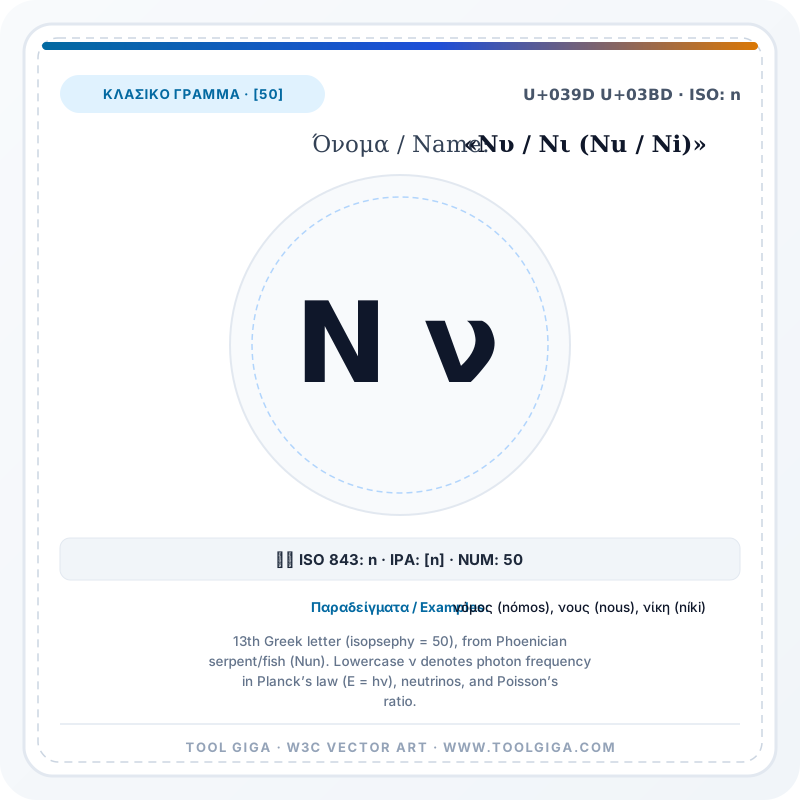
#13 · U+039D / U+03BD
[50]
Greek Letter Ν ν (Nu / Ni) — Photon Frequency (E = hν), Neutrino & Fish [50]
ISO 843: n · IPA: [n] · Isopsephy: 50 · Frequency (E = hν), Neutrino & Poisson's Ratio (Νυ / Νι)
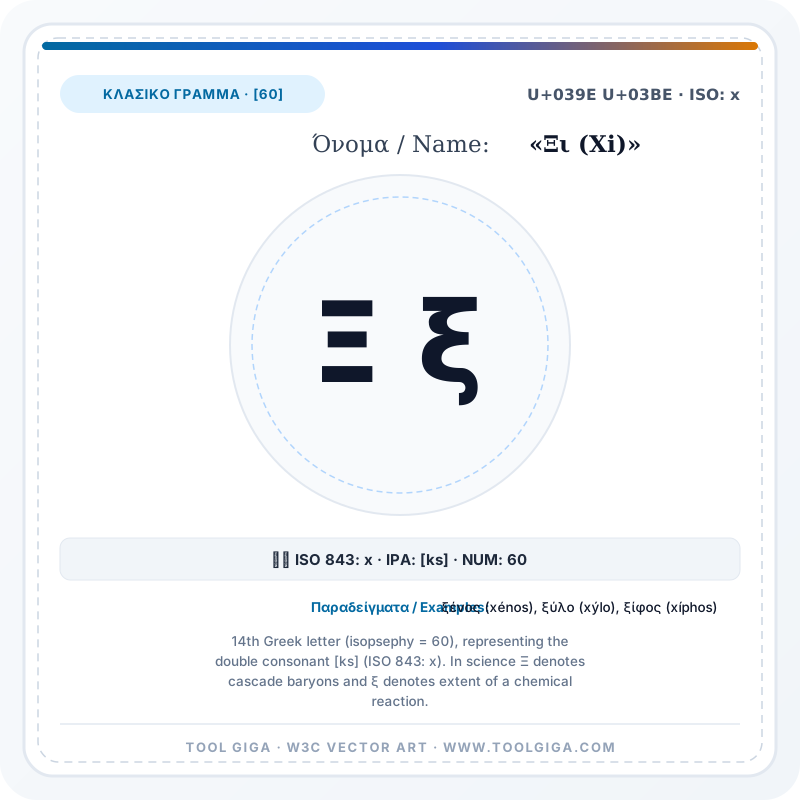
#14 · U+039E / U+03BE
[60]
Greek Letter Ξ ξ (Xi) — Double Consonant [ks], Cascade Baryon & Reaction Extent [60]
ISO 843: x (ks) · IPA: [ks] · Isopsephy: 60 · Cascade Baryon (Ξ) & Chemical Reaction Extent (Ξι)
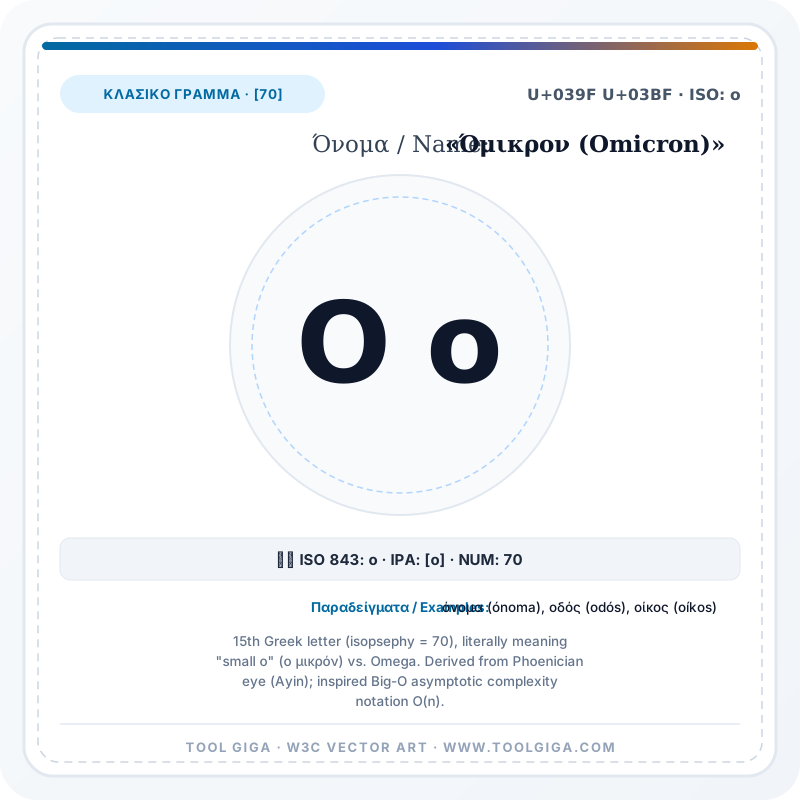
#15 · U+039F / U+03BF
[70]
Greek Letter Ο ο (Omicron) — 'Small O', Eye Pictograph & Big-O Notation [70]
ISO 843: o · IPA: [o] · Isopsephy: 70 · 'Small O' (o mikron), Eye & Big-O Notation (Όμικρον)
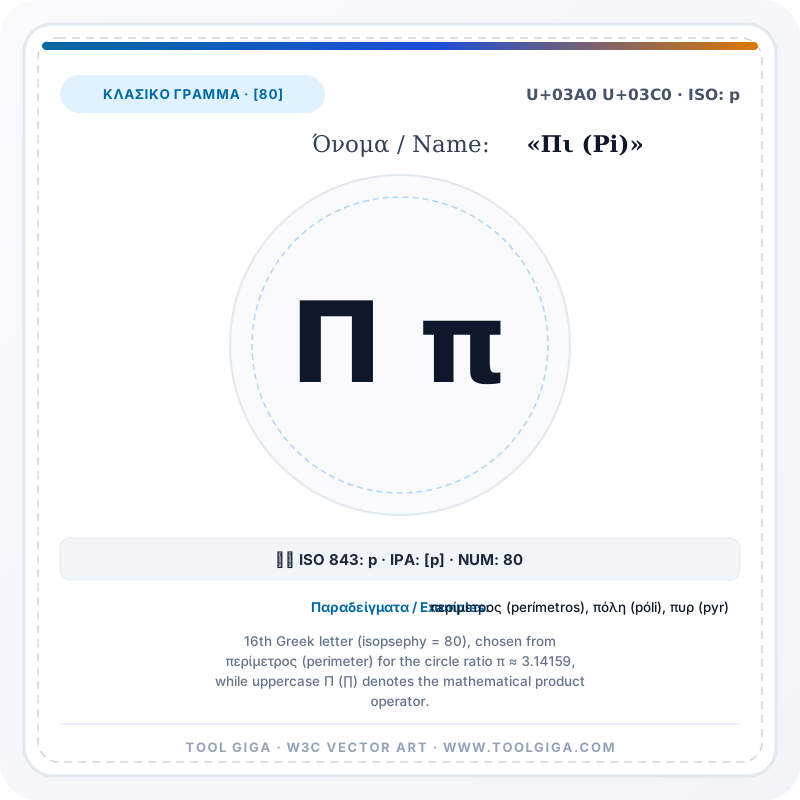
#16 · U+03A0 / U+03C0
[80]
Greek Letter Π π (Pi) — Circle Constant (3.14159...), Product Operator ∏ & Osmotic Pressure [80]
ISO 843: p · IPA: [p] · Isopsephy: 80 · Circle Constant (π ≈ 3.14159) & Product ∏ (Πι)
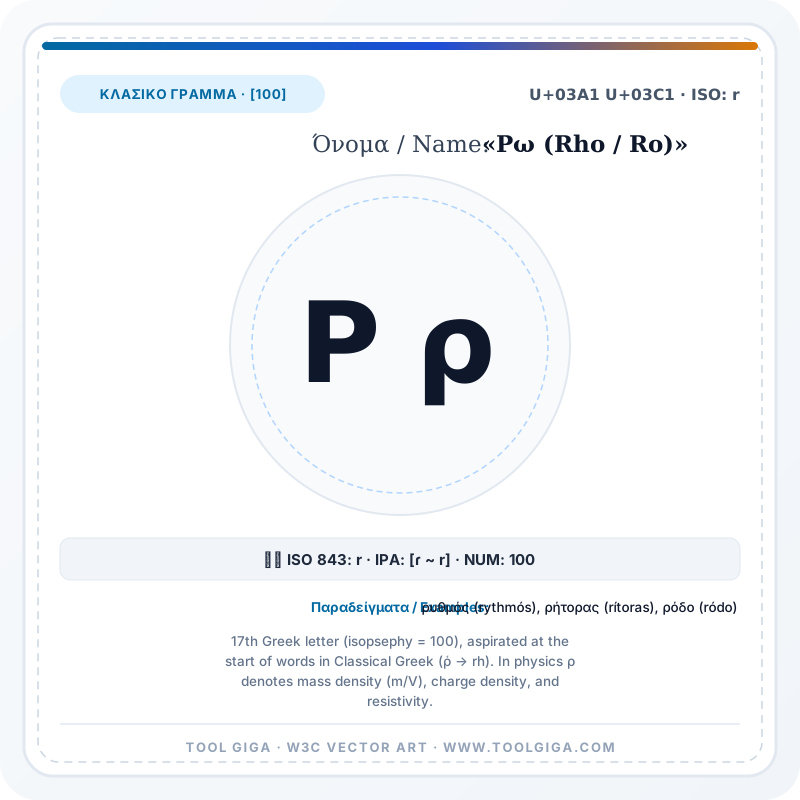
#17 · U+03A1 / U+03C1
[100]
Greek Letter Ρ ρ (Rho / Ro) — Mass Density (ρ = m/V), Resistivity & Head [100]
ISO 843: r · IPA: [ɾ ~ r] · Isopsephy: 100 · Density (ρ = m/V), Resistivity & Correlation (Ρω)
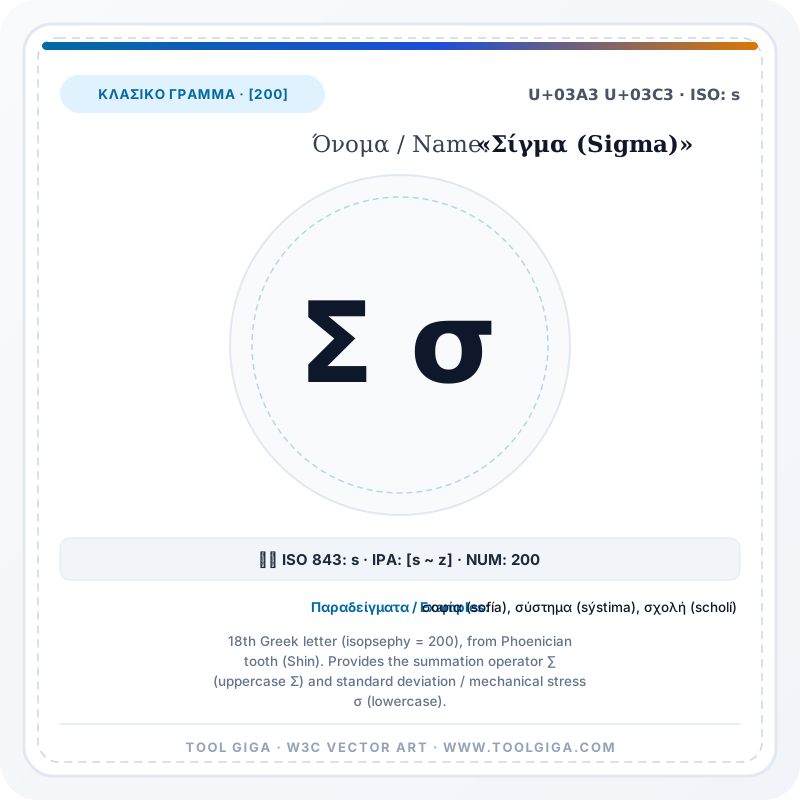
#18 · U+03A3 / U+03C3
[200]
Greek Letter Σ σ (Sigma) — Summation (∑), Standard Deviation (σ) & Stress [200]
ISO 843: s · IPA: [s ~ z] · Isopsephy: 200 · Summation (∑) & Standard Deviation (σ) (Σίγμα)
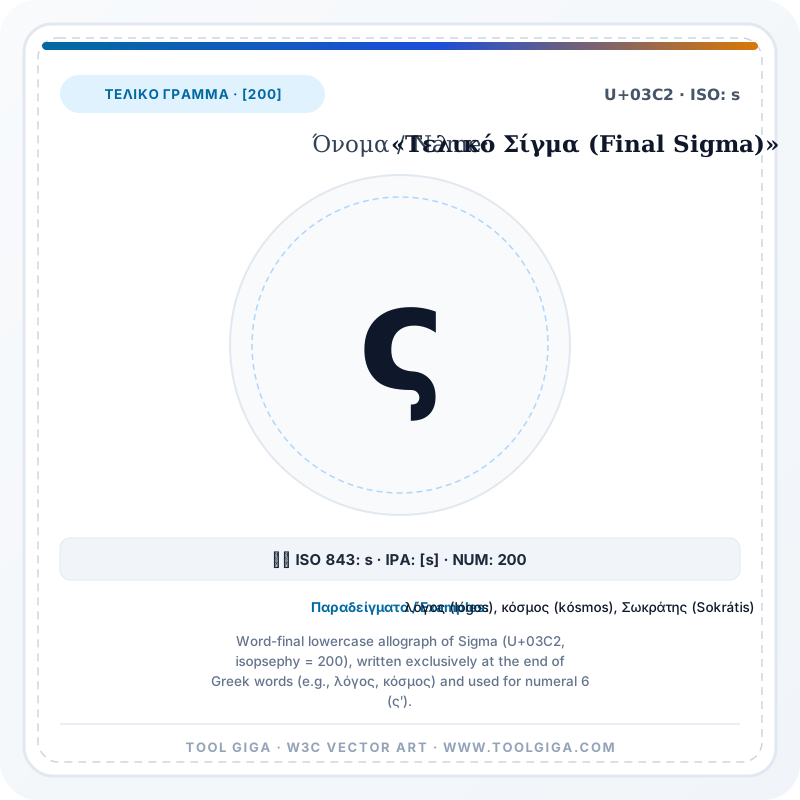
#19 · U+03C2
[200]
Greek Letter ς (Final Sigma / Teliko Sigma) — Word-Final Positional Form [200]
ISO 843: s · IPA: [s] · Isopsephy: 200 · Mandatory Word-Final Lowercase Sigma (Τελικό Σίγμα)
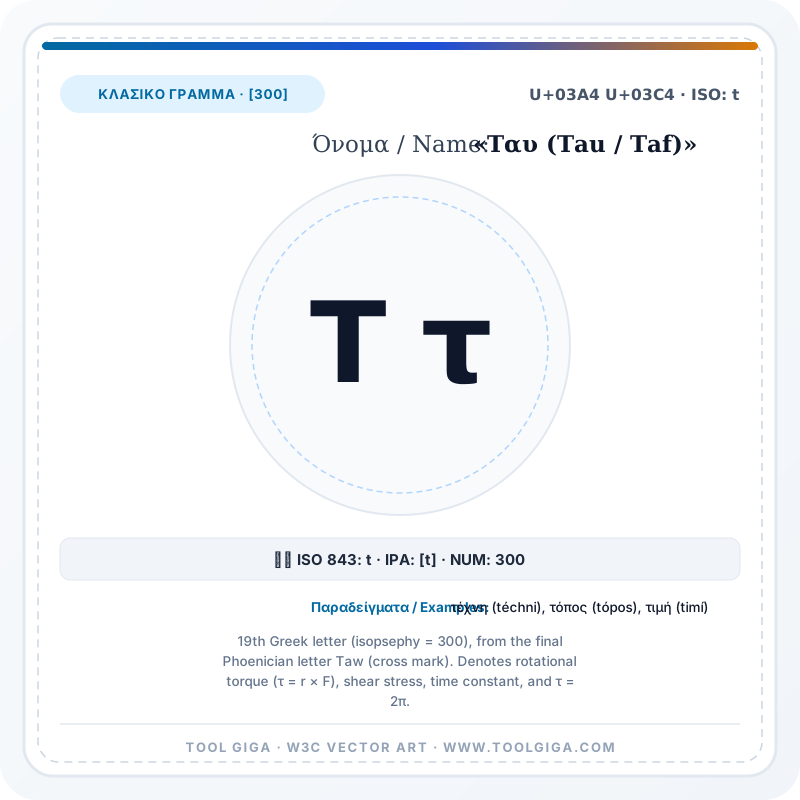
#20 · U+03A4 / U+03C4
[300]
Greek Letter Τ τ (Tau / Taf) — Torque (τ), Time Constant, Circle Turn (2π) & Cross [300]
ISO 843: t · IPA: [t] · Isopsephy: 300 · Torque (τ = r×F), Time Constant & Circle τ = 2π (Ταυ)
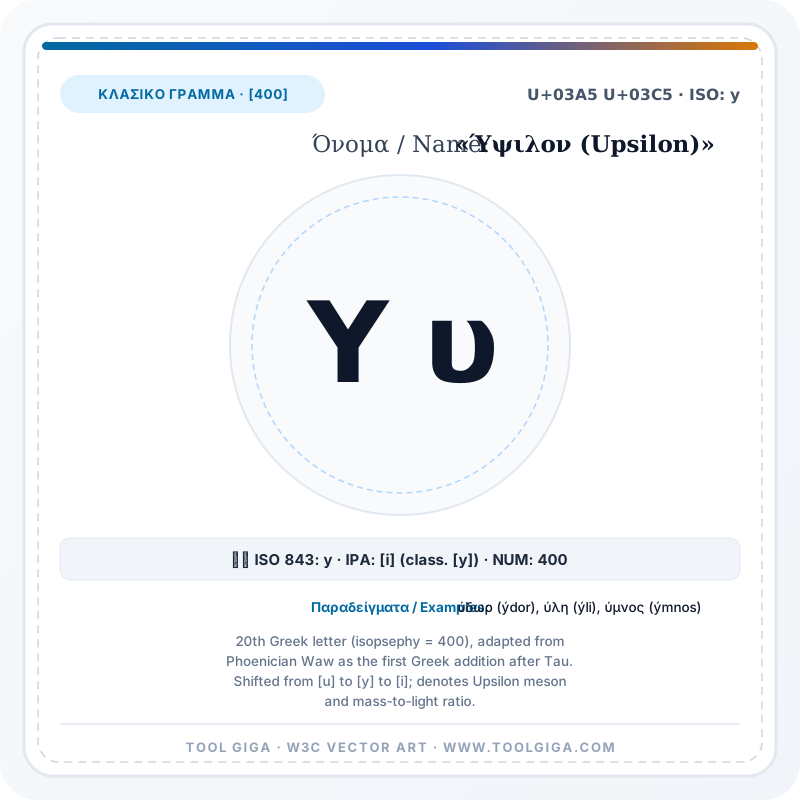
#21 · U+03A5 / U+03C5
[400]
Greek Letter Υ υ (Upsilon) — Pythagorean Fork, Bottomium Meson & Mass-to-Light [400]
ISO 843: y · IPA: [i] (class. [y]) · Isopsephy: 400 · Bottomium Meson & Mass-to-Light Ratio (Ύψιλον)
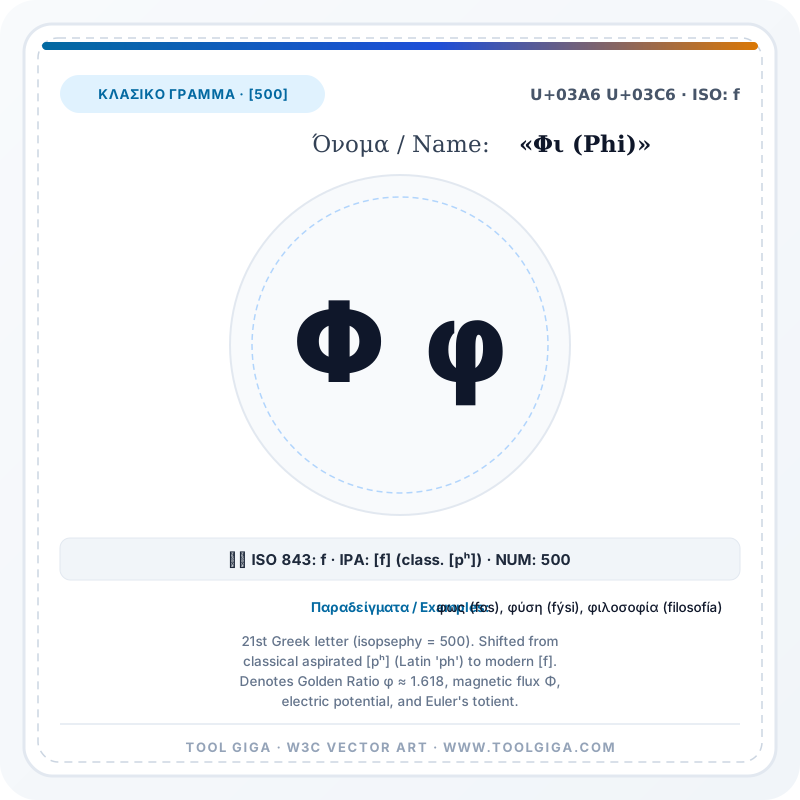
#22 · U+03A6 / U+03C6
[500]
Greek Letter Φ φ (Phi) — Golden Ratio (1.618), Magnetic Flux & Euler's Totient [500]
ISO 843: f · IPA: [f] (class. [pʰ]) · Isopsephy: 500 · Golden Ratio (1.618), Magnetic Flux & Totient (Φι)
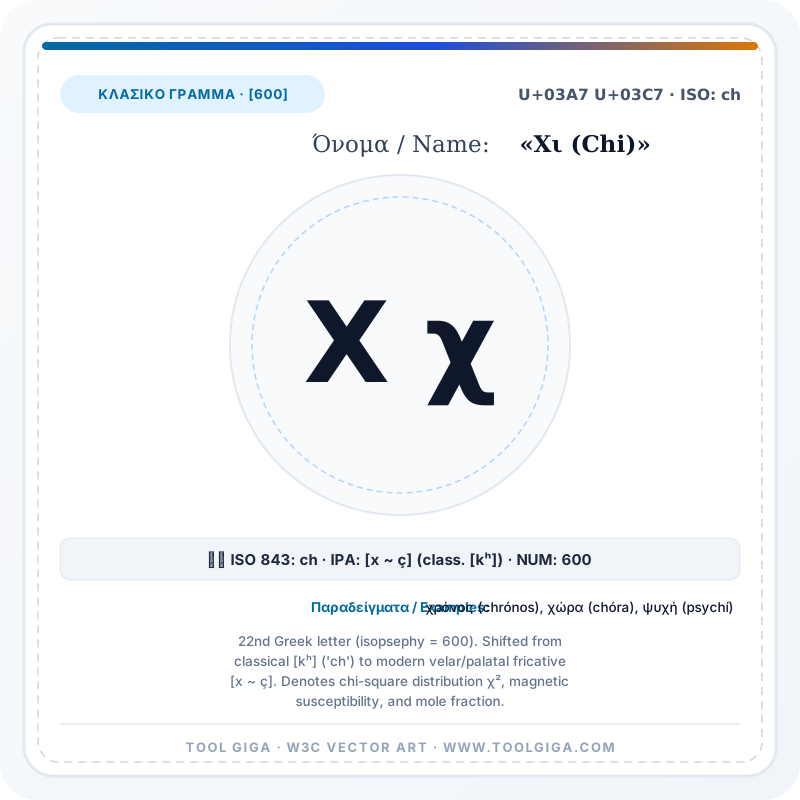
#23 · U+03A7 / U+03C7
[600]
Greek Letter Χ χ (Chi) — Chi-Square Distribution, Susceptibility & Mole Fraction [600]
ISO 843: ch · IPA: [x ~ ç] (class. [kʰ]) · Isopsephy: 600 · Statistical Fit Test, Susceptibility & Mole Fraction (Χι)
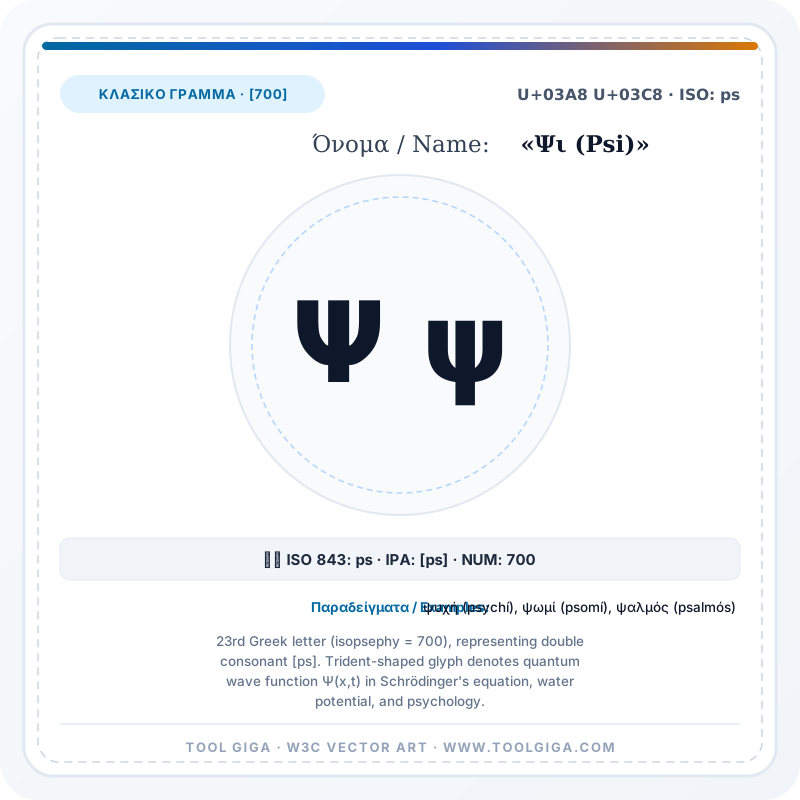
#24 · U+03A8 / U+03C8
[700]
Greek Letter Ψ ψ (Psi) — Quantum Wave Function, Water Potential & Psychology [700]
ISO 843: ps · IPA: [ps] · Isopsephy: 700 · Quantum Wave Function, Water Potential & Psychology (Ψι)
#25 · U+03A9 / U+03C9
[800]
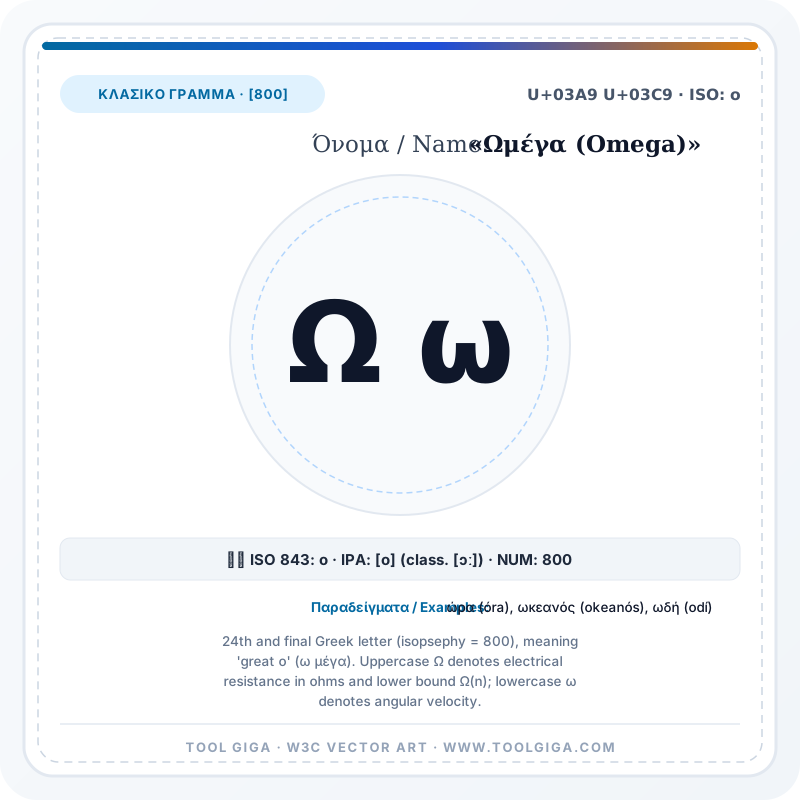
Greek Letter Ω ω (Omega) — SI Unit Ohm (Ω), Angular Velocity & Ultimate End [800]
ISO 843: o · IPA: [o] (class. [ɔː]) · Isopsephy: 800 · Ohm Resistance (Ω), Angular Velocity & End (Ωμέγα)
#26 · U+03DC / U+03DD
[6]
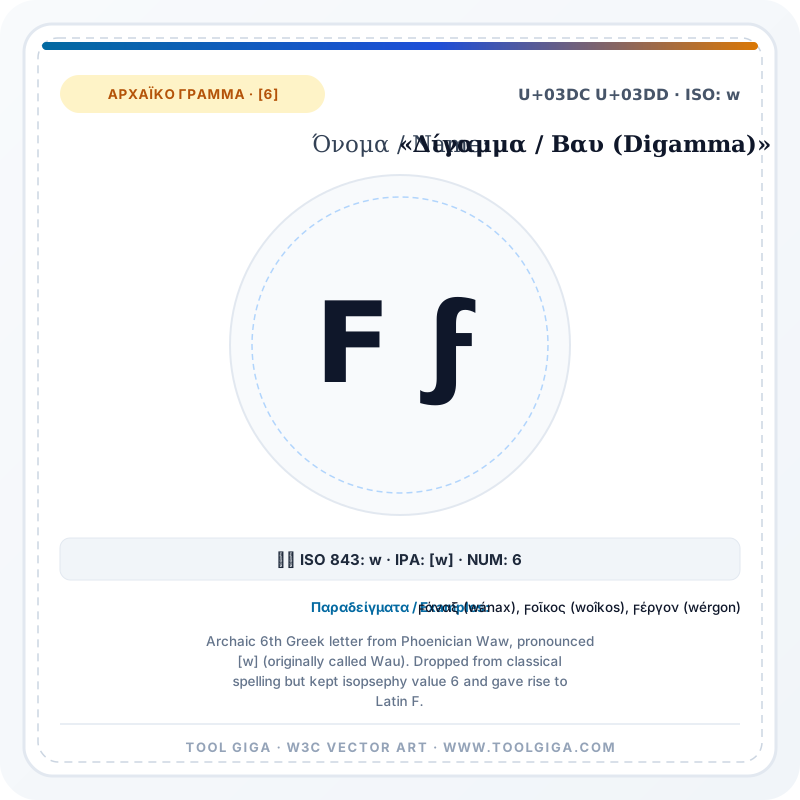
Archaic Greek Ϝ ϝ (Digamma / Wau) — Labial-Velar [w], Numeral 6 & Ancestor of F [6]
ISO 843: w · IPA: [w] · Isopsephy: 6 · Archaic 6th Letter, Homeric Meter & Ancestor of F (Δίγαμμα)
#27 · U+03DA / U+03DB
[6]
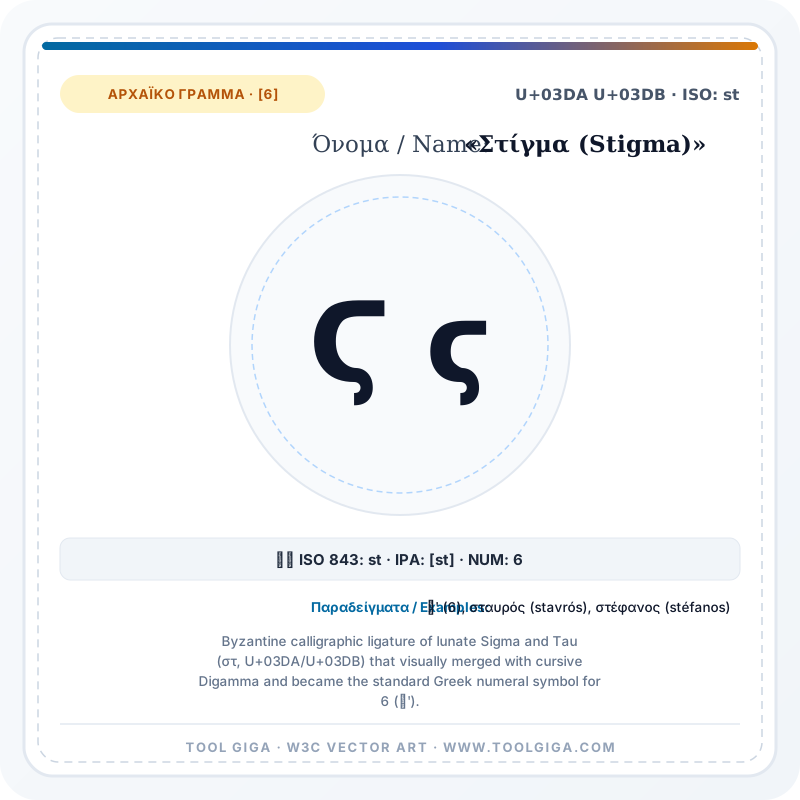
Byzantine Ligature Ϛ ϛ (Stigma) — Sigma-Tau Ligature (στ) & Greek Numeral Six [6]
ISO 843: st · IPA: [st] · Isopsephy: 6 (ϛʹ) · Byzantine στ Ligature & Numeral 6 (Στίγμα)
#28 · U+03D8 / U+03D9
[90]
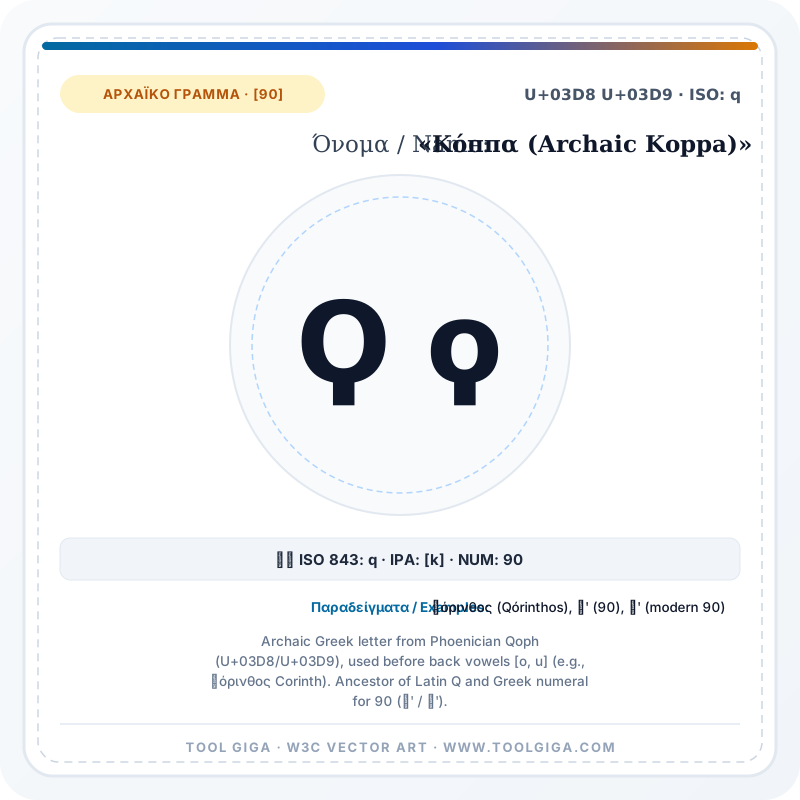
Archaic Greek Ϙ ϙ (Koppa / Qoppa) — Corinthian Emblem, Ancestor of Q & Numeral 90 [90]
ISO 843: q · IPA: [k] · Isopsephy: 90 · Corinthian Coin Emblem, Ancestor of Q & Numeral 90 (Κόππα)
#29 · U+03E0 / U+03E1
[900]
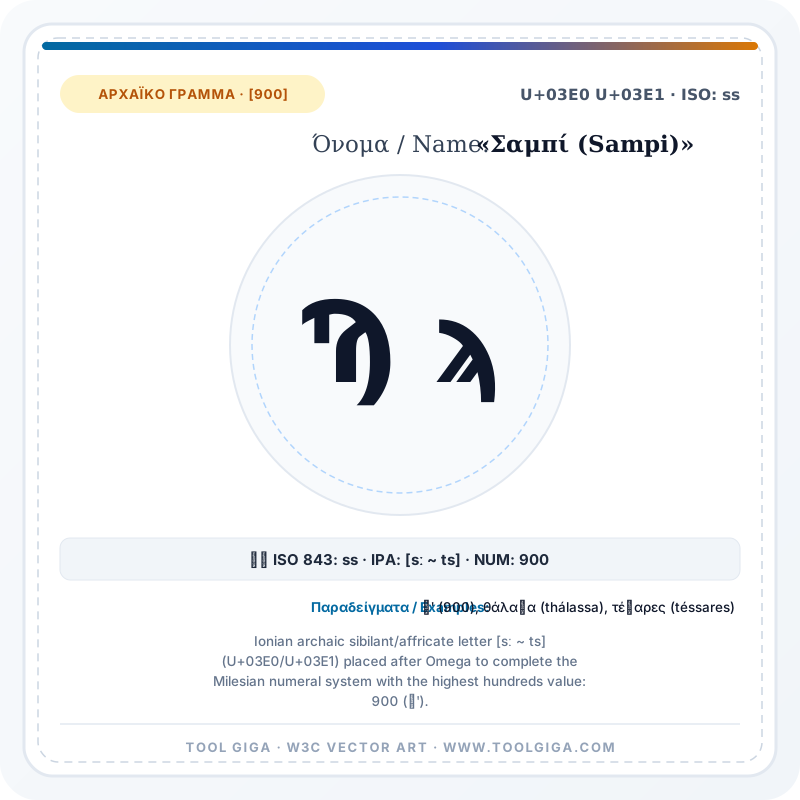
Archaic Greek Ϡ ϡ (Sampi) — Ionian Sibilant [ss/ts] & Highest Hundreds Numeral [900]
ISO 843: ss · IPA: [sː ~ ts] · Isopsephy: 900 (ϡʹ) · Ionian Sibilant & Numeral 900 (Σαμπί)
#30 · U+0370 / U+0371
[8]
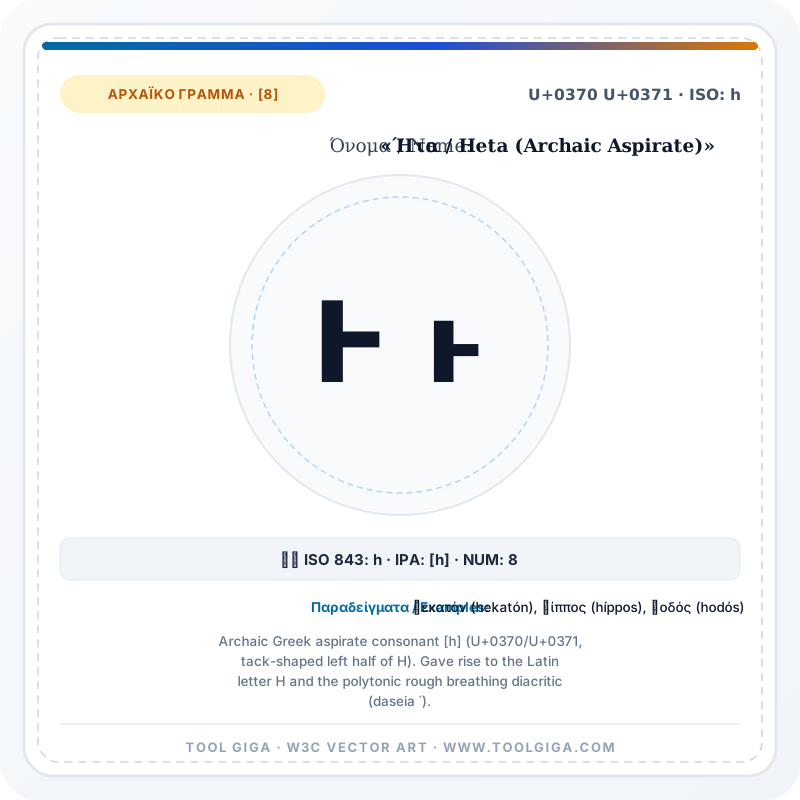
Archaic Greek Ͱ ͱ (Heta) — Glottal Aspirate [h], Rough Breathing Origin & Latin H [8]
ISO 843: h · IPA: [h] · Isopsephy: 8 · Archaic Aspirate [h] & Origin of Rough Breathing (῾) (Heta)
#31 · U+03FA / U+03FB
[—]
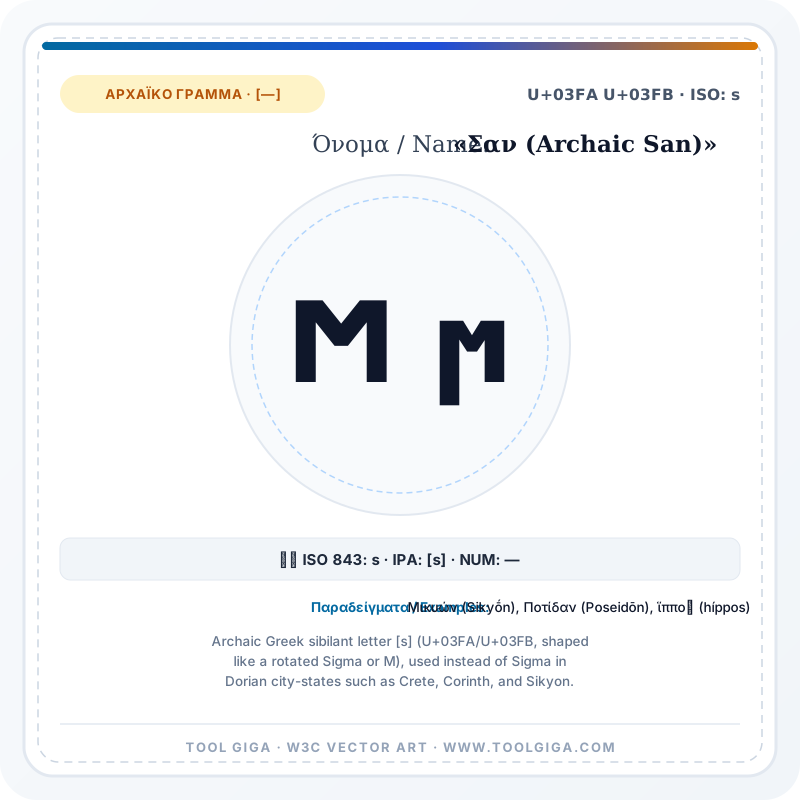
Archaic Greek Ϻ ϻ (San) — Dorian Sibilant [s] of Crete, Corinth & Sikyon [—]
ISO 843: s · IPA: [s] · Isopsephy: — · Dorian Alternative to Sigma in Crete, Corinth & Sikyon (Σαν)
#32 · U+03F7 / U+03F8
[—]
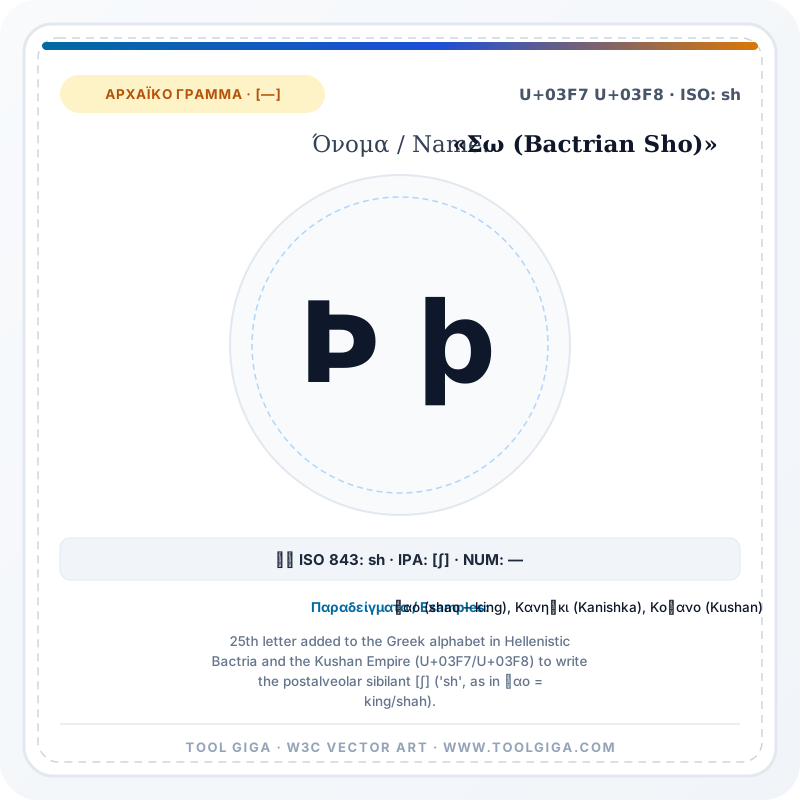
Hellenistic Greek Ϸ ϸ (Bactrian Sho) — 25th Letter for [ʃ] on Kushan Coins [—]
ISO 843: sh · IPA: [ʃ] · Isopsephy: — · 25th Greek Letter in Bactria & Kushan Empire (Σω / Sho)
#33 · U+03D1
[9]
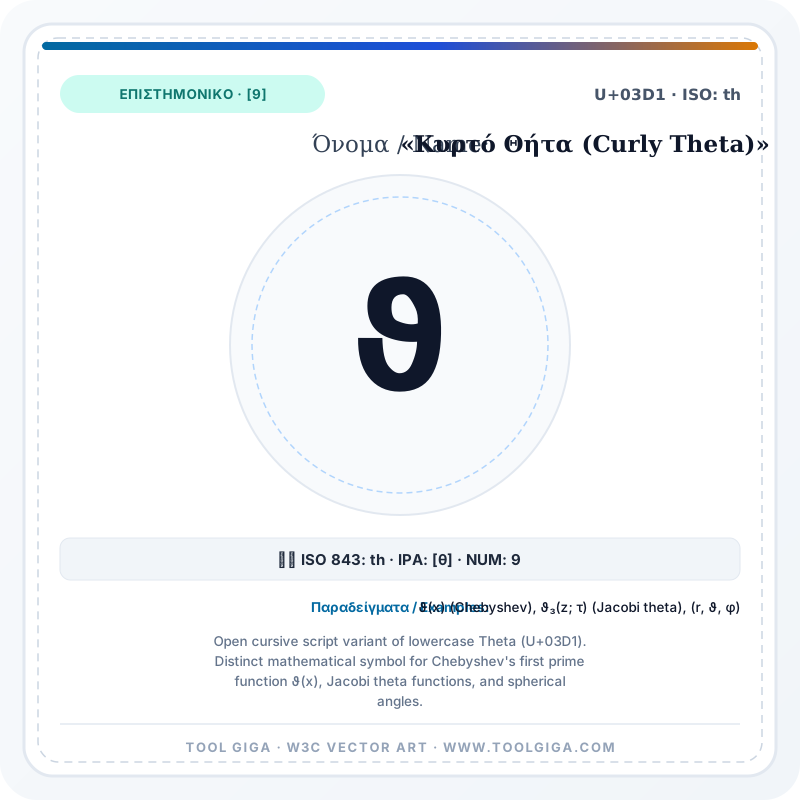
Greek Symbol ϑ (Curly Theta) — Chebyshev Prime Function & Spherical Angle [9]
ISO 843: th · U+03D1 · Isopsephy: 9 · Chebyshev Prime Function ϑ(x) & Jacobi Theta (Κυρτό Θήτα)
#34 · U+03D5
[500]
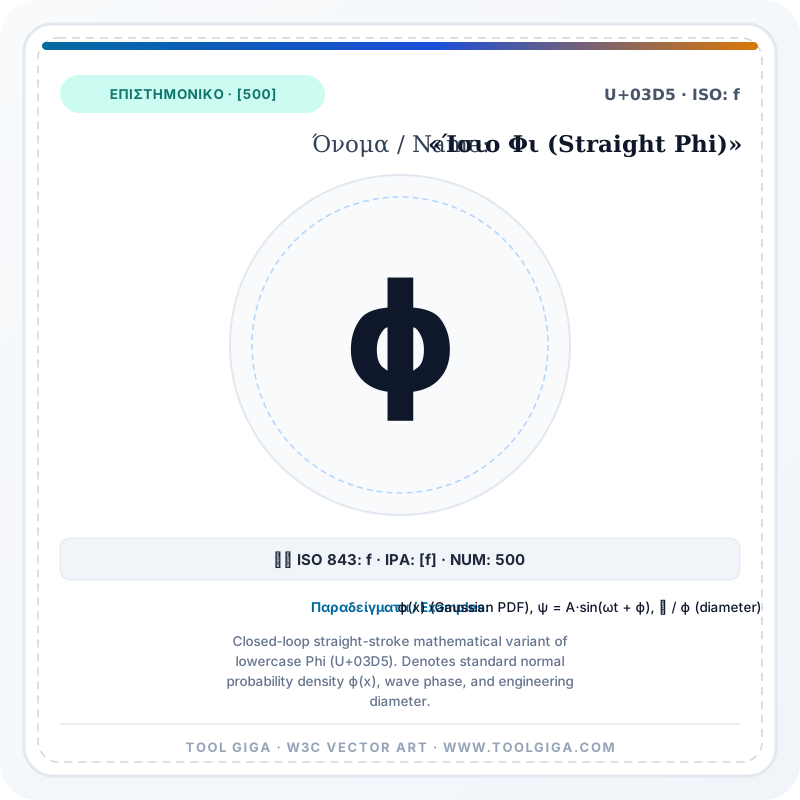
Greek Symbol ϕ (Straight Phi) — Normal Density, Wave Phase & Engineering Diameter [500]
ISO 843: f · U+03D5 · Isopsephy: 500 · Standard Normal Density ϕ(x), Wave Phase & Diameter (Ίσιο Φι)
#35 · U+03D6
[80]
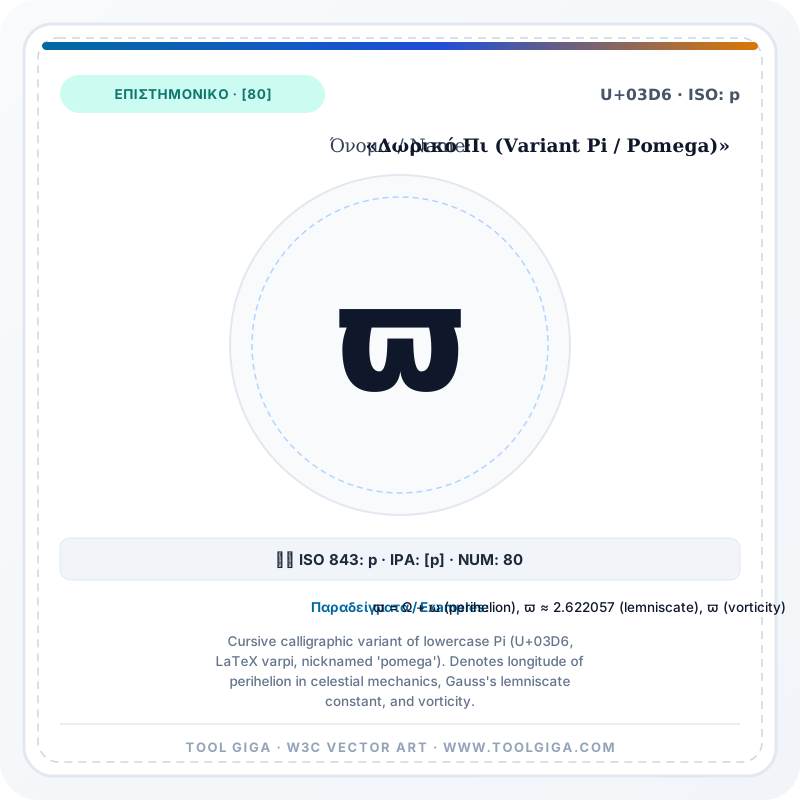
Greek Symbol ϖ (Variant Pi / Pomega) — Longitude of Perihelion & Lemniscate Constant [80]
ISO 843: p · U+03D6 · Isopsephy: 80 · Longitude of Perihelion, Vorticity & Lemniscate Constant (Δωρικό Πι)
#36 · U+03F0
[20]
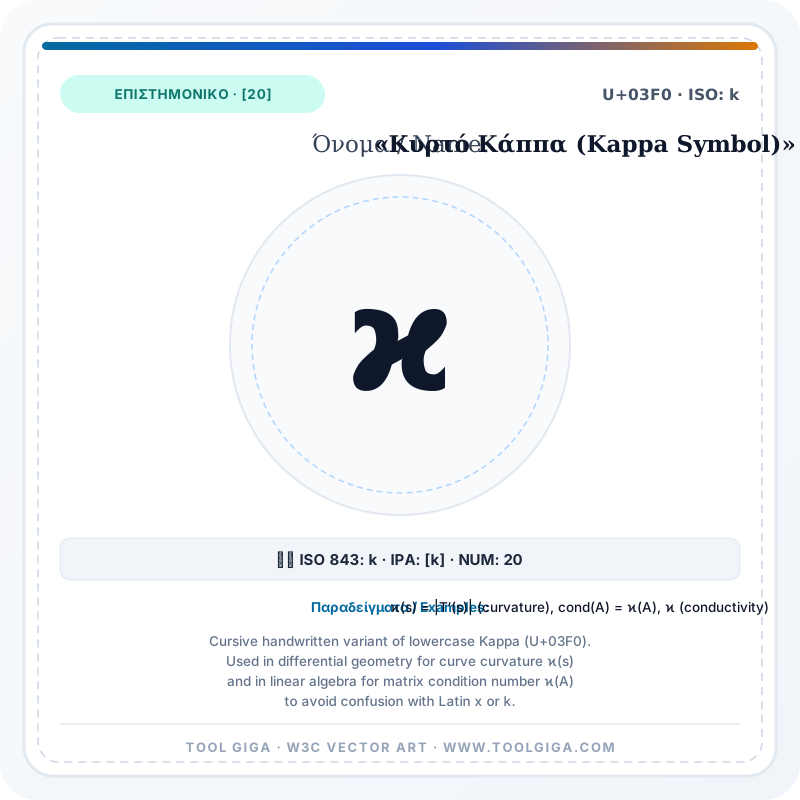
Greek Symbol ϰ (Cursive Kappa) — Differential Curvature & Matrix Condition Number [20]
ISO 843: k · U+03F0 · Isopsephy: 20 · Differential Curvature ϰ(s) & Matrix Condition Number (Κυρτό Κάππα)
#37 · U+03F1
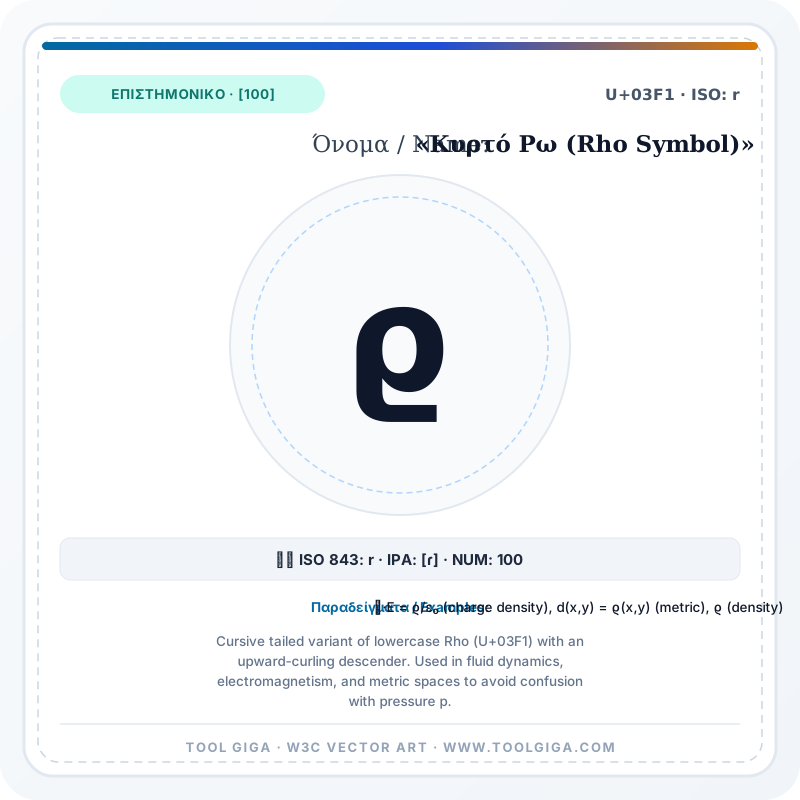
[100]
Greek Symbol ϱ (Tailed Rho) — Charge Density, Metric Distance & Fluid Density [100]
ISO 843: r · U+03F1 · Isopsephy: 100 · Charge/Fluid Density & Metric Distance (Distinct from p) (Κυρτό Ρω)
#38 · U+03F5
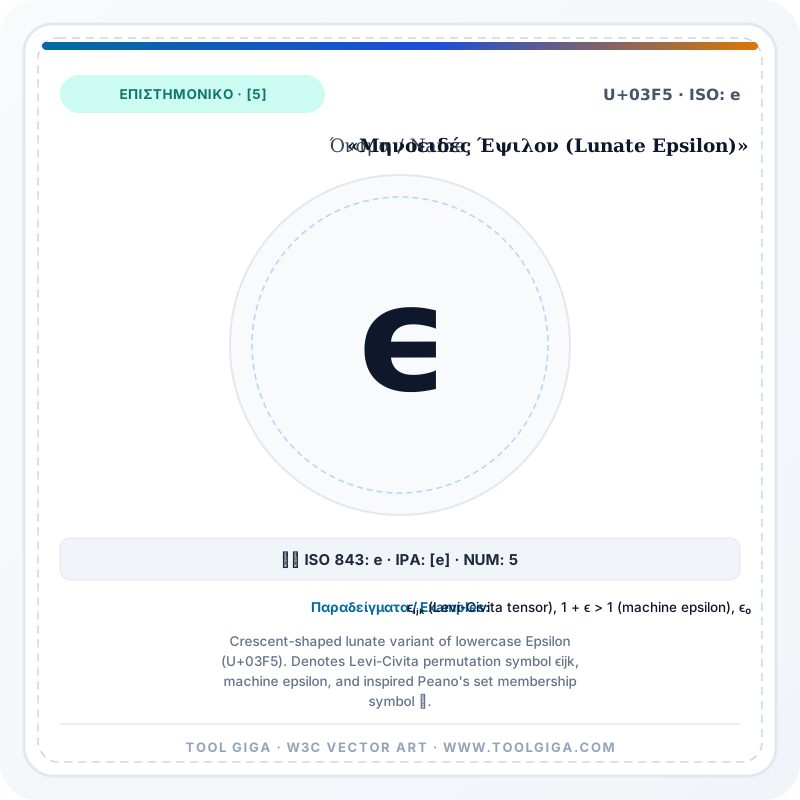
[5]
Greek Symbol ϵ (Lunate Epsilon) — Levi-Civita Tensor, Machine Precision & Set Origin [5]
ISO 843: e · U+03F5 · Isopsephy: 5 · Levi-Civita Tensor ϵijk, Machine Epsilon & Origin of ∈ (Μηνοειδές Έψιλον)
#39 · U+03D0
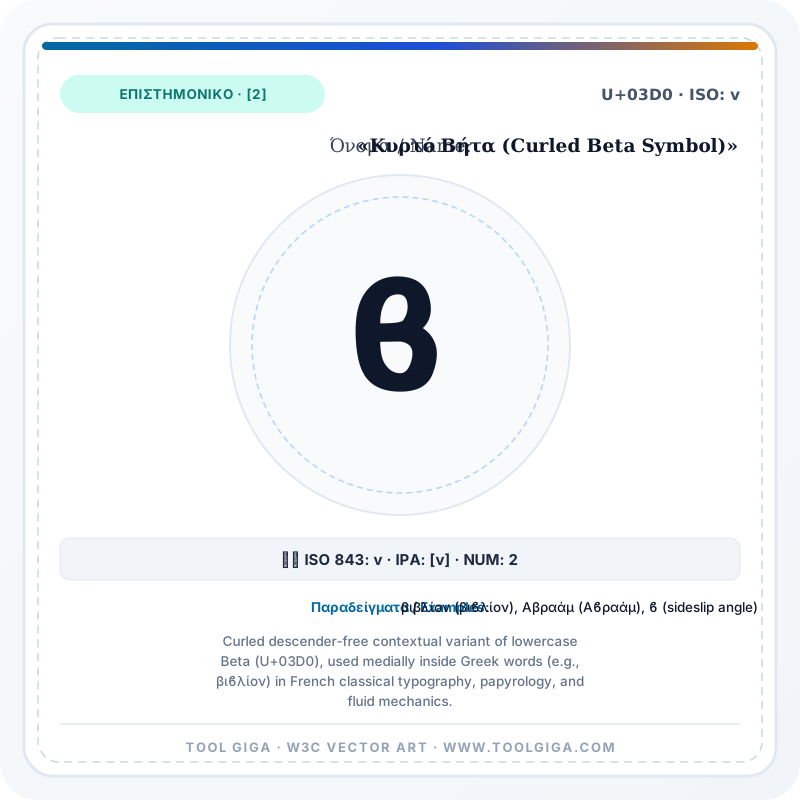
[2]
Greek Symbol ϐ (Curled Beta / U+03D0) — Medial Cursive Typography & Aerodynamics [2]
Unicode: U+03D0 · IPA: [v] · Isopsephy: 2 · Word-Medial Descender-Free Beta (βιϐλίον) (Κυρτό Βήτα)
#40 · U+03D2
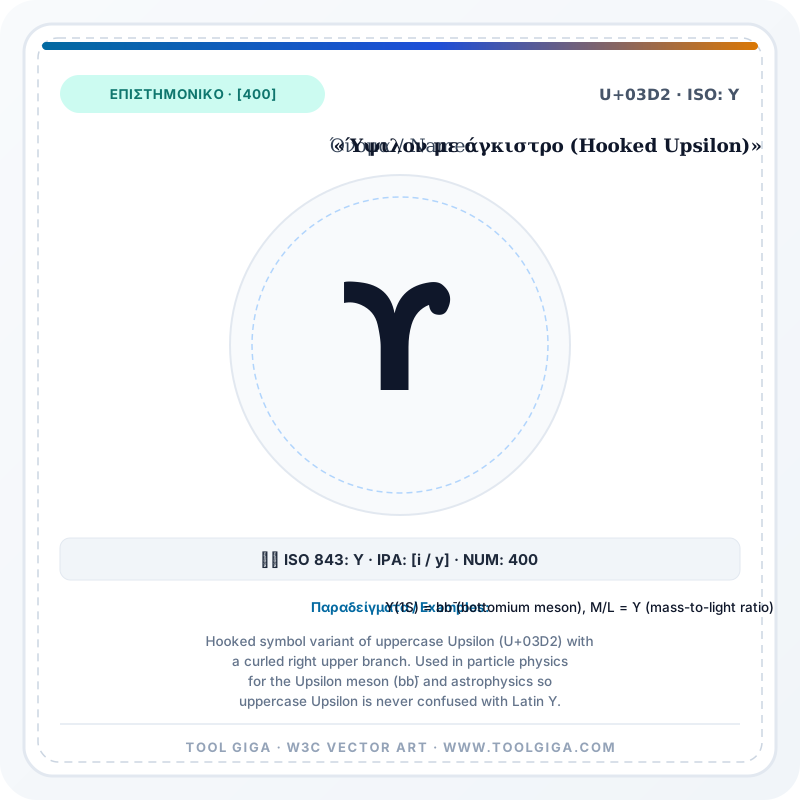
[400]
Greek Symbol ϒ (Hooked Upsilon) — Bottomium Meson & Astrophysical Mass-to-Light [400]
ISO 843: Y · U+03D2 · Isopsephy: 400 · Bottomium Meson ϒ(1S) Distinct from Latin Y (Ύψιλον με άγκιστρο)
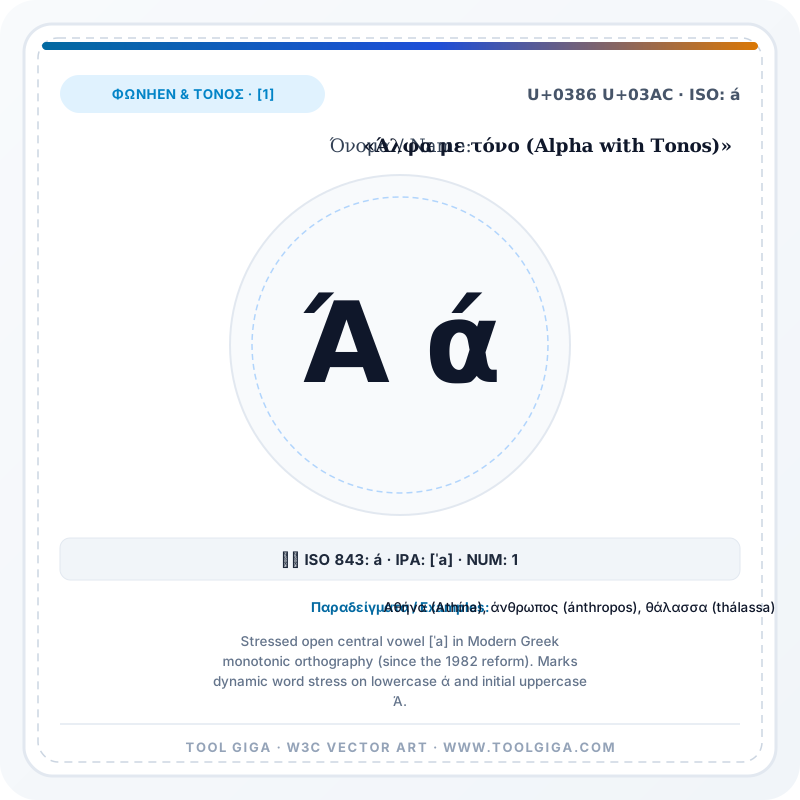
#41 · U+0386 / U+03AC
[1]
Greek Vowel Ά ά (Alpha with Tonos) — Stressed Open Vowel & 1982 Monotonic Accent [1]
ISO 843: á · IPA: [ˈa] · Isopsephy: 1 · Stressed Open Vowel in Monotonic Greek (Άλφα με τόνο)
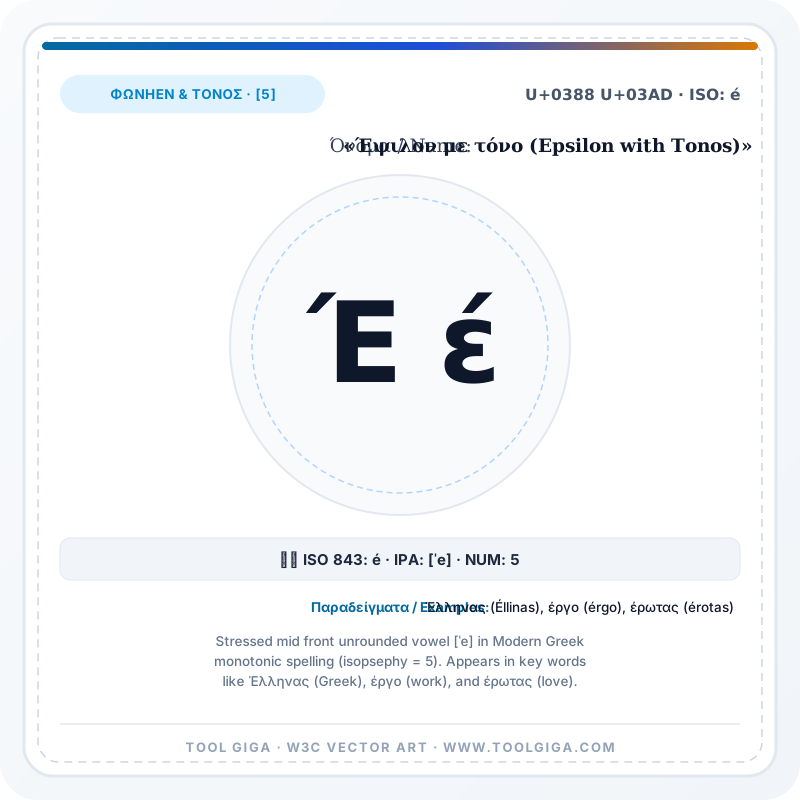
#42 · U+0388 / U+03AD
[5]
Greek Vowel Έ έ (Epsilon with Tonos) — Stressed Mid Front Vowel [5]
ISO 843: é · IPA: [ˈe] · Isopsephy: 5 · Stressed Mid Front Vowel [ˈe] (Έψιλον με τόνο)
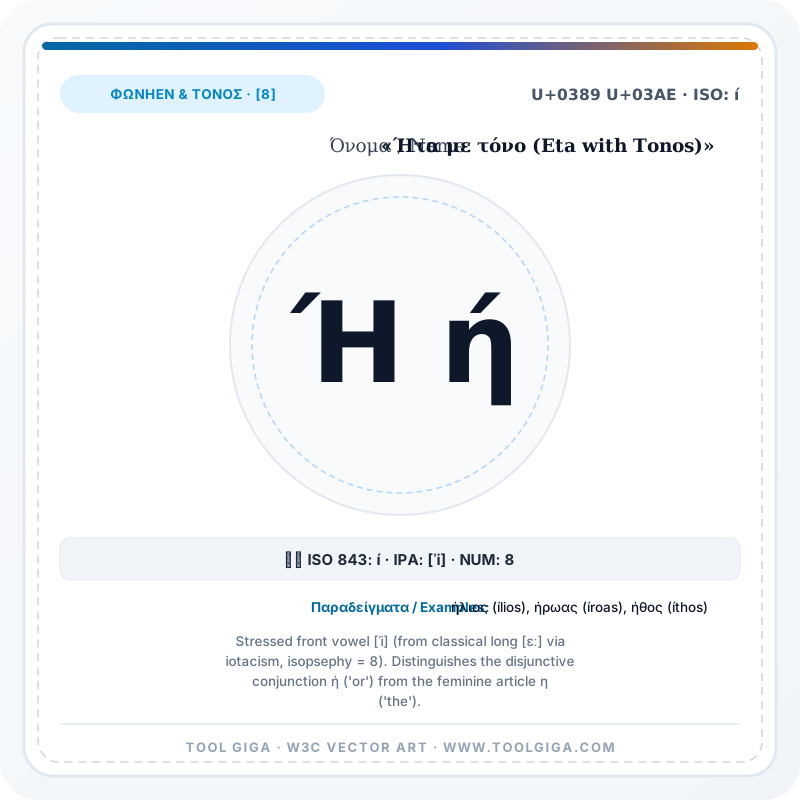
#43 · U+0389 / U+03AE
[8]
Greek Vowel Ή ή (Eta with Tonos) — Stressed Iotacized Vowel & Disjunctive 'Or' [8]
ISO 843: í · IPA: [ˈi] · Isopsephy: 8 · Stressed Eta [ˈi] & Disjunctive Conjunction 'or' (Ήτα με τόνο)
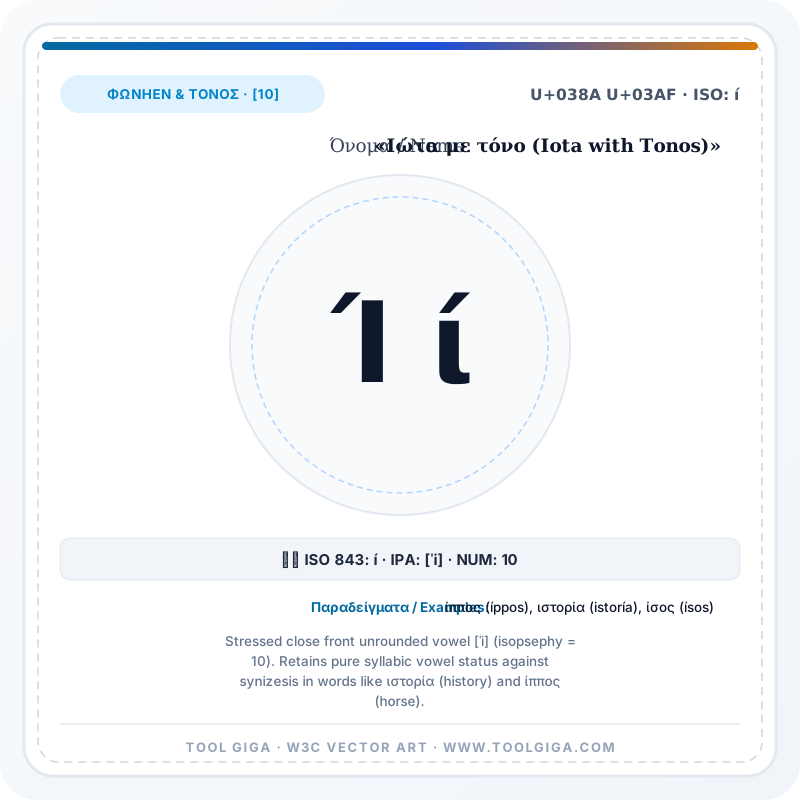
#44 · U+038A / U+03AF
[10]
Greek Vowel Ί ί (Iota with Tonos) — Stressed Close Front Vowel & Syllabic Guard [10]
ISO 843: í · IPA: [ˈi] · Isopsephy: 10 · Stressed Pure Close Front Vowel [ˈi] (Ιώτα με τόνο)
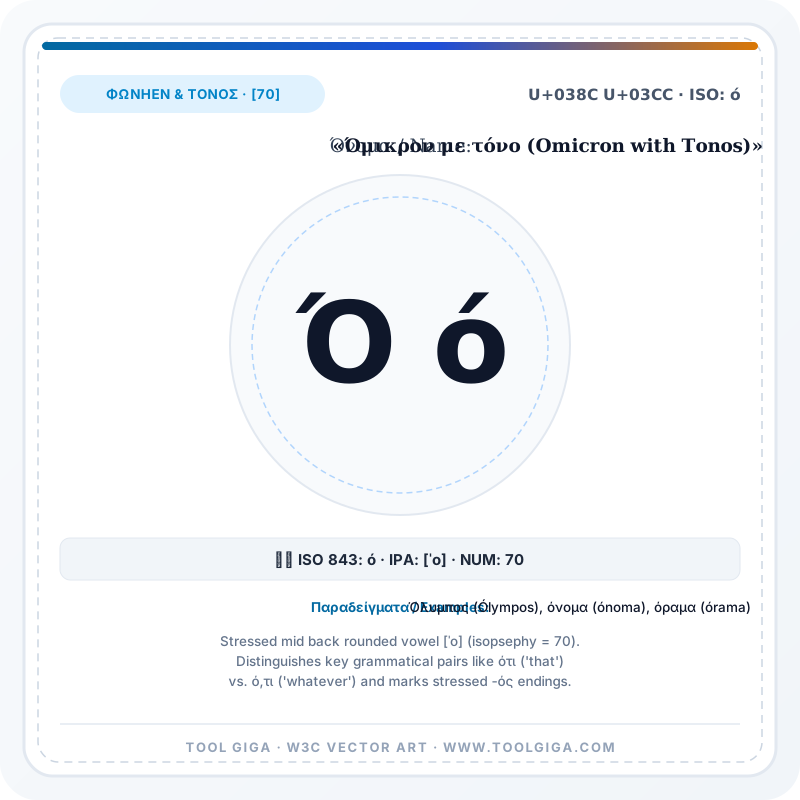
#45 · U+038C / U+03CC
[70]
Greek Vowel Ό ό (Omicron with Tonos) — Stressed Rounded Back Vowel [70]
ISO 843: ó · IPA: [ˈo] · Isopsephy: 70 · Stressed Mid Back Rounded Vowel [ˈo] (Όμικρον με τόνο)
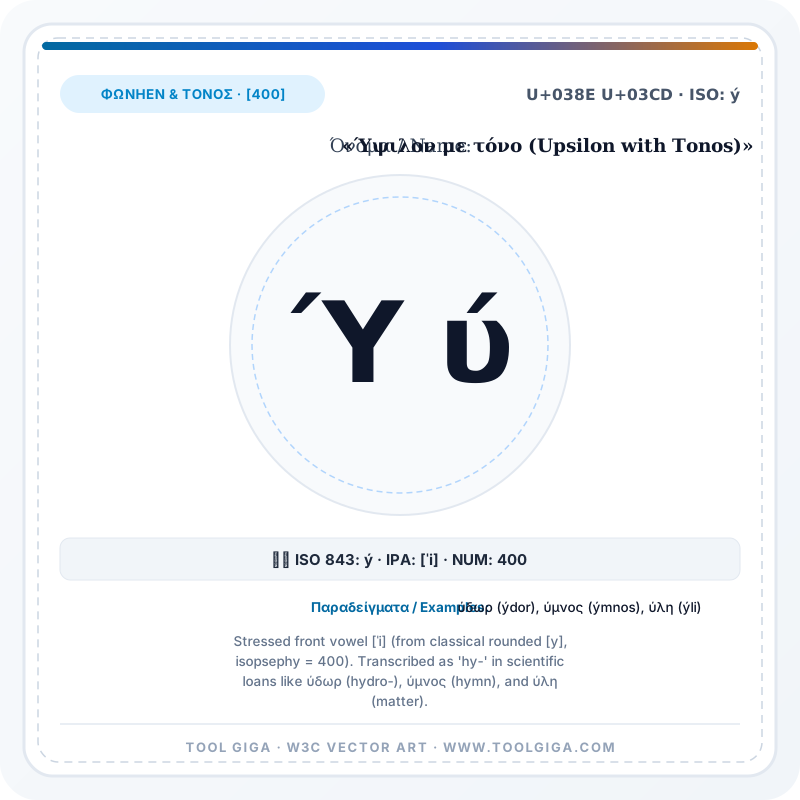
#46 · U+038E / U+03CD
[400]
Greek Vowel Ύ ύ (Upsilon with Tonos) — Stressed Vowel & Scientific 'Hydro-/Hypno-' Root [400]
ISO 843: ý · IPA: [ˈi] · Isopsephy: 400 · Stressed Upsilon & Origin of 'Hydro-/Hymn' (Ύψιλον με τόνο)
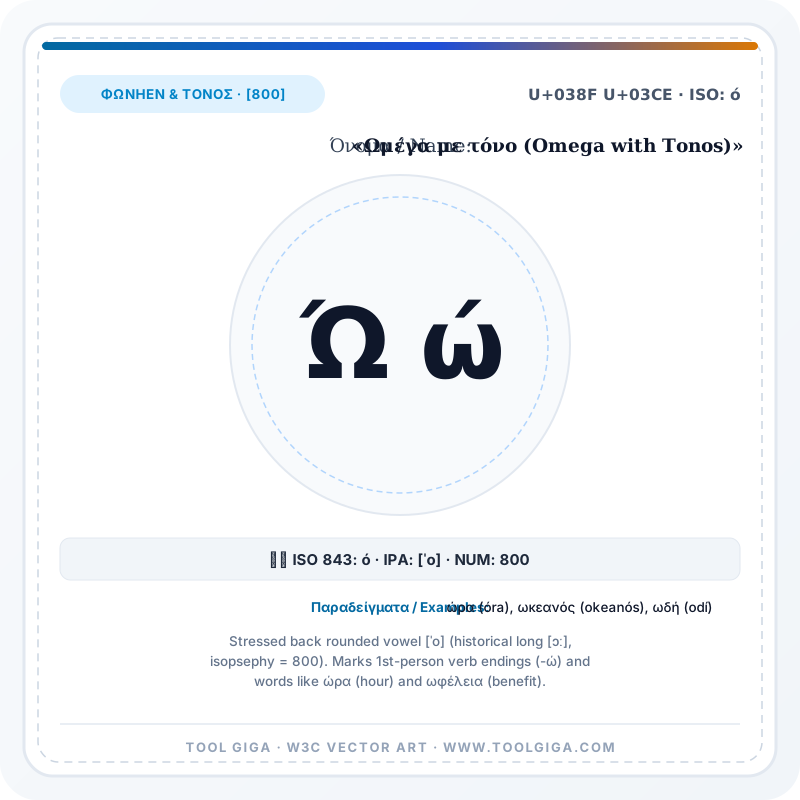
#47 · U+038F / U+03CE
[800]
Greek Vowel Ώ ώ (Omega with Tonos) — Stressed Long 'O' & Oxytone Verb Ending [800]
ISO 843: ó · IPA: [ˈo] · Isopsephy: 800 · Stressed Omega [ˈo] & 1st-Person Verb Ending -ώ (Ωμέγα με τόνο)
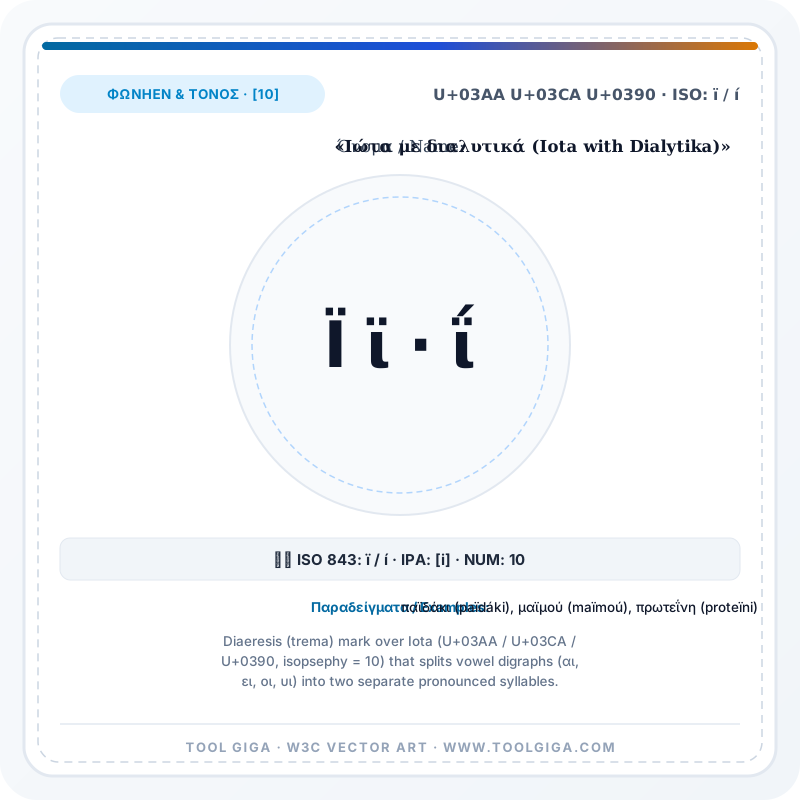
#48 · U+03AA / U+03CA / U+0390
[10]
Greek Vowel Ϊ ϊ · ΐ (Iota with Dialytika) — Diaeresis Hiatus & Syllable Splitter [10]
ISO 843: ï / í · IPA: [i] · Isopsephy: 10 · Diaeresis Splitting Vowel Digraphs into Hiatus (Ιώτα με διαλυτικά)
#49 · U+03AB / U+03CB / U+03B0
[400]
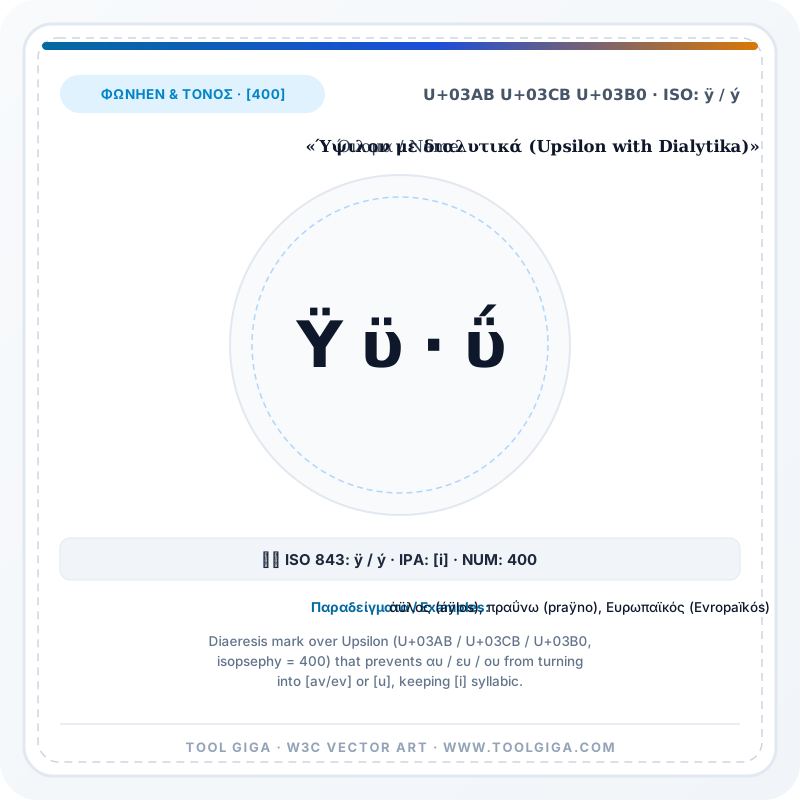
Greek Vowel Ϋ ϋ · ΰ (Upsilon with Dialytika) — Digraph Consonantalization Blocker [400]
ISO 843: ÿ / ý · IPA: [i] · Isopsephy: 400 · Diaeresis Preventing αυ/ευ Consonantalization (Ύψιλον με διαλυτικά)
#50 · U+1F08 / U+1F00
[1]
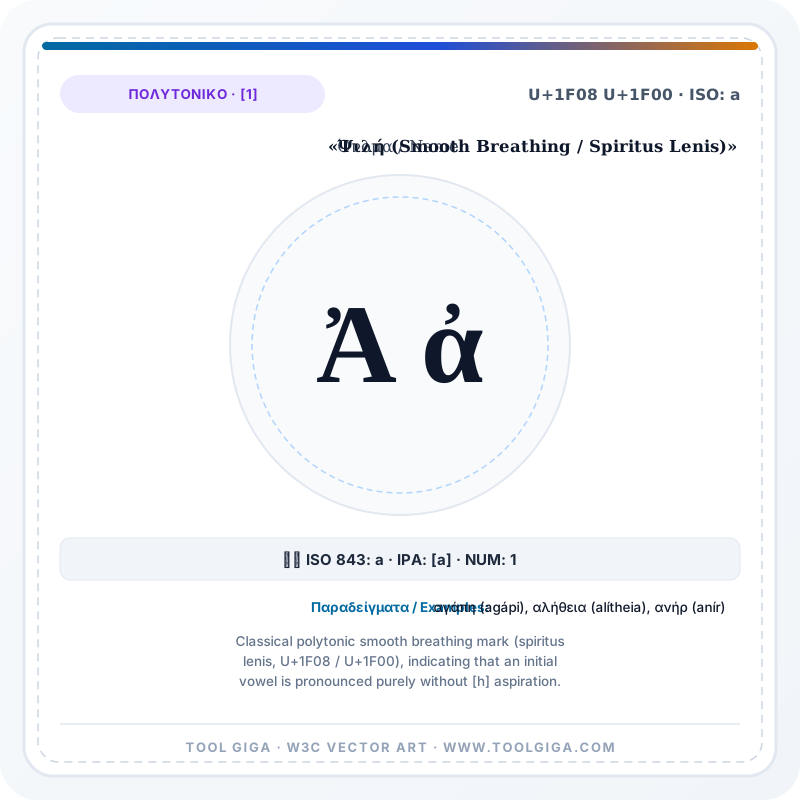
Polytonic Sign Ἀ ἀ (Psili / Smooth Breathing) — Unaspirated Initial Vowel [1]
ISO 843: a · IPA: [a] · Isopsephy: 1 · Smooth Breathing (Spiritus Lenis) — No Initial [h] (Ψιλή)
#51 · U+1F09 / U+1F01
[1]
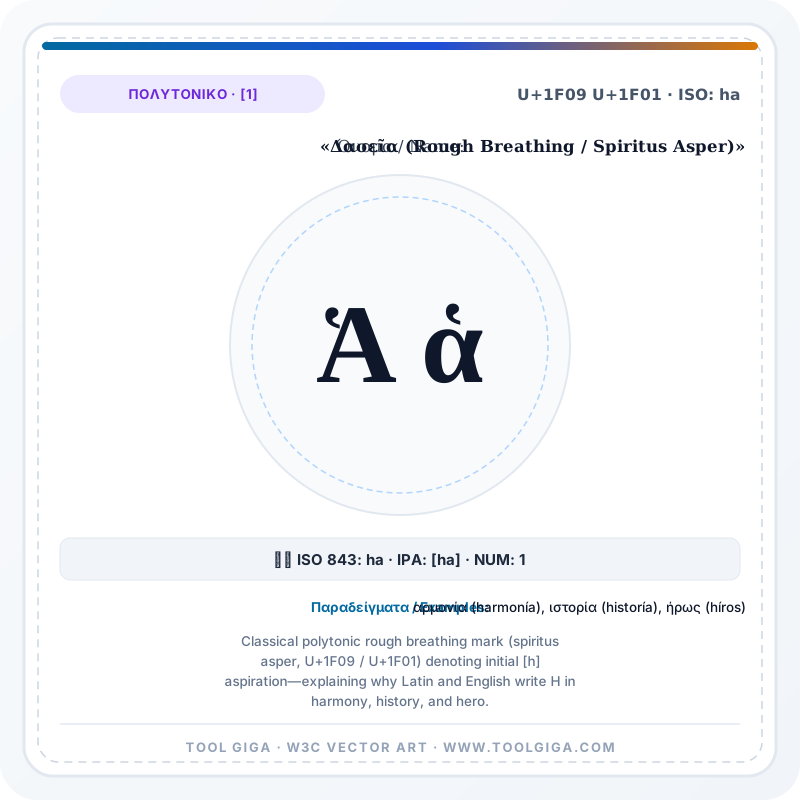
Polytonic Sign Ἁ ἁ (Daseia / Rough Breathing) — Initial [h] & Origin of 'Harmony/History' [1]
ISO 843: ha · IPA: [ha] · Isopsephy: 1 · Rough Breathing [h-] — Origin of H in Harmony/History (Δασεῖα)
#52 · U+1FBB / U+1F70
[1]
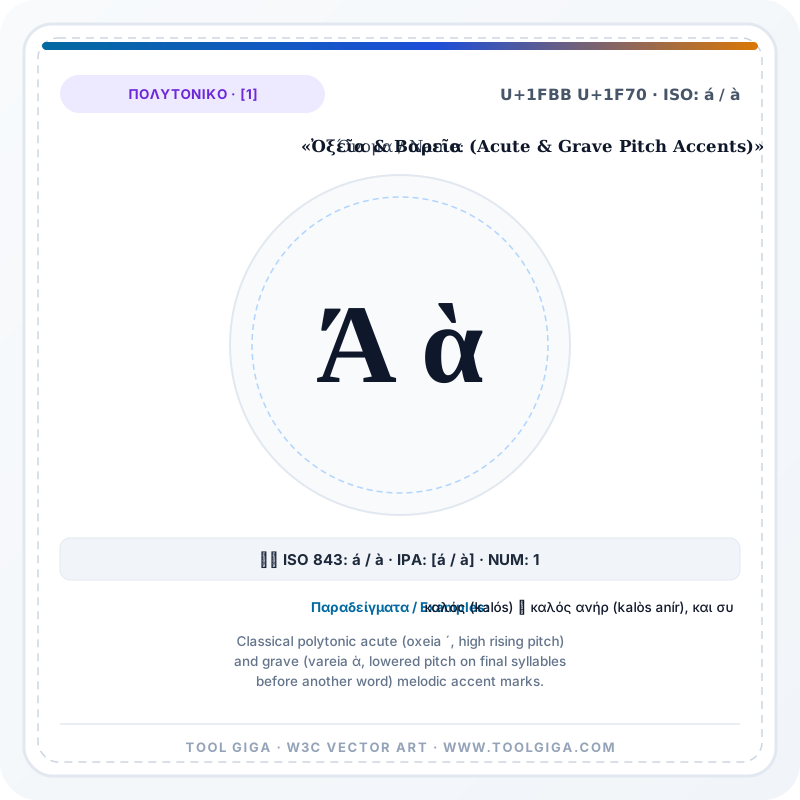
Polytonic Signs Ά ὰ (Oxeia & Vareia) — Classical Acute & Grave Musical Pitch Accents [1]
ISO 843: á / à · IPA: [á / à] · Isopsephy: 1 · Classical Acute (Oxeia) & Grave (Vareia) Pitch Accents
#53 · U+1FB6 / U+1FC6 / U+1FF6
[—]
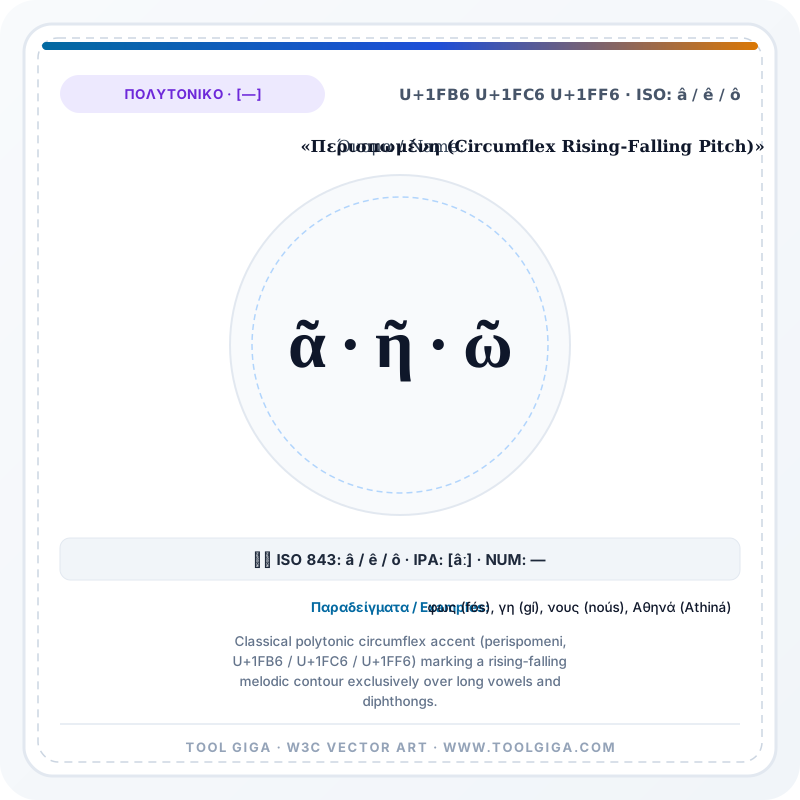
Polytonic Sign ᾶ · ῆ · ῶ (Perispomeni) — Classical Circumflex Rising-Falling Pitch [—]
ISO 843: â / ê / ô · IPA: [âː] · Circumflex Rising-Falling Pitch on Long Vowels (Περισπωμένη)
#54 · U+1FB3 / U+1FC3 / U+1FF3
[10]
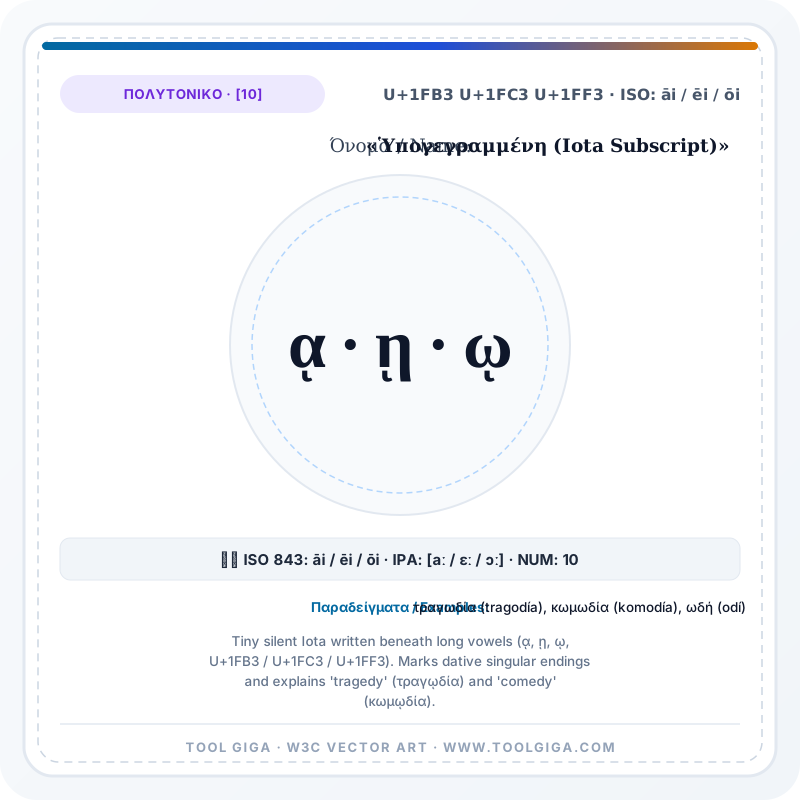
Polytonic Sign ᾳ · ῃ · ῳ (Ypogegrammeni / Iota Subscript) — Silent Long Diphthong & Dative Marker [10]
ISO 843: āi/ēi/ōi · Isopsephy: 10 · Silent Iota Subscript in Dative & τραγῳδία 'Tragedy' (Ὑπογεγραμμένη)
#55 · U+1FEC / U+1FE5
[100]
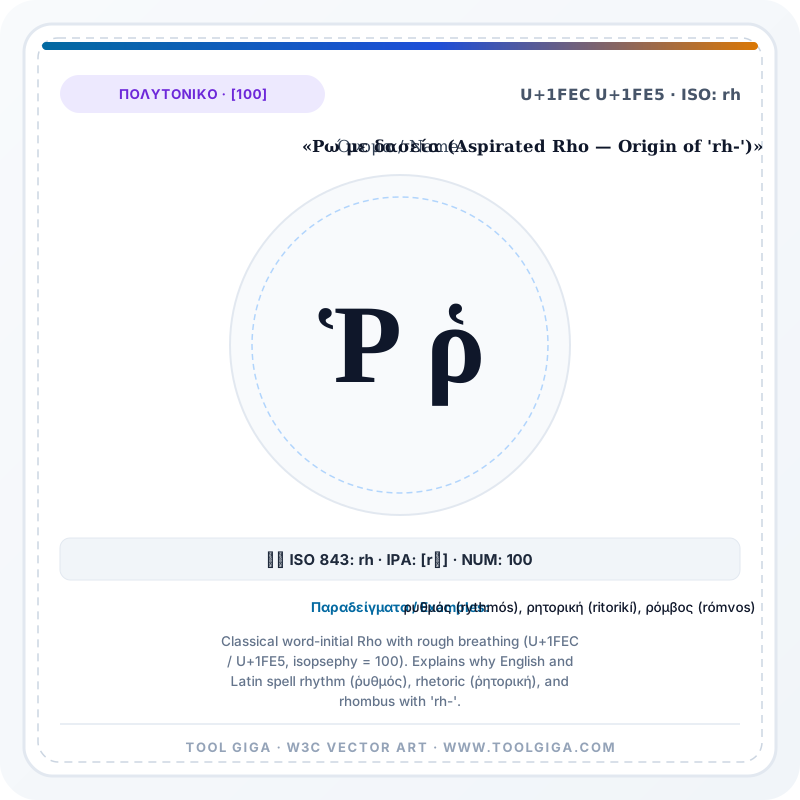
Polytonic Sign Ῥ ῥ (Rho with Daseia) — Voiceless Trill & Origin of English 'Rh-' [100]
ISO 843: rh · IPA: [r̥] · Isopsephy: 100 · Aspirated Initial Rho — Origin of 'rh-' in Rhythm/Rhetoric (Ρω με δασεία)
#56 · U+039F U+03A5
[470]
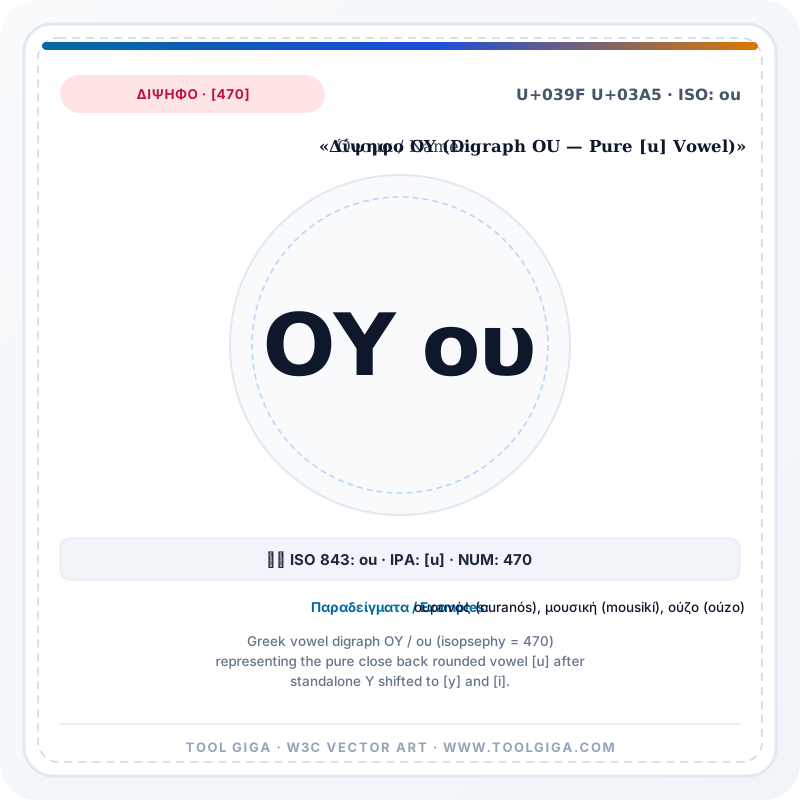
Greek Digraph ΟΥ ου (Omicron-Upsilon) — Pure Close Back [u] Vowel & Origin of Cyrillic У [470]
ISO 843: ou · IPA: [u] · Isopsephy: 470 · Digraph for Pure [u] Vowel & Origin of Cyrillic У (Δίψηφο ΟΥ)
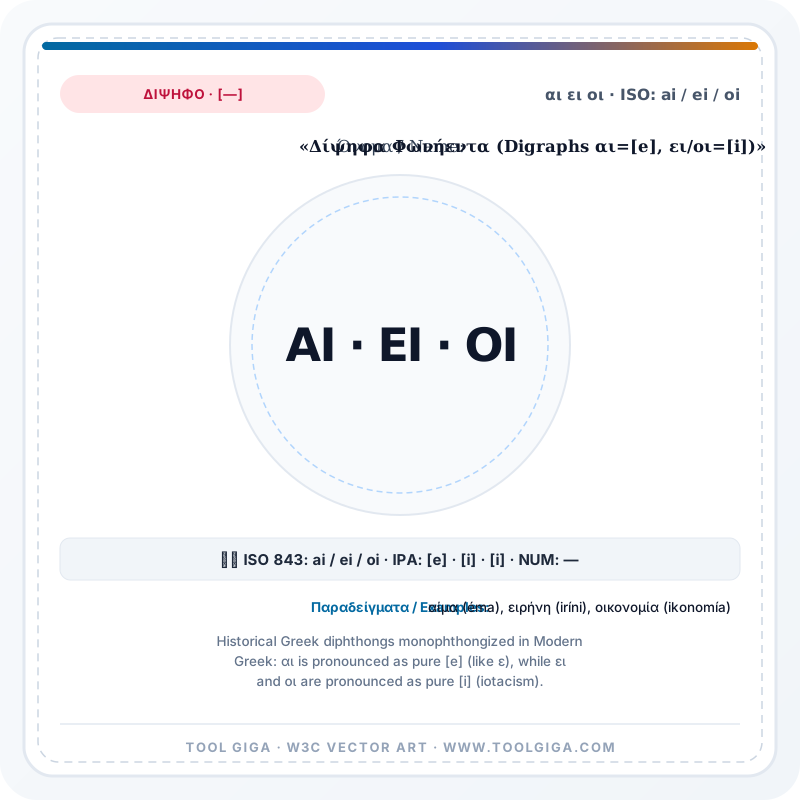
#57 · αι / ει / οι
[—]
Greek Vowel Digraphs ΑΙ · ΕΙ · ΟΙ — Monophthongized [e] & Iotacized [i] Vowels [—]
ISO 843: ai/ei/oi · IPA: αι=[e], ει/οι=[i] · Historical Diphthongs Pronounced as Single Vowels (Δίψηφα Φωνήεντα)
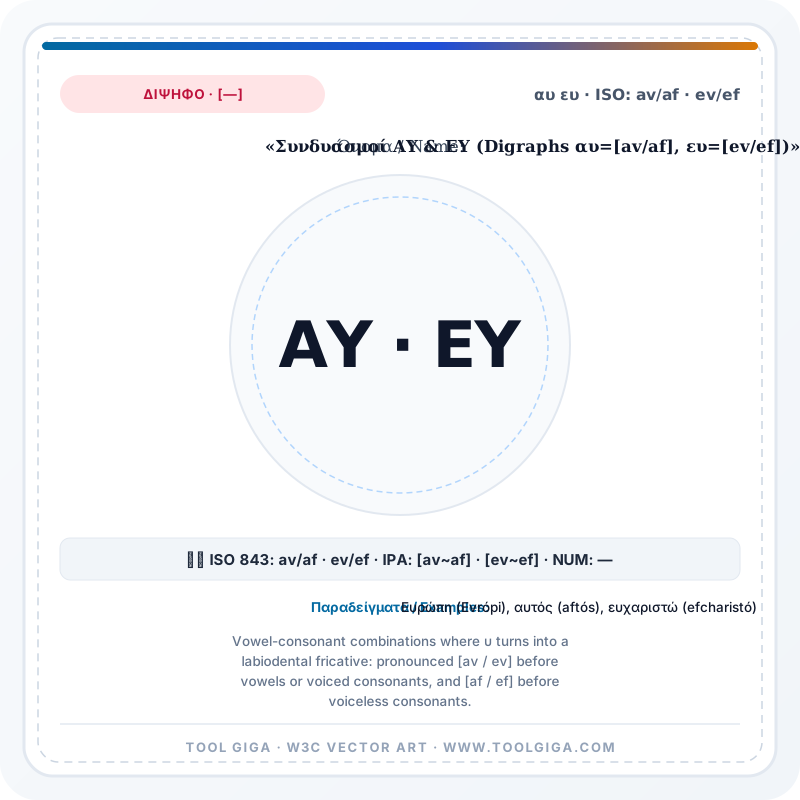
#58 · αυ / ευ
[—]
Greek Combinations ΑΥ · ΕΥ — Labiodental [av/af] & [ev/ef] Assimilation Rule [—]
ISO 843: av/af, ev/ef · IPA: [av~af], [ev~ef] · Voiced [v] or Voiceless [f] Assimilation (Συνδυασμοί ΑΥ & ΕΥ)
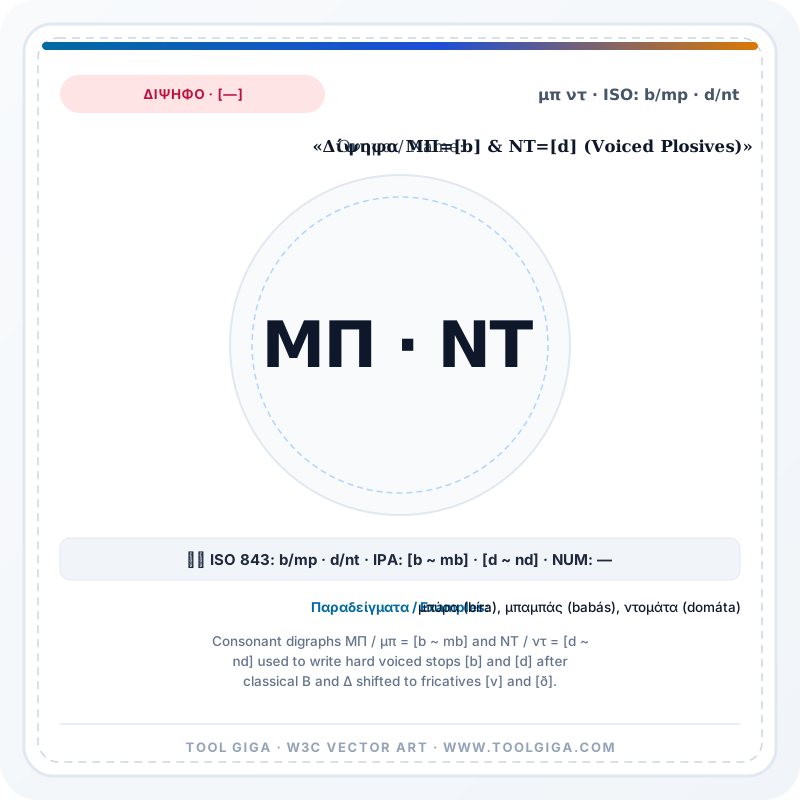
#59 · μπ / ντ
[—]
Greek Digraphs ΜΠ · ΝΤ — Voiced Bilabial [b] & Dental [d] Plosive Orthography [—]
ISO 843: b/mp, d/nt · IPA: [b~mb], [d~nd] · Digraphs for Hard [b] & [d] Stops (Δίψηφα ΜΠ & ΝΤ)
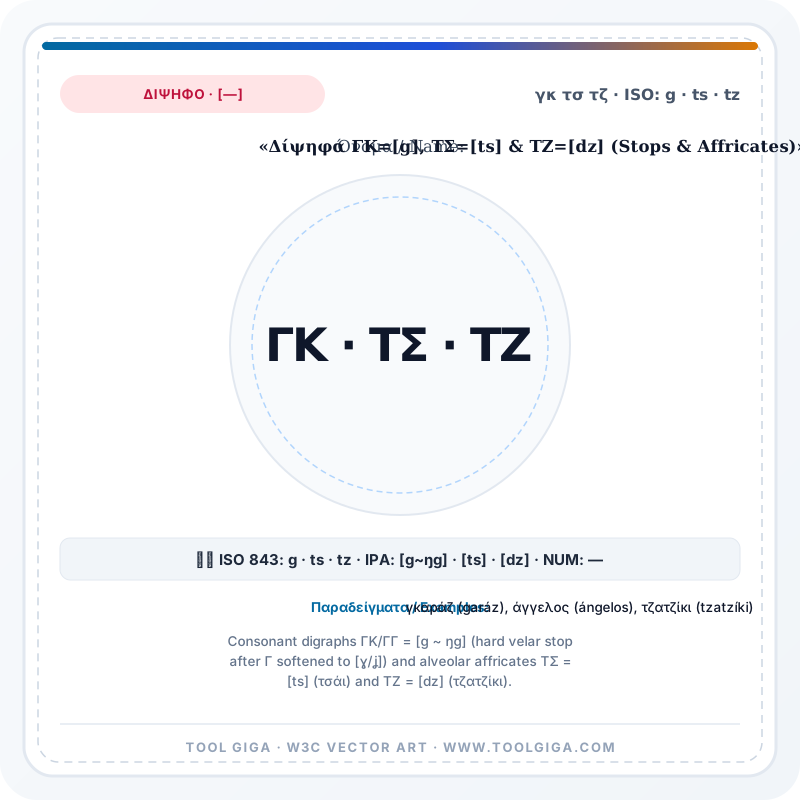
#60 · γκ / τσ / τζ
[—]
Greek Digraphs ΓΚ · ΤΣ · ΤΖ — Hard Velar Stop [g] & Alveolar Affricates [ts / dz] [—]
ISO 843: g, ts, tz · IPA: [ɡ~ŋɡ], [ts], [dz] · Hard Velar Stop & Alveolar Affricates (ΓΚ, ΤΣ, ΤΖ)
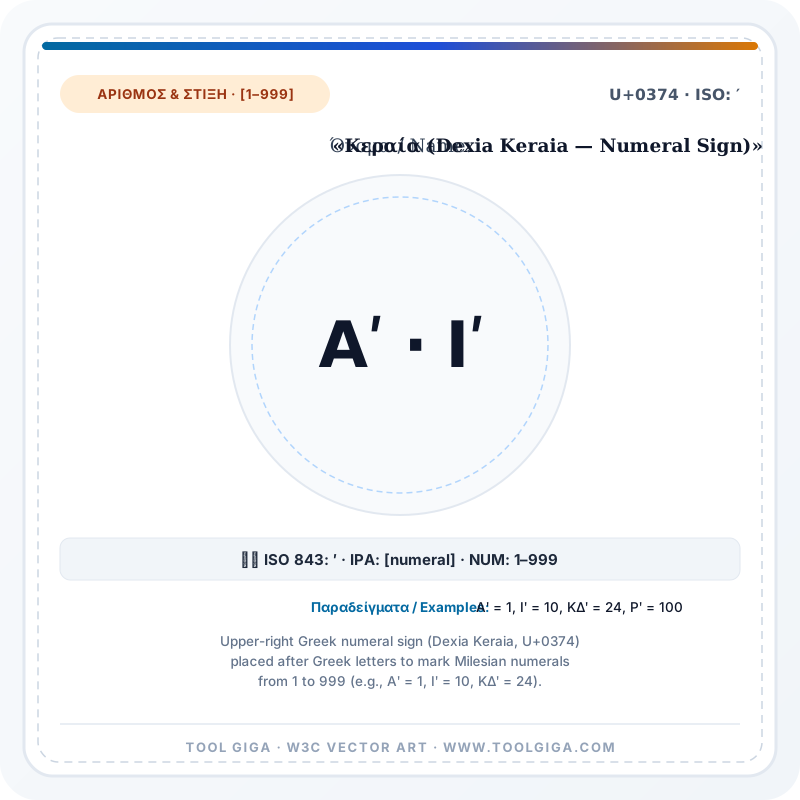
#61 · U+0374
[1–999]
Greek Sign ʹ (Dexia Keraia / U+0374) — Milesian Numeral Marker (Αʹ = 1, Ιʹ = 10) [1–999]
Unicode: U+0374 · Range: 1–999 · Upper-Right Horn Turning Letters into Numerals (Κεραία)
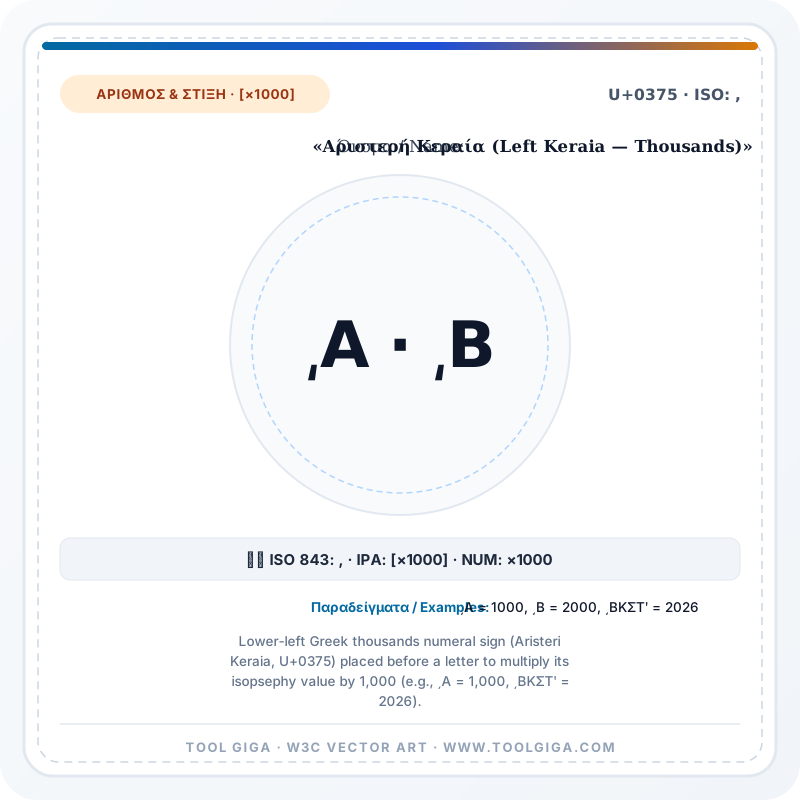
#62 · U+0375
[×1000]
Greek Sign ͵ (Aristeri Keraia / U+0375) — Lower-Left Thousands Multiplier (͵Α = 1,000) [×1000]
Unicode: U+0375 · Multiplier: ×1,000 · Lower-Left Stroke Marking Thousands (Αριστερή Κεραία)
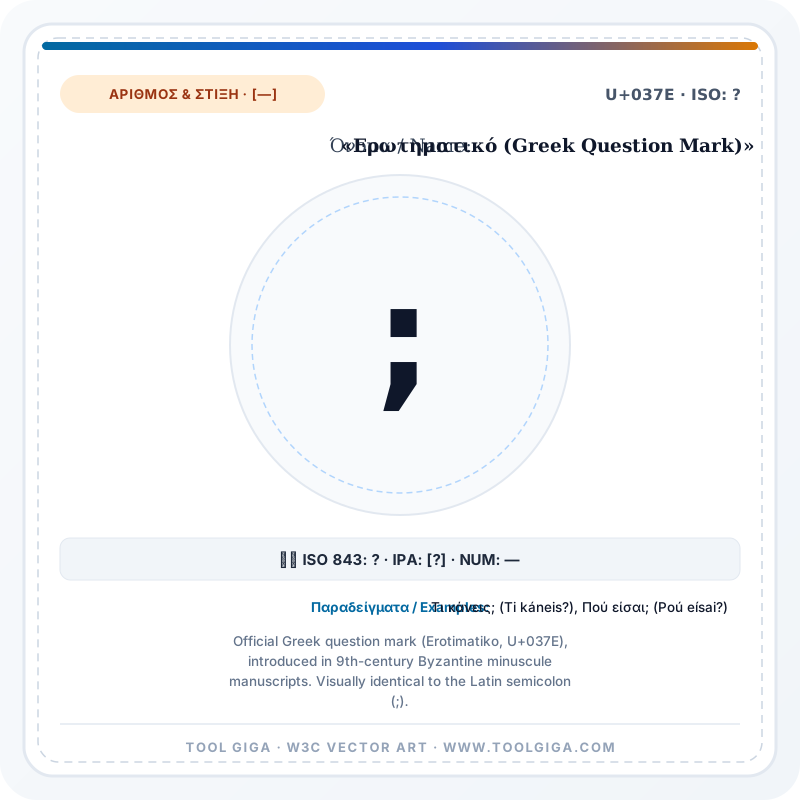
#63 · U+037E
[—]
Greek Punctuation ; (Erotimatiko / U+037E) — Official Greek Question Mark [?]
Unicode: U+037E · Equivalent: ? · Greek Question Mark Shaped Like a Semicolon (Ερωτηματικό)
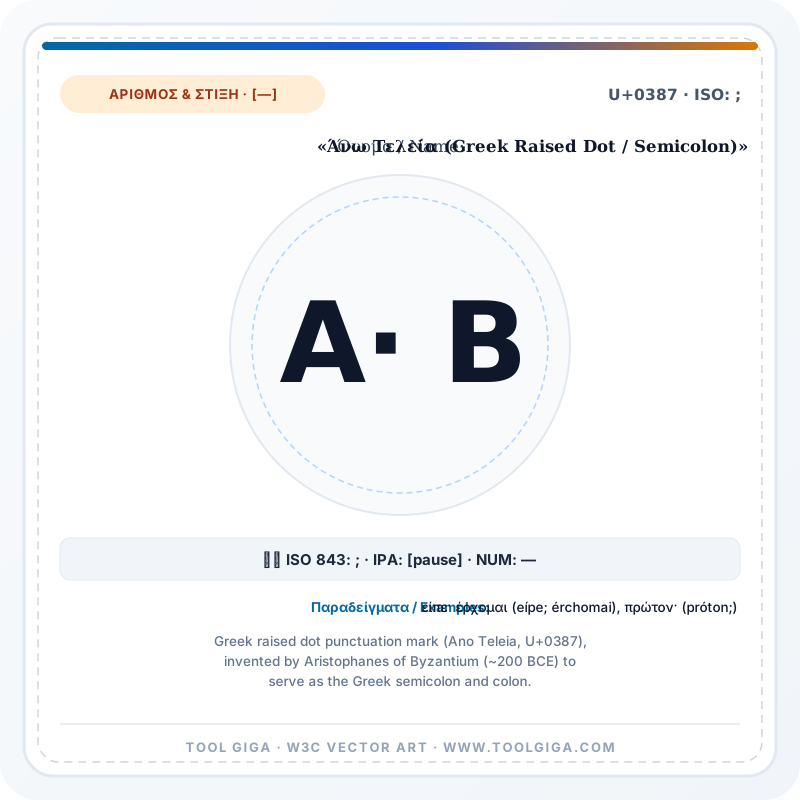
#64 · U+0387
[—]
Greek Punctuation · (Ano Teleia / U+0387) — Alexandrian Raised Dot & Semicolon [;]
Unicode: U+0387 · Equivalent: ; · Alexandrian Raised Dot Functioning as Semicolon (Άνω Τελεία)
#65 · U+1FBD
[—]
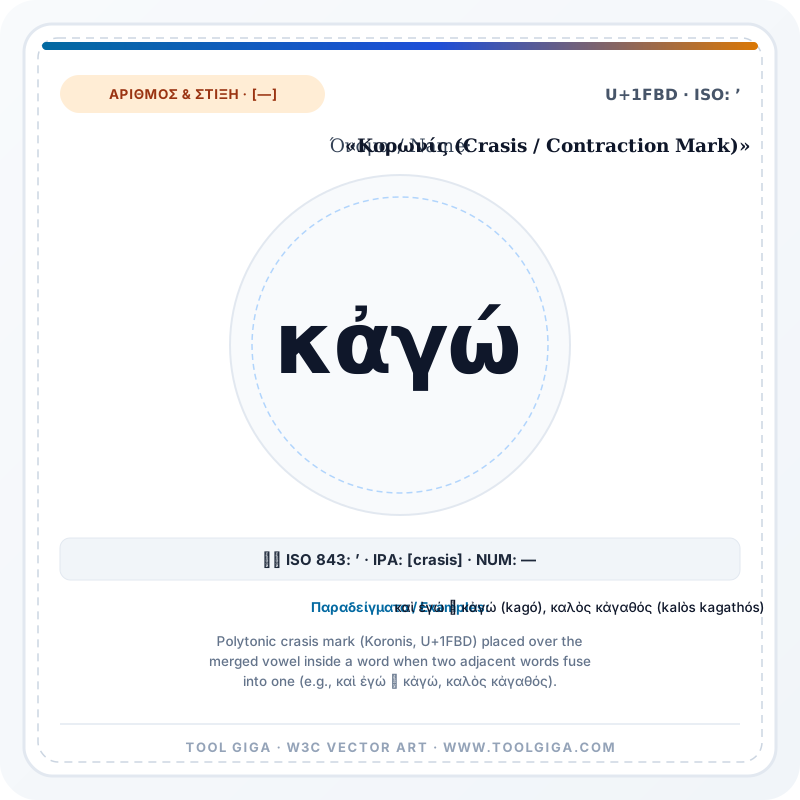
Greek Sign ᾽ (Koronis / U+1FBD) — Crasis Word-Merger Mark (καὶ ἐγώ ➔ κἀγώ) [—]
Unicode: U+1FBD · Phenomenon: Crasis · Mark Over Merged Vowel of Two Fused Words (Κορωνίς)
#66 · U+10143
[5]
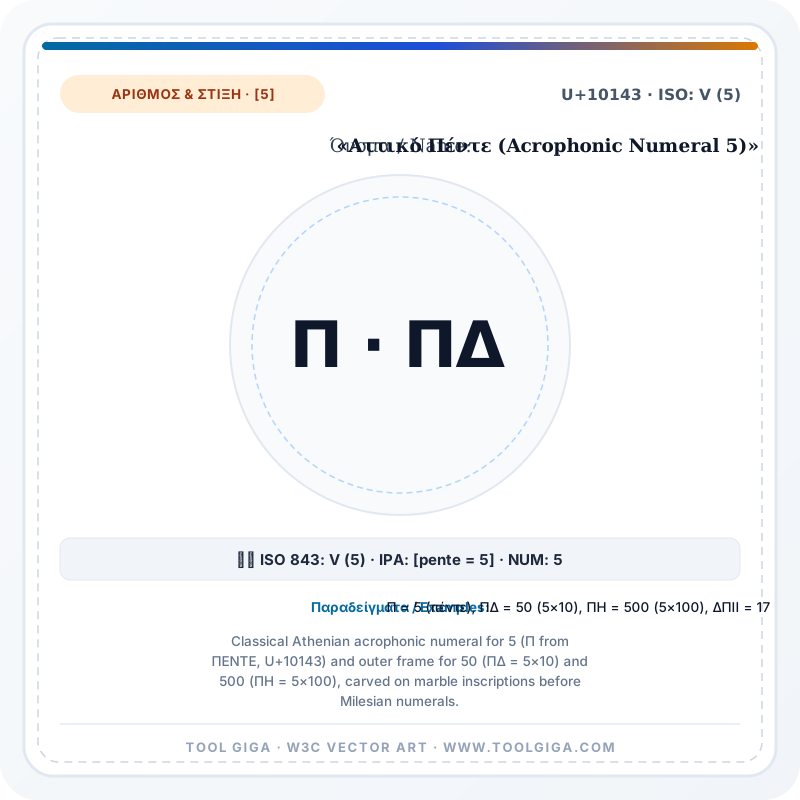
Attic Numeral Π · Π (Pente / U+10143) — Classical Athenian Acrophonic Number 5 [5]
Unicode: U+10143 · Value: 5 (ΠΕΝΤΕ) · Classical Athenian Acrophonic Numeral System (Αττικό Πέντε)
#67 · Δ=10 / Η=100
[10 / 100]
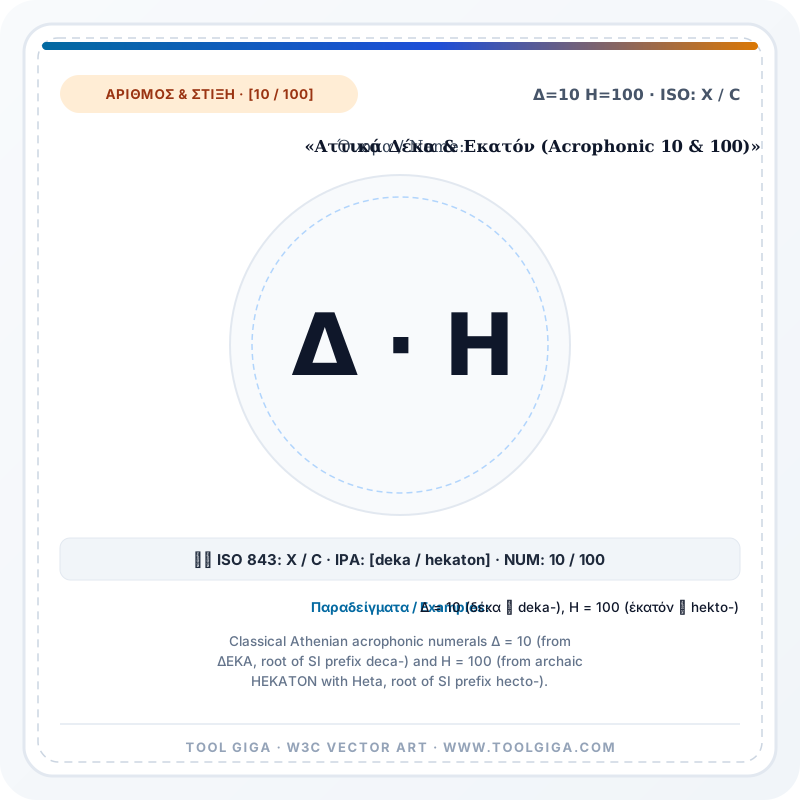
Attic Numerals Δ · Η (Deka 10 & Hekaton 100) — Origin of Metric 'Deca-' & 'Hecto-' [10 / 100]
Values: Δ=10 (ΔΕΚΑ), Η=100 (ΗΕΚΑΤΟΝ) · Acrophonic Numerals & SI Prefixes deca-/hecto-
#68 · Χ=1000 / Μ=10000
[1000 / 10000]
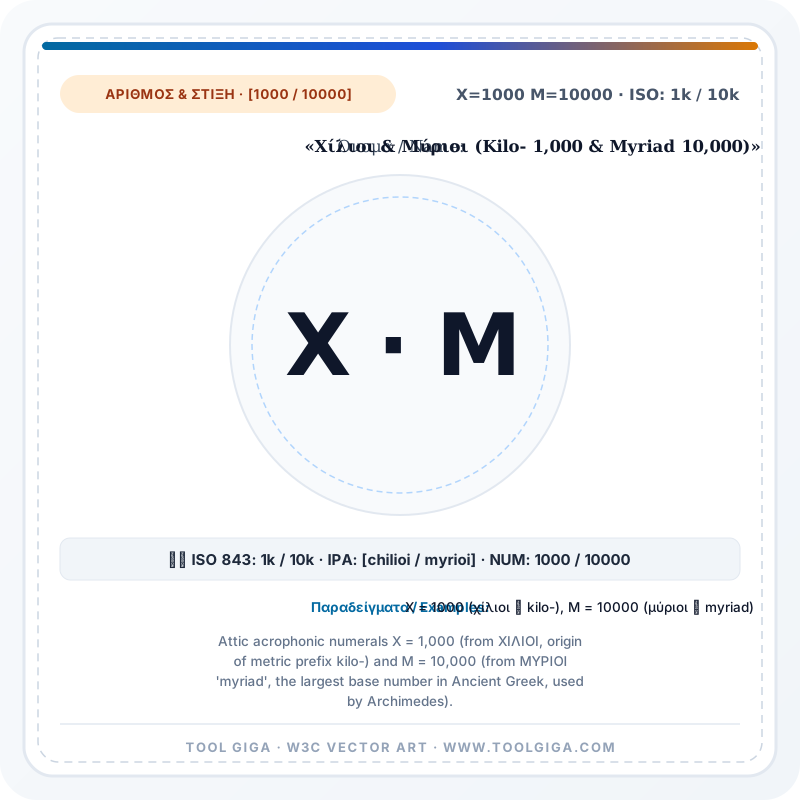
Attic Numerals Χ · Μ (Chilioi 1,000 & Myrioi 10,000) — Origin of 'Kilo-' & Archimedes' Myriad [1k / 10k]
Values: Χ=1,000 (ΧΙΛΙΟΙ ➔ kilo-), Μ=10,000 (ΜΥΡΙΟΙ ➔ myriad) · Largest Greek Base Numerals
#69 · U+2126
[800]
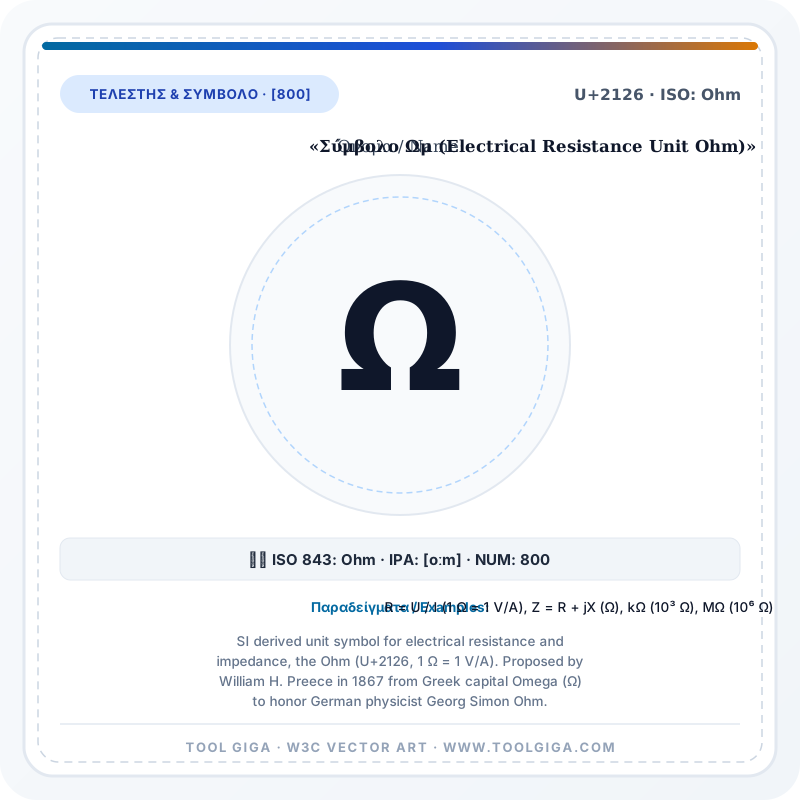
Ohm Sign — SI Unit of Electrical Resistance (Ω)
SI Unit: 1 Ω = 1 V/A · U+2126 (≡ U+03A9) · Isopsephy: 800 · Electrical resistance & impedance Ohm (Σύμβολο Ωμ)
#70 · U+2127
[—]
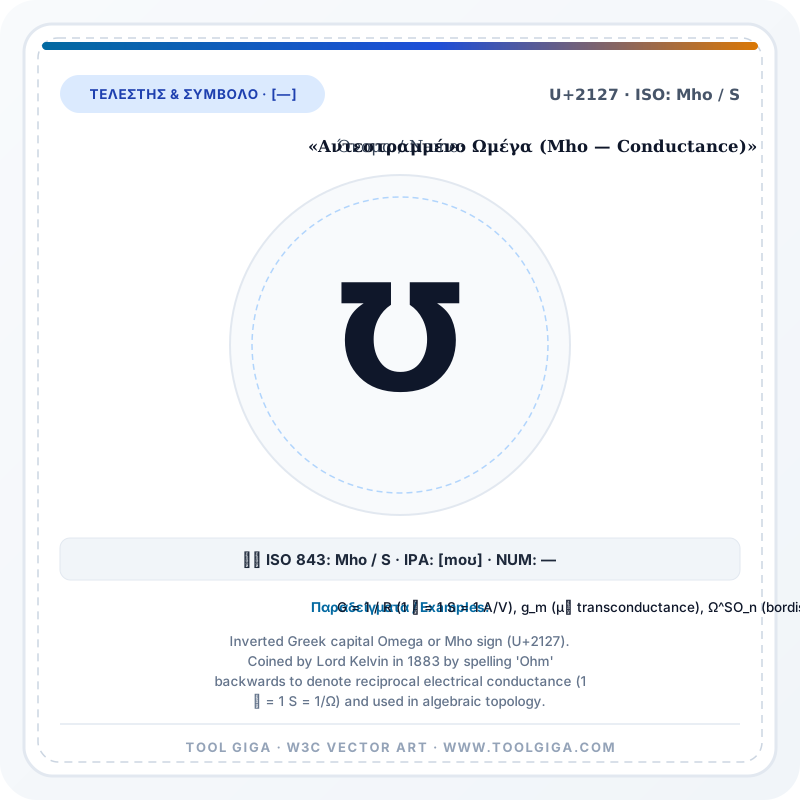
Inverted Ohm / Mho Sign — Conductance (℧)
Reciprocal Ohm: 1 ℧ = 1 S = 1/Ω · U+2127 · Electrical conductance (Mho) & topological bordism (Αντεστραμμένο Ωμέγα)
#71 · U+00B5
[40]
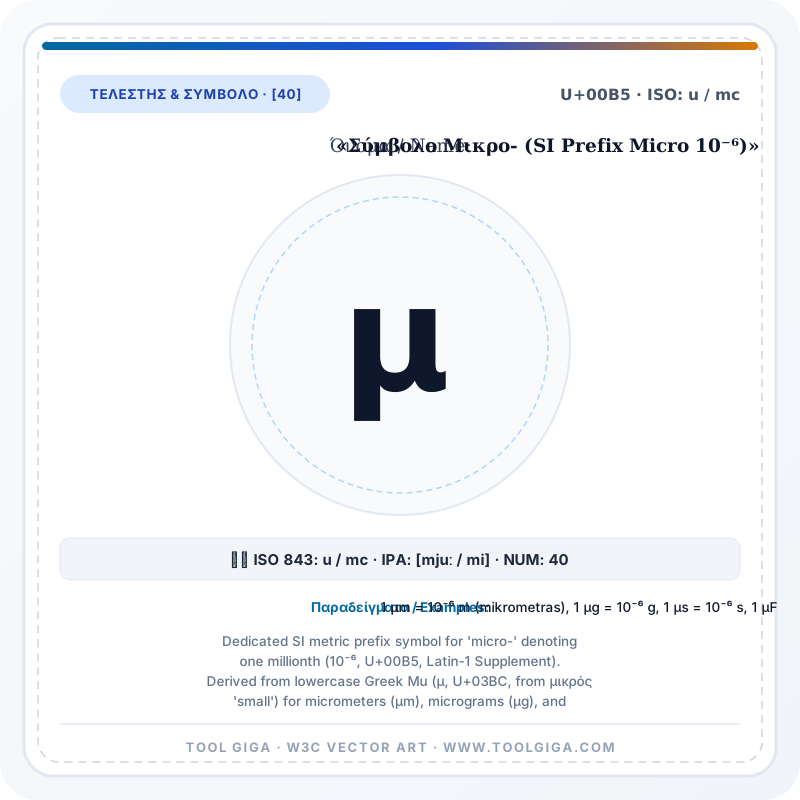
Micro Sign — SI Prefix 10⁻⁶ (µ)
SI Prefix: 10⁻⁶ (0.000001) · U+00B5 (≈ U+03BC) · Isopsephy: 40 · One millionth: µm, µg, µs, µF (Σύμβολο Μικρο-)
#72 · U+2206
[4]
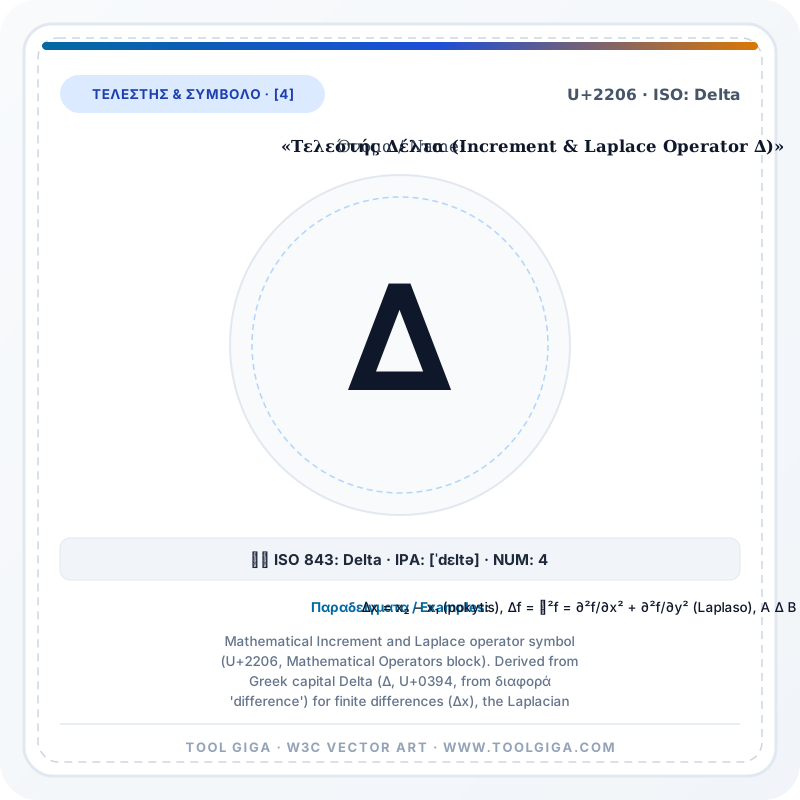
Increment & Laplace Operator — Mathematical Delta (∆)
Math Operator: ∆x, ∆f = ∇²f · U+2206 · Isopsephy: 4 · Finite difference, Laplacian & symmetric difference (Τελεστής Δέλτα)
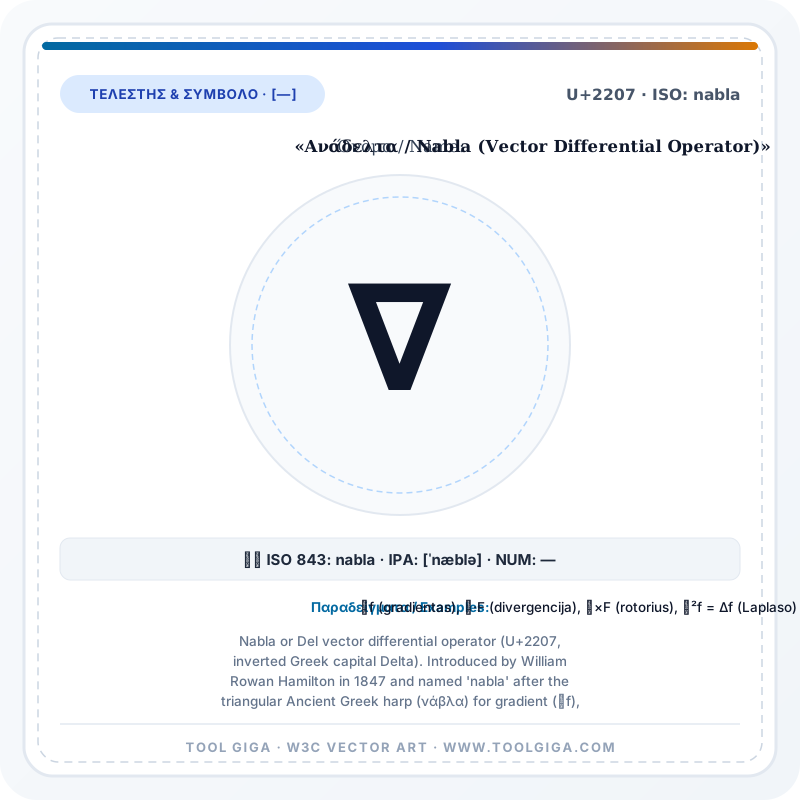
#73 · U+2207
[—]
Nabla / Del — Vector Differential Operator (∇)
Vector Operator: (∂/∂x, ∂/∂y, ∂/∂z) · U+2207 · Gradient ∇f, divergence ∇·F, curl ∇×F & Maxwell's equations (Ανάδελτα / Nabla)
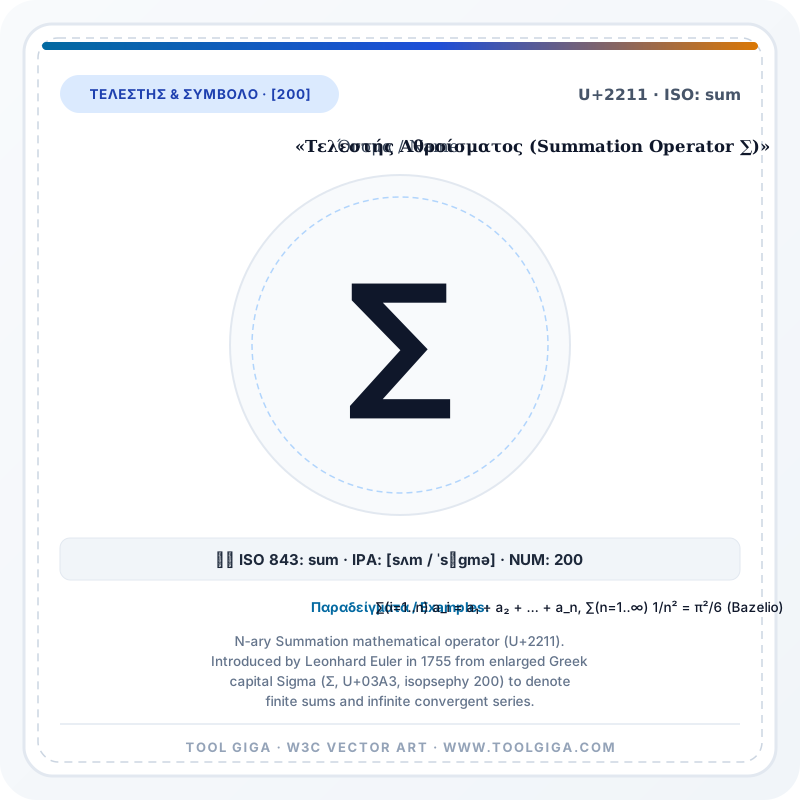
#74 · U+2211
[200]
N-Ary Summation Operator — Sigma Sum (∑)
Math Operator: ∑(i=1..n) a_i · U+2211 (from Σ) · Isopsephy: 200 · Euler's discrete sum & infinite series operator (Τελεστής Αθροίσματος)
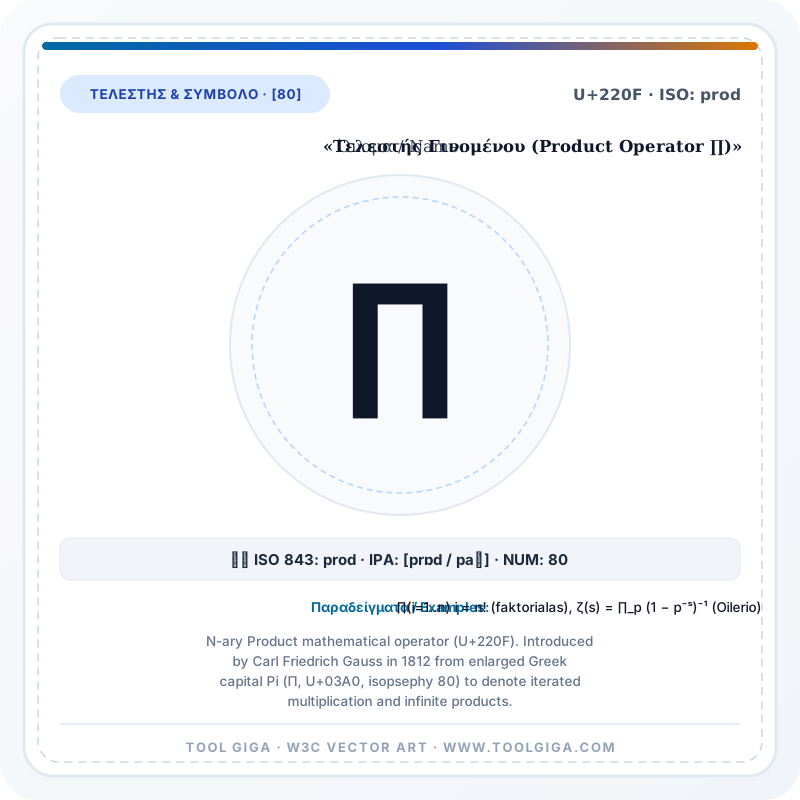
#75 · U+220F
[80]
N-Ary Product Operator — Capital Pi Product (∏)
Math Operator: ∏(i=1..n) a_i · U+220F (from Π) · Isopsephy: 80 · Gauss's iterated product & Cartesian product (Τελεστής Γινομένου)
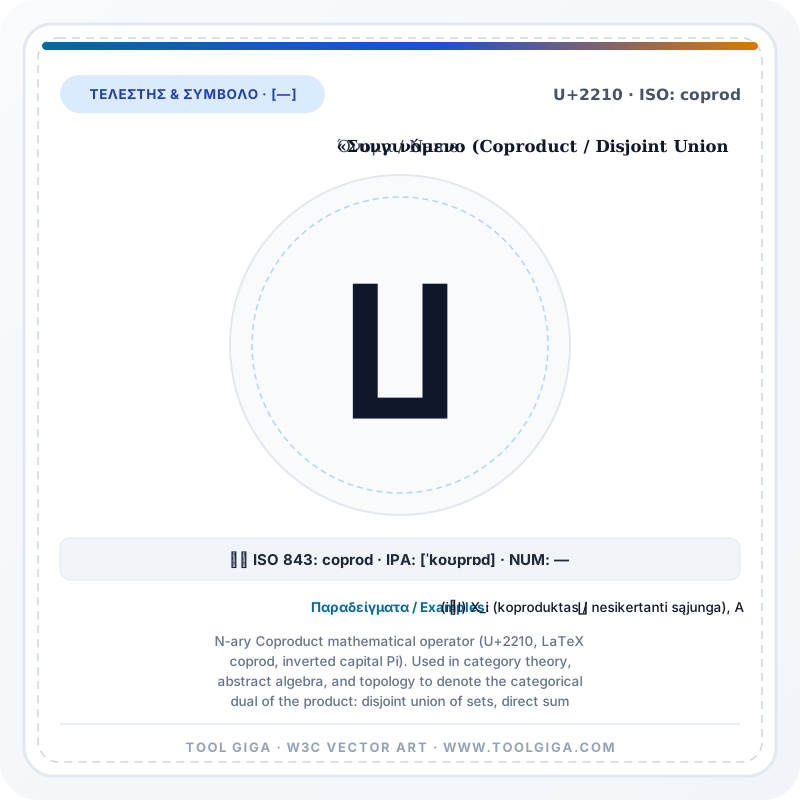
#76 · U+2210
[—]
N-Ary Coproduct Operator — Inverted Pi (∐)
Math Operator: ∐(i∈I) X_i · U+2210 (inverted ∏) · Categorical coproduct, disjoint union & free product (Συνγινόμενο)
#77 · U+20AF
[—]
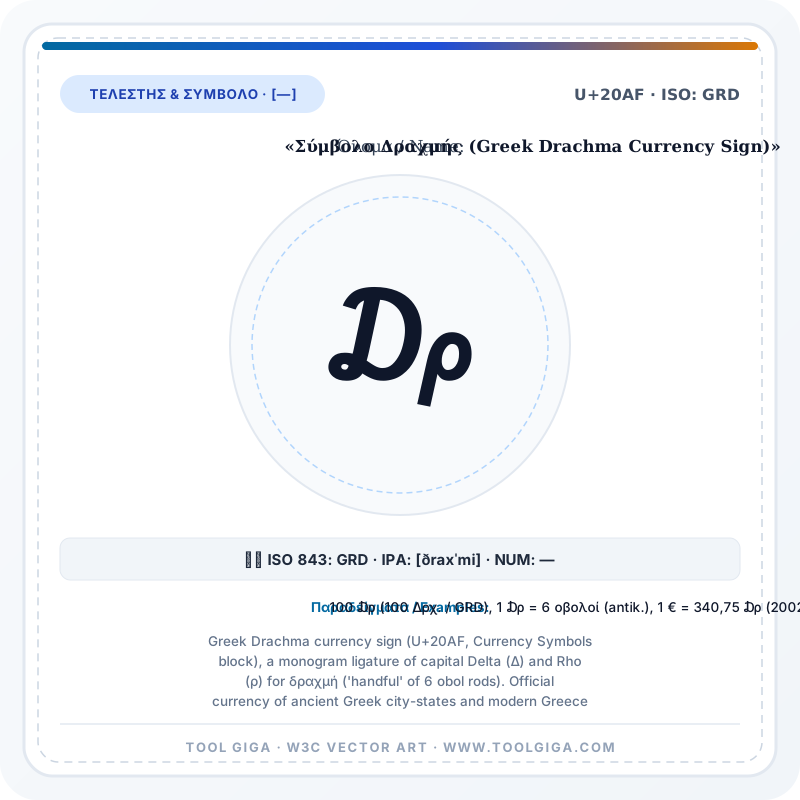
Drachma Sign — Greek Currency Symbol (₯)
Currency Sign: ₯ (ISO: GRD, Δρχ.) · U+20AF · Delta-Rho ligature for the Greek Drachma ('handful of 6 obols', Σύμβολο Δραχμής)
#78 · U+2627
[700]
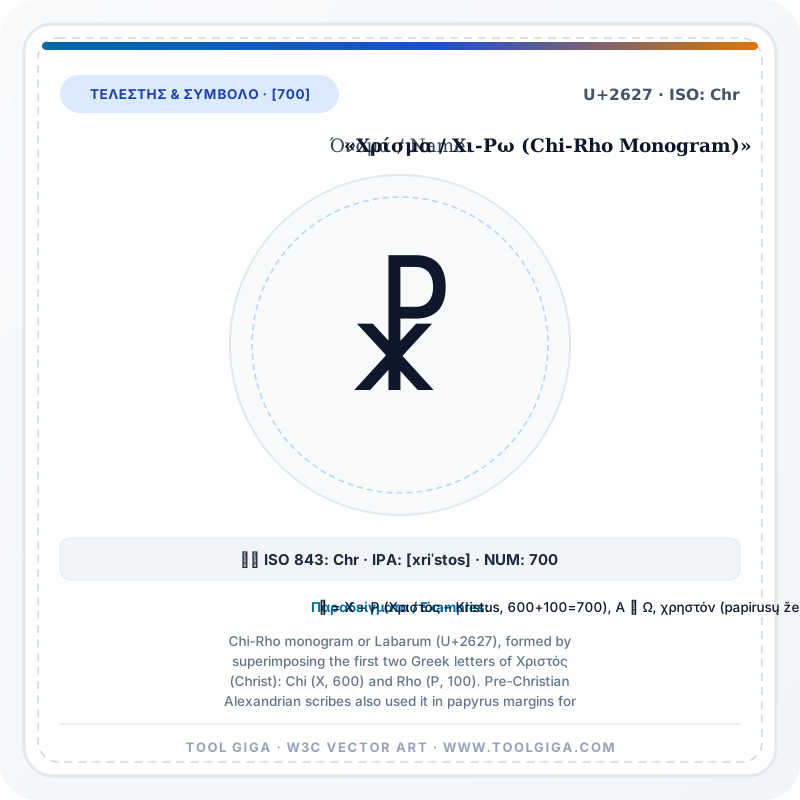
Chi-Rho Monogram — Chrismon / Labarum (☧)
Monogram: Χ + Ρ · U+2627 · Isopsephy: 700 (600+100) · Christogram (Χριστός) & Alexandrian note χρηστόν (Χρίσμα / Χι-Ρω)
#79 · U+2CE8
[400]
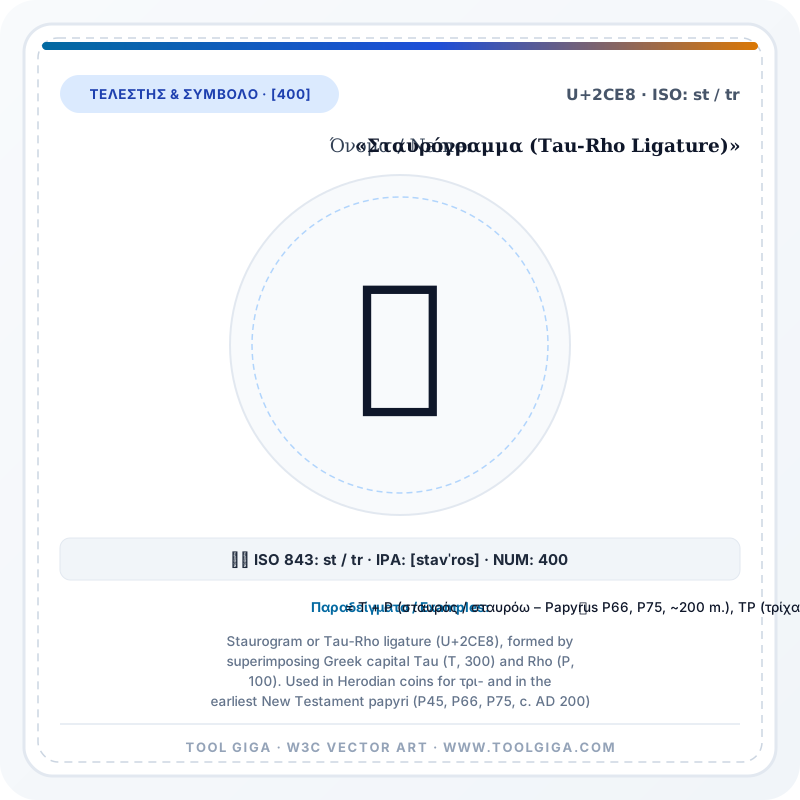
Staurogram — Tau-Rho Ligature (⳨)
Ligature: Τ + Ρ · U+2CE8 · Isopsephy: 400 (300+100) · Papyrus monogram for σταυρός ('cross') & τρι- (Σταυρόγραμμα)
#80 · U+037F / U+03F3
[—]
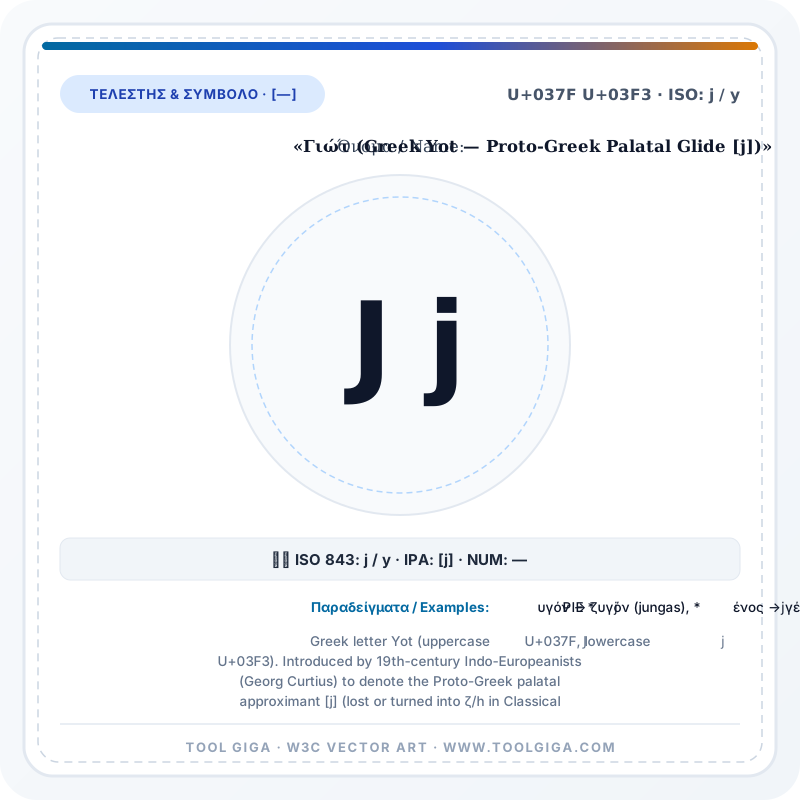
Greek Letter Yot — Proto-Greek Palatal Glide (Ϳ ϳ)
ISO 843: j / y · IPA: [j] · U+037F / U+03F3 · Proto-Greek palatal approximant [j] & Arvanitika script (Γιώτ)
No Greek letters or symbols found matching your search.